1. Abstract
Mistral 3 is a new generation of open-source model family launched by Mistral AI, including Mistral Large 3 with sparse expert architecture, and Ministral 3 series (3B/8B/14B) for local and edge scenarios. All weights are open under the Apache 2.0 license, supporting multimodal (text + image) and multilingual, covering different computing power and cost requirements from individual developers to enterprise-level inference.
2. Core features
- Multi-model families: Large 3 (MoE architecture, 41B active parameters, 675B total parameters) and Ministral 3 (3B/8B/14B, including base/instruct/reasoning variants).
- Open source and commercialization: The Apache 2.0 license is uniformly adopted, which is suitable for enterprise secondary development and privatization deployment.
- Multimodal and multilingual: Natively supports image understanding and dialogue in 40+ languages, and performs well in non-English scenarios.
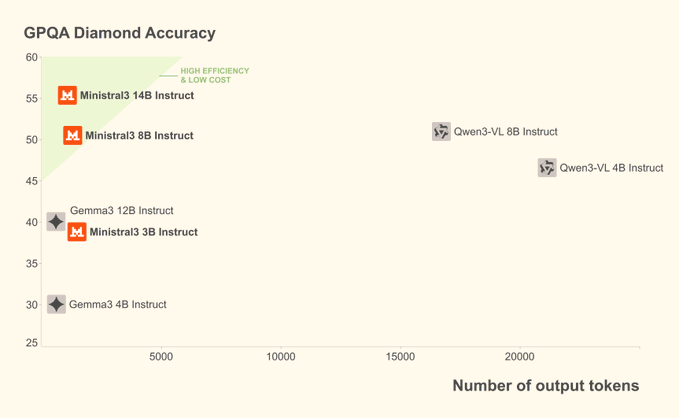
- Cost-effective optimization: The Ministral series emphasizes "fewer tokens, similar or better results" to reduce inference costs.
- Hardware collaborative optimization: Cooperate with NVIDIA, vLLM, Red Hat, etc., to adapt to low-precision inference solutions such as Hopper/Blackwell GPUs, TensorRT-LLM, SGLang, etc.
3. Installation
- Cloud API: Open an account on Mistral AI Studio, Amazon Bedrock, Azure Foundry, and other platforms, and call Mistral 3 series models through the official SDK or HTTP API.
- Open source weights: Download Large 3 and Ministral 3 weights from Hugging Face and other channels, and deploy them in combination with vLLM, TensorRT-LLM, SGLang and other inference frameworks.
- Local/edge: choose a single multi-card or local GPU/high-end consumer graphics card according to the model size; The Ministral 3B/8B is better suited for laptops, edge devices, and embedded deployments.
4. Typical Use Cases
- Enterprise Knowledge Assistant: Utilize multilingual capabilities to provide Q&A, document retrieval, and summarization for global users.
- Code and tool calls: used for code completion, script generation and multi-tool orchestration in developer scenarios.
- Multimodal analysis: describe pictures, OCR-assisted understanding, and then combine text for reasoning and Q&A.
- Local privacy scenarios: Ministral 3 runs locally for privacy-sensitive data analysis and automated workflows.
- Long context application: Combine the reasoning framework with external retrieval to realize long document reading and complex instruction decomposition.
5. Ecology and Competing Products
- Ecological integration: It has been connected to multiple cloud services and inference platforms, and provides official documentation, governance, and compliance guidelines to facilitate unified access for enterprises.
- Comparison with other open source large models: At the same parameter level, the Ministral 3 series focuses on cost-effectiveness and inference token count advantages; As an open-source MoE model, Large 3 is close to a partially closed-source commercial model in terms of multilingual and instruction compliance.
- Relationship with the community model: It can be used as a replaceable backend in the existing RAG and Agent frameworks, suitable for smooth migration from other LLMs, and the actual effect still needs to be combined with business evaluation.
6. Limitations and precautions
- Large model computing power threshold: Large 3 requires multi-card high-end GPUs or cloud inference services, and the local deployment cost is high.
- Multimodal capability boundary: Errors may still occur in the understanding of complex images/scenes, and manual verification is required for important services.
- Inference cost estimation: Although fewer token outputs are emphasized, QPS and budget evaluation are still necessary in high-concurrency scenarios.
- Model update rhythm: New reasoning versions and weight updates may be released in the future, and compatibility and migration costs need to be paid attention to.
7. Project address
https://mistral.ai/news/mistral-3
8. FAQ
Q: What is the open source license of the Mistral 3 model?
A: The official claim that both the Mistral Large 3 and the Ministral 3 series are licensed under the Apache 2.0 license and can be commercially and redistributed, but they still need to comply with the license terms and the usage agreements of each cloud platform.
Q: How should I choose between Mistral Large 3 and Ministral 3?
A: Large 3 is suitable for scenarios with extremely high requirements for effect and inference quality, and sufficient computing power or budget; The Ministral 3 Series is better suited for on-premises, edge, and cost-sensitive applications, with incremental improvements in performance and resource usage in 3B/8B/14B.
Q: Is Mistral 3 suitable for Chinese and multilingual applications?
A: The official emphasizes good performance in 40+ languages, especially in non-English/Chinese scenarios; In Chinese and other language businesses, it is still recommended to conduct special evaluations, and fine-tune them in combination with domain data if necessary.
Q: How can I quickly experience the Ministral 3 model locally?
A: You can download the corresponding model from the open-source weight hosting platform, combine it with vLLM or other inference engines, and run it on a single machine or a high-end consumer GPU. When resources are limited, prefer the 3B or 8B version.
Q: How does Mistral 3 ensure privacy and compliance?
A: Enterprises should configure logs, desensitization, and access control policies based on their own data compliance requirements, and prioritize privatization or on-premises deployment in highly sensitive scenarios.