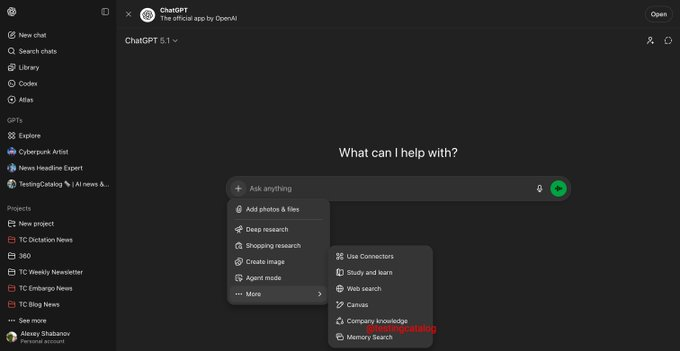
Some third-party technology media and experience users have found that an entrance called "Memory search" briefly appears in the ChatGPT web interface, and the function description points to searching from the saved memories of the account, allowing users to directly pull past preferences and information in the conversation. At present, the portal has only appeared briefly on a small number of accounts and has not yet been opened to all users, and OpenAI's official page and announcements have not yet introduced this model separately, and the overall is still in the closed beta or grayscale stage.
At the same time, OpenAI's officially launched ChatGPT Atlas browser provides an optional "Browser memories" browser memory function and supports searching on the summary of browsing history to help users retrieve visited job information, articles or product links. This capability essentially summarizes browsing records in a structured manner and supports retrieval, but the words "Browser memories" and "Browser memory" are used instead of "Memory search" in Atlas' external introduction and help documents, which is different from the naming of the tags in the test interface.
Based on the existing public information, it is widely speculated that the Memory search being tested by the ChatGPT main site may extend similar memory retrieval capabilities from the Atlas browser scenario to the general conversation scenario. However, the final name of the feature, its full scope of capabilities, whether it is connected to Atlas browser memory, and when it will be available to all users have not yet been officially confirmed by OpenAI. If users obtain relevant test entrances, they need to pay attention to the switching, viewing, and deletion paths of memory and browser memory in the settings, and make a trade-off between convenient retrieval and personal privacy.
FAQs
Q: What is the function of ChatGPT's "Memory Search"?
A: According to the description of the test interface, it is used to search for existing memory entries in the account in chat using natural language, allowing the assistant to quickly refer to past saved information, but it is still in the small-scale testing stage.
Q: Is this memory search feature now available to all ChatGPT users?
A: No, only a small number of users have reported seeing the relevant entrance briefly on the web page, and OpenAI has not listed it as an official feature on its official website or help documentation, and the launch time is not yet clear.
Q: What is the relationship between "Memory Search" and "Browser memories" in the Atlas browser?
A: Both involve retrieving context from saved information, Atlas has officially provided browser memory and search, and Memory Search is considered a similar capability for general-purpose chat memory, but it has not been officially stated whether the two belong to the same product line.
Q: What exactly can Atlas' "Browser memories" do?
A: After activation, Atlas will summarize the content of the visited web page and save it as a browser memory, allowing users to ask ChatGPT to help retrieve previously viewed pages or information when asking subsequent questions, and can view, archive, or delete these memories in the settings.
Q: What are the privacy considerations when using this type of memory and memory search feature?
A: ChatGPT memory and Atlas browser memory are both optional, users can close, view, and delete, and deleting browsing history will also clear the corresponding browser memory. It is recommended to turn off relevant memories or use your browser's privacy/incognito mode when sensitive content is involved.