1. Brand and positioning
Boston Dynamics is a robotics company originating from MIT and now part of Hyundai Motor Group, focusing on "highly dynamic and highly maneuverable" robots for a long time. It does not make toys, but is more industrial and professional-grade platforms, with the goal of allowing robots to move flexibly like animals and humans in complex environments for inspection, logistics and difficult operations.
2. Overview of the core product line
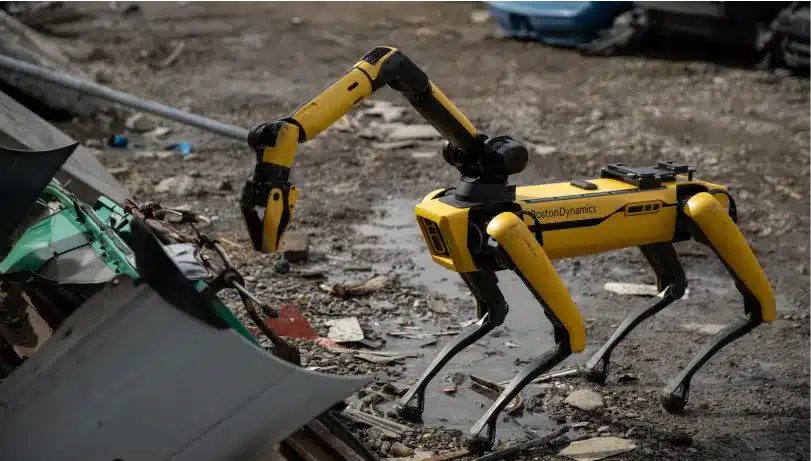
Spot: The quadruped robot is also the most well-known "robot dog". It supports autonomous walking, obstacle avoidance and self-recharging, and can be used for inspection, monitoring and data collection in factories, energy facilities, tunnels and other scenarios, with the key value in places where "it is difficult for people to go and it is very expensive to go".
Stretch: Handling robot for warehouses and logistics centers, with long arms and vacuum suction cups, specializing in repetitive manual work such as dismantling, box handling, and palletizing, increasing throughput and reducing manual high-intensity loading and unloading.
Atlas: A new generation of all-electric humanoid robots, which are still used as research and test platforms to explore complex whole body movements and operations, laying the foundation for future industrial-grade humanoids.
3. Key technical characteristics
These robots generally have powerful motion control (running, jumping, climbing, and crossing obstacles), environmental perception (multi-camera, lidar), autonomous planning and remote control capabilities. The direct meaning for users is that "dangerous, dirty, tiring, and repetitive" tasks can be handed over to robots, such as high-temperature, high-altitude, and narrow space inspections, or large-scale repeated handling to reduce safety risks and labor costs.
4. Applicable scenarios and user groups
Spot is more suitable for inspection, 3D modeling, and security patrols in industries such as energy, chemical, electric power, construction, and public safety. Stretch is aimed at large warehousing, e-commerce logistics, and 3PL; For the time being, Atlas mainly serves research institutions and large enterprise R&D teams. It is difficult for ordinary consumers to buy directly, and a more realistic way is to introduce it into specific business processes through integrators or official project cooperation.
Q&A
Q1: Can Spot be bought as a "home pet robot"?
A: It is not realistic in terms of price, system complexity and positioning. Spot is aimed at B-end industry customers and requires professional deployment and mission configuration, making it unsuitable as a household toy or pet replacement.
Q2: Will Boston Dynamics' robots be used in the military?
A: The company emphasizes that it mainly focuses on civilian and industrial scenarios, but the underlying technology does have potential military value. As an end-user, it is more important to pay attention to national regulatory policies and application-specific compliance.
Q3: What do businesses need to prepare if they want to use Spot or Stretch?
A: It is necessary to evaluate the site environment (ground conditions, obstacles, network coverage), safety specifications, data access methods, and reserve personnel for daily operation and maintenance and task scheduling. It is also recommended to start with a pilot project and then gradually expand the scale.
Q4: What are the advantages of Boston Dynamics compared to traditional AGV/AMR vehicles?
A: AGV/AMR is suitable for regular ground and fixed routes; Embodied robots such as Spot and Atlas are better at unstructured environments, such as stairs, slopes, gravel roads, and narrow spaces, and the two are complementary rather than simple replacements.