1. Summary
FLUX.2 is a next-generation visual generation and editing model launched by Black Forest Labs, aimed at real production-grade creative workflows, not just demonstrating scenes. It supports up to about 4MP resolution, multi-reference image input, fine-typography text and brand color control, and unifies text and image editing in the same architecture. The family includes the commercial API model and the open-weight FLUX.2[dev], which takes into account the needs of enterprise use and open source community self-deployment.
2. Core Features
- Multi-reference control: Up to about 10 pictures can be referenced at a time, achieving high consistency between characters, products, and styles.
- High quality and realism: Matching Transformer and new VAE based on stream, closer to real photography in terms of details, lighting and spatial logic.
- Strong text rendering: Support stable generation of small text such as complex typography, infographics, and UI prototypes.
- Flexible resolution: up to 4MP, arbitrary aspect ratio, support different stages from low-score sketches to high-score finished products.
- Controllability: Provides parameters such as step count and guidance scale (more prominent in the [flex] variant), balancing speed, detail, and instruction following.
- Open weights: FLUX.2[dev] provides 32B open weights and reference inference code, which is convenient for local or self-built service deployment.
3. Installation
- Obtain the official FLUX.2 inference repository through GitHub and install Python dependencies and inference scripts.
- Download the FLUX.2[dev] weights (or community quantitative version) from Hugging Face, and configure the graphics card and memory according to the instructions.
- If you need hosting and auto scaling, you can directly use BFL API or Playground without self-managed infrastructure.
4. Typical use cases
- Marketing and advertising: Consistent visuals of multi-material and multi-scene roles, accurate matching of brand colors and product synthesis.
- Product visualization and e-commerce: Generate product maps in large quantities with different backgrounds, lighting and environments.
- Creative production and storyboarding: Quickly generate concept maps with a unified style for film and television, games, or brand events.
- Design and UI/UX: Generate interface sketches, infographics, and component diagrams of readable text.
- Media and entertainment: Character consistency across scenes, environment generation, and multi-style visual asset production.
5. Ecology and competing products
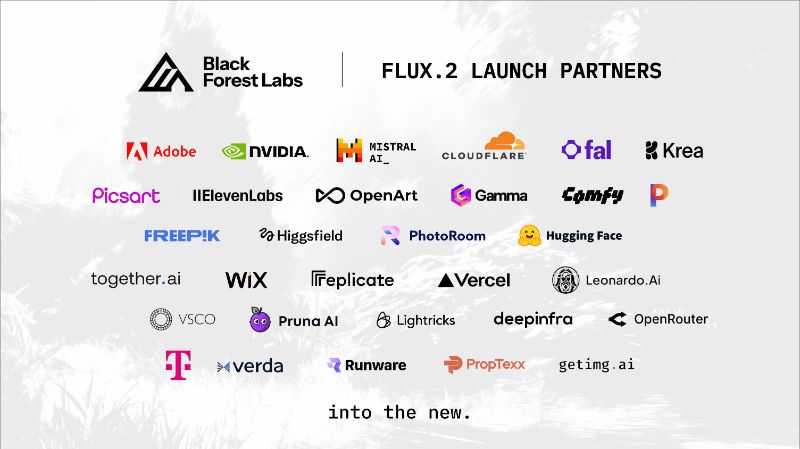
- Ecology: The FLUX.2 series covers different forms such as pro, flex, and dev, with both managed APIs and local open weights, and collaborates with tool chains such as NVIDIA and ComfyUI.
- Compared with the previous generation FLUX.1: Fully upgraded in multi-reference control, text rendering, world knowledge and resolution, more suitable for production-level workflows.
- Compared with other image models: It has obvious positioning advantages in the combination of "multi-reference consistency + text layout + brand control", not just the quality of a single realistic image.
6. Limitations and precautions
- FLUX.2[dev] has about 32B parameters, which has a high demand for video memory, and local deployment needs to evaluate hardware and consider quantitative or distributed solutions.
- There are differences in licenses and capabilities between different variants (pro/flex/dev/future klein), so you need to read the license terms carefully before commercialization.
- Although the text and world knowledge is stronger, factual or structural errors may still occur in complex scenarios, and the output is recommended for manual review before production.
- The attribute control (color, composition, character details) is highly adjustable, and some prompt engineering experience is still required to obtain stable results.
7. Project address
https://bfl.ai/models/flux-2
8. FAQ
Q: What are the optional versions of the FLUX.2 image generation model?
A: FLUX.2 [pro], FLUX.2 [flex], FLUX.2 [dev], and the smaller FLUX.2 [klein] are planned to be released, which are aimed at different scenarios such as enterprise hosting, fine-grained control, and open weight self-deployment.
Q: Is the license for the FLUX.2 [dev] open source image model commercially available?
A: FLUX.2[dev] uses a separate license agreement, which is usually non-commercial or requires additional licenses, so please check the latest license description carefully on Hugging Face or GitHub before using it.
Q: What are the approximate hardware requirements for deploying the FLUX.2[dev] image model on-premises?
A: Full-precision inference requires high-end GPUs with large video memory, which can reduce the demand on consumer GPUs through official reference code and community quantification models, but the specific resolutions and batches that can be supported must be combined with hardware testing.
Q: What are the options available if I don't want to deploy the FLUX.2 image generation service myself?
A: You can directly use the playground and API provided by Black Forest Labs, or access the integrated FLUX.2 service through inference platforms such as FAL, Replicate, Cloudflare, and Together AI.