Back to AI information
OpenAI Launches GPT-5.1-Codex-Max: A New Generation of Cutting-Edge Agent Coding Models on Codex

OpenAI Launches GPT-5.1-Codex-Max: A New Generation of Cutting-Edge Agent Coding Models on Codex

AI information Admin 96 views

"Meet GPT-5.1-Codex-Max, our latest frontier agentic coding model, available in Codex starting today." Officially, it is positioned as a "cutting-edge agent coding model", focusing on scenarios such as complex software engineering and automated tool calls, rather than ordinary chat use. The copy clearly states that the model is available on Codex starting today, indicating that it has entered the actual accessible phase and is not just a research preview.

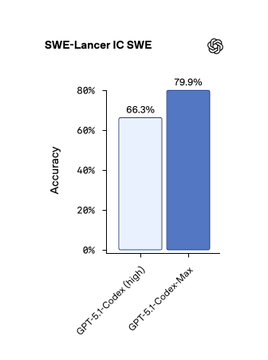
According to the information released at the same time, GPT-5.1-Codex-Max is emphasized in three aspects compared to the previous generation of coding models: first, it is faster, and the response and iteration speed has been improved; second, it has stronger capabilities, especially in multi-step reasoning and complex codebase operations; third, it is more token-saving, capable of handling longer contexts with similar budgets. The copy also mentions that the model can "work continuously" in long tasks, relying on built-in compaction capabilities to automatically sort out key information when the context is too long, so that it can be continuously advanced across multiple context windows in a single project. However, specific context length limits, billing methods, and access details are not provided in this paragraph, and you still need to refer to the subsequent documentation and product description.

FAQ

Q: This sentence "Meet GPT-5.1-Codex-Max..." Is it a real official release?

A: Yes, this statement comes from OpenAI's official developer account and related product pages, which is used to officially introduce the listing of GPT-5.1-Codex-Max on Codex.

Q: What type of model does GPT-5.1-Codex-Max belong to?

A: It is an "agent-based coding model" for programming and engineering tasks, emphasizing automatic calling of tools, continuous execution of long-link tasks, and handling of complex codebases, rather than a general-purpose chat model.

Q: What exactly does "faster, more capable and token-efficient" mean in the copywriting?

A: This means that among similar coding models, GPT-5.1-Codex-Max has faster inference, higher success rate for complex tasks, and can accomplish more work with fewer tokens under the same budget, making it more suitable for large-scale projects and long-term tasks.

Q: What are "built-in compaction abilities"?

A: This means that the model has a built-in context compression mechanism: when a conversation or task becomes very long and nears the context limit, it automatically summarizes and retains key information, discarding redundant content, and continues to work on the same task for a long time.

Q: How can developers use GPT-5.1-Codex-Max now?

A: The official copy states that the model is already available in Codex, which usually means that it can be called through Codex-related interfaces or APIs. However, the specific access method, billing standards, and regional scope of opening need to refer to OpenAI's subsequent documentation and console instructions.


GPT5.1CodexMax cutting-edge agent coding model GPT5.1CodexMax is launched in the Codex system GPT5.1CodexMax complex software engineering scenarios GPT5.1CodexMax long-link automated coding GPT5.1CodexMax is aimed at large code repositories GPT5.1CodexMax supports multi-step reasoning capabilities GPT5.1CodexMax is faster than the previous generation model GPT5.1CodexMax is smarter and more stable GPT5.1CodexMax is suitable for longrunning tasks GPT5.1CodexMaxprojectscale project support GPT5.1CodexMax emphasizes token usage efficiency GPT5.1CodexMax does more with a similar budget GPT5.1CodexMax has built-in contextual compression capabilities GPT5.1CodexMax automatically organizes key information for long tasks GPT5.1CodexMax works across multiple context windows GPT5.1CodexMax continues to promote a single project GPT5.1 CodexMax in Automated Tool Calls GPT5.1CodexMax differs from traditional chat models How GPT5.1CodexMax is connected to OpenAICodex GPT5.1CodexMax is suitable for agent-based coding workflows GPT5.1CodexMax optimizes the implementation of complex business logic GPT5.1CodexMax performs in multi-file reconstruction tasks GPT5.1CodexMax supports continuous integration and test orchestration GPT5.1CodexMax enhances the development efficiency of engineering teams GPT5.1CodexMax is suitable for long-term code execution GPT5.1CodexMax's role in the automation toolchain GPT5.1CodexMax for context length limit discussion How GPT5.1 CodexMaxcompaction mechanism works GPT5.1CodexMax is more token-saving than the old codex GPT5.1CodexMax is suitable for large-scale reconstruction scenarios GPT5.1CodexMax helps maintain complex microservices projects GPT5.1CodexMax's capabilities in codebase navigation GPT5.1CodexMax supports multiple rounds of iterative optimization of code Analysis of the differences between GPT5.1CodexMax and GPT5.1codex Does GPT5.1CodexMax require a new billing plan? How GPT5.1 CodexMax developers evaluate migration costs GPT5.1CodexMax incorporates agent framework best practices GPT5.1CodexMax is suitable for automatically generating test cases GPT5.1CodexMax's performance in complex debugging tasks GPT5.1CodexMax supports cross-module dependency analysis GPT5.1 CodexMax is used in DevOps automation processes GPT5.1CodexMax helps reduce manual repetitive code typing GPT5.1CodexMax combines long-dialog engineering collaboration scenarios What GPT5.1 CodexMax means to large model engineers Limitations to be aware of in the early stages of the launch of GPT5.1CodexMax GPT5.1CodexMax future documentation and price to be confirmed The prospects of GPT5.1CodexMax in enterprise-level projects GPT5.1CodexMax is officially defined as a cutting-edge model When GPT5.1CodexMax will reach all Codex users GPT5.1CodexMax is suitable as the main coding backend

Recommended Tools

More