1. Basic information
MeDo is an AI no-code full-stack development platform launched by Baidu and an overseas version of the domestic product "Miaoda". The platform focuses on natural language-driven application generation and supports automatic generation from requirements description to production-level applications. MeDo covers front-end interfaces, back-end logic, data structures, and deployment processes for individuals and organizations that need to build applications quickly.
The MeDo official website is medo.dev and is mainly suitable for individual developers, entrepreneurial teams, small and medium-sized enterprises, product managers, operation personnel, and education practitioners.
2. Product Overview
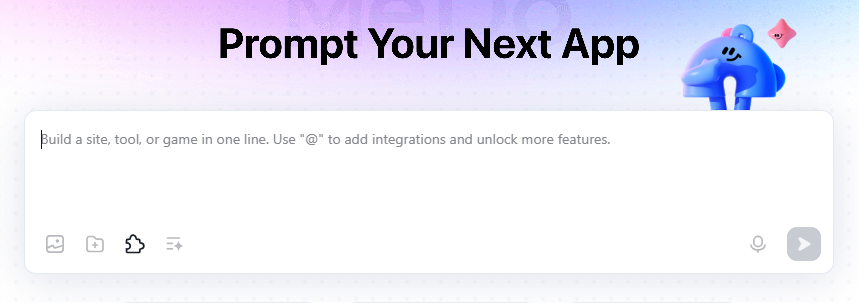
MeDo takes "natural language generation application" as its core concept. Users can enter a single requirement description to generate a complete full-stack project, including page layout, functional logic, and database structure. The platform provides a visual editor for secondary adjustments, and supports one-click deployment and hosting.
MeDo aims for production-grade apps, not just display pages. Build apps can be used directly as a business system, showcase site, or internal tool. The platform offers simplified operations for zero-code users and greater scalability for professional users.
3. Core functions
1. Main functions
- Natural language generation application: automatically generate page structure, logical flow and data model based on user input.
- Visual editing: Drag-and-drop interface to adjust layouts, styles, components, and copy without writing code.
- Front-end and back-end integrated generation: Automatically build front-end display, back-end interface, and database structure.
- One-click deployment and hosting: Publish applications directly within the platform without server or O&M configuration.
- Template library support: Provide examples and templates for official websites, e-commerce, forms, business systems, etc. as a starting point.
2. Technical characteristics
- large model requirements analysis: automatically identify business requirements and convert them into engineering structures.
- Automated engineering orchestration: Generate code and basic configuration for front-end, back-end and data layers.
- Modular design: functions are organized in a component manner, supporting reuse and expansion.
- Cross-scenario output capability: Supports multiple types of business scenarios such as websites, light applications, and activity pages.
- Production-grade application generation: Design for a balance between performance, availability, and running costs.
4. Pricing and version
There is no public fixed plan for the pricing model of MeDo. According to current public information, the platform emphasizes reducing development costs and shortening the launch cycle, and the specific billing method, package content and regional differences have not yet been determined. The actual price is subject to the official instructions at the time of registration.
5. Applicable scenarios and groups
- Official website and display page: Applicable to brand official website, event page, product introduction page.
- E-commerce and business systems: Support functions such as product display, order management, and data storage.
- Content and community applications: Used for content platforms such as blogs, knowledge bases, and small communities.
- Educational tools: Used for registration systems, homework management, and classroom interaction tools.
- Internal Office Tools: For internal processes such as form systems, approval flows, and dashboards.
Key users include entrepreneurs, product managers, operators, educators, and developers looking to improve efficiency.
6. FAQs
Q: Does MeDo require any programming basics?
A: No programming foundation is required for everyday use. The clearer the expression of complex business requirements, the more stable the generation effect.
Q: What types of applications can MeDo generate?
A: It supports multiple types of scenarios such as official websites, e-commerce systems, form tools, content platforms, internal management systems, and light applications.
Q: What is the relationship between MeDo and Miaoda?
A: MeDo is an overseas version of Miaoda, with the same core capabilities, only the market and language are different.
Q: How do applications generated with MeDo go live?
A: The platform provides one-click deployment function, and the application can be accessed directly through the link after it is launched.
Q: Is MeDo useful for professional developers?
A: It can be used to generate project prototypes, internal tools, and rapid validation schemes, reducing basic repetitive work.