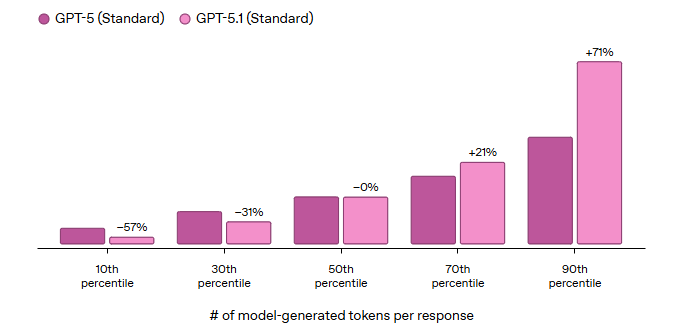
On November 12, 2025, OpenAI published a blog on its official website, announcing the launch of a new version of GPT-5.1 based on the GPT-5 series, and began to push it to ChatGPT users in stages, starting with paying users. The official name of this update is GPT-5.1, not GPT-6, because it is positioned as a "substantial iteration" within the GPT-5 generation, while retaining the old version of GPT-5 for a period of time as a compatibility option in the transition stage. Some technology media reported that the old version of GPT-5 is expected to remain in ChatGPT for about three months as a "traditional model" option, and then gradually roll off the offline.
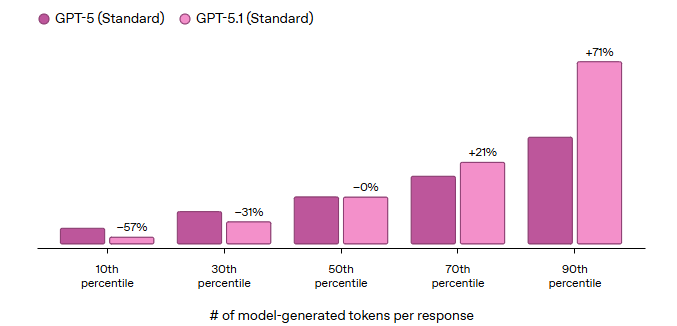
at the capability level, GPT-5.1 consists of two models, GPT-5.1 Instant and GPT-5.1 Thinking. Instant is the most commonly used default model, emphasizing a gentler, more conversational answering style with significant improvements in instruction understanding and execution, and consistent responses. According to the official introduction, Instant supports adaptive reasoning mechanisms for the first time, will actively "think one step further" when encountering difficult problems, and outperform GPT-5 in math and programming benchmarks such as AIME 2025 and Codeforces. Thinking is positioned as an advanced reasoning model that allocates thinking time more finely, faster than older versions on simple tasks, longer reasoning chains on complex problems, and deliberately reducing jargon and unexplained terms at all times.
Focusing on the ChatGPT experience, OpenAI has introduced more conversational styles and personalized controls in this update, allowing users to switch between multiple preset personalities such as default, professional, friendly, straightforward, quirky, etc., and test more refined style adjustment options. According to the GPT-5.1 system card appendix released together, GPT-5.1 Instant and GPT-5.1 Thinking continue the security framework of GPT-5 and add special assessments for mental health and emotional dependence scenarios to detect signs such as delusions and mania that users may have, as well as unhealthy dependence on chatbots, to reduce the risk of misleading.
FAQs
Q: What is the relationship between GPT-5.1 and the previous GPT-5?
A: OpenAI positioned GPT-5.1 as an iterative upgrade of the GPT-5 series in its announcement, rather than a new generation of models, and the name was followed to emphasize that it still belongs to the GPT-5 generation, but has substantial improvements in conversational experience, reasoning capabilities, and security assessments.
Q: What are GPT-5.1 Instant and GPT-5.1 Thinking suitable for?
A: Instant is the default general model, which is more suitable for high-frequency scenarios such as daily conversation, writing, and office collaboration, taking into account speed and comprehension. Thinking is an advanced reasoning model, which is more suitable for tasks that require multi-step reasoning, such as complex mathematical derivation, long-process code planning, and professional analysis reports.
Q: When will regular users be able to use GPT-5.1?
A: The official description is "gradually rolled out to all users from the day of release", and the launch order starts from paid users and then expands to a larger scope; During the transition period, users can still find the GPT-5 legacy portal in the ChatGPT model list, with specific arrival times varying by account and region.
Q: Will the old version of GPT-5 go offline immediately?
A: OpenAI said it would retain a transition period, and technology media quoted the company as saying that GPT-5 is expected to remain in ChatGPT's "traditional model" menu for about three months before considering going offline, so the two generations of models will exist in parallel for a period of time in the short term.
Q: What are the new changes in GPT-5.1 in terms of security and compliance?
A: According to the latest system card appendix, GPT-5.1 continues GPT-5's restrictions on violence, illegality, hatred, self-harm, etc., and adds two types of security assessments, "mental health" and "emotional dependence", to test the model's performance in sensitive conversations before launch, thereby reducing the risk of inappropriate responses in scenarios such as mental illness and over-attachment to chatbots.