I. Basic Information
Kagi is a user-paid search and AI tools platform that emphasizes ad-free, tracking-free, and controllable results. The platform offers a browser-oriented search experience with several enhanced capabilities, including customizable Lenses focused search, Universal Summarizer, Kagi Assistant conversational AI, Small Web site aggregation, and privacy-related features. Kagi provides services to individuals, teams, and educational institutions, offering search and AI credits through subscriptions; specific credit limits and policies are subject to official announcements.
II. Product Overview
Kagi aims to restore search to its core function as a tool, eliminating advertising and commercial interference through a paid model while improving the readability and verifiability of results. Users can complete searches, summaries, and conversational explorations within a unified interface, switching between different models and workflows depending on the task. The platform modularizes common research steps: first, Lenses are used to limit information sources; then, Summarizer summarizes long articles, videos, or podcasts; finally, Assistant generates structured key points or action steps. Small Web complements the latest releases from independent blogs and niche creators, helping users break free from the information cocoon of mainstream platforms. Kagi also offers adaptation solutions for libraries and teams to deploy ad-free and explainable search processes in teaching and organizational environments.
III. Core Functions
1. Main functions
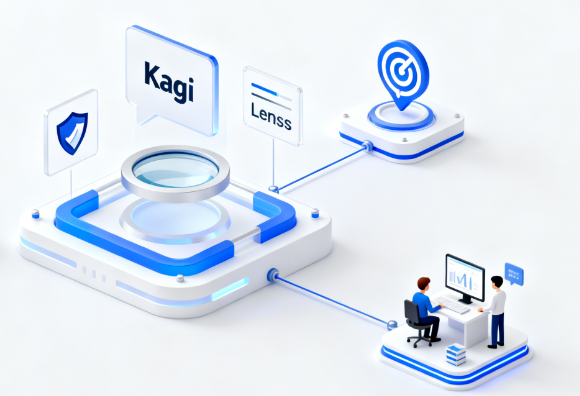
Focus on Search and Lenses: By using preset or custom Lenses, you can limit specific sources and parameters such as forums, academic, and development sites with a single click, reducing irrelevant results.
Universal Summarizer: Input any webpage, document, or audio/video link with transcription to get a summary of key points and extract crucial facts for quickly interpreting long content.
Kagi Assistant: Offers multiple large models and integrates with Kagi Search, supporting tasks such as information retrieval, brainstorming, coding, and writing, with results traceable to their source.
Small Web: Regularly collects and recommends content from independent websites over the past week, highlighting high-quality articles from personal blogs and niche communities.
Privacy and Access: Supports mechanisms such as Privacy Pass to enhance anonymity and resist fingerprinting while maintaining convenient access; can be accessed via browser extensions and mobile devices.
2. Technical characteristics
Model orchestration and switchability: Select or automatically schedule different models according to the task, and enable or disable online retrieval.
Results controllability and preference weighting: Supports boosting or de-weighting specific domains, combined with clickbait filtering and interface personalization, to form a stable results style.
Interfaces and Ecosystem: Provides APIs such as Summarizer and Search, as well as RSS output, to facilitate integration into workflows and data products.
Education and Team Support: Provides a library-style approach and team quota management to facilitate comparison of search quality and source credibility in teaching demonstrations and corporate environments.
IV. Pricing and Versions
Kagi uses a subscription model and offers a search trial quota. Individuals and teams can choose different tiers, with the cost converted into a monthly quota for search and AI usage. A credit-based refund policy applies if there is no usage for an extended period. Specific prices, quotas, included features, and applicable users are subject to change over time; please refer to the information displayed on the current page. Some advanced features may only be available in specific tiers.
V. Applicable Scenarios and Target Audience
Suitable for developers and researchers, Lenses and Summarizer allow for quick access to forum discussions, academic materials, and technical insights.
Suitable for journalists, analysts, and content teams to cross-validate between the Small Web and mainstream sources, producing high-quality topics and fact summaries.
Suitable for educational institutions and libraries, this tool demonstrates ad-free search, source credibility, and the impact of commercialization, fostering search literacy.
Suitable for organizations that prioritize privacy and compliance, this system allows for unified management of data limits and access methods under a team-based plan, reducing the risk of data breaches.
VI. Frequently Asked Questions
Q: What are the differences between Kagi and traditional free search engines?
Kagi replaces advertising revenue with a subscription model, reducing commercial interference, and provides result controls such as Lenses, penalized domains, and clickbait filtering, making it easy to customize results for specific tasks.
Q: Does Universal Summarizer support long articles and multimedia content?
It supports summarizing web pages, documents, and audio/video recordings with transcriptions, with a relatively wide length limit, for quickly grasping key information and source points.
Q: Does Kagi Assistant always search online?
It can switch between online and offline modes. When online, it can use Kagi search to enhance fact-checking; when offline, it focuses on model inference.
Q: Is the source of Small Web fixed?
Small Web compiles a curated list of independent blogs and niche sites, focusing on newly published content from the past week. The source is continuously maintained and updated according to quality standards.
Q: How are billing and credit limits managed?
The subscription plan is based on a monthly quota and includes search and AI usage; the team and premium plans offer more granular quotas and member management, and specific policies are subject to official announcements.