I. Basic Information
CircleCI is a continuous integration and continuous delivery platform for software teams, providing configuration-as-code pipeline orchestration, automated build testing, and deployment capabilities. The platform supports integration with mainstream code hosting services, and its core functionality involves defining jobs, workflows, and resource usage through configuration files, achieving a standardized delivery path from submission to deployment. The platform also provides cloud-hosted environments and self-hosted Runners to adapt to different security, compliance, and performance requirements.
II. Product Overview
CircleCI organizes its pipeline around declarative configuration. Developers maintain configuration files in the repository root directory, breaking jobs down into parallelizable and reusable units, and managing dependencies and execution order through workflows. The platform provides elastic computing power around container and virtual machine execution environments, supporting on-demand selection of resource specifications and caching strategies. To reduce integration costs and improve repeatability, CircleCI provides Orbs as reusable configuration packages for rapid integration testing, deployment, and third-party tools. Self-hosted Runners allow jobs to execute in a controlled environment, enabling fine-grained scheduling through resource classes and queue strategies.
III. Core Functions
1. Main functions
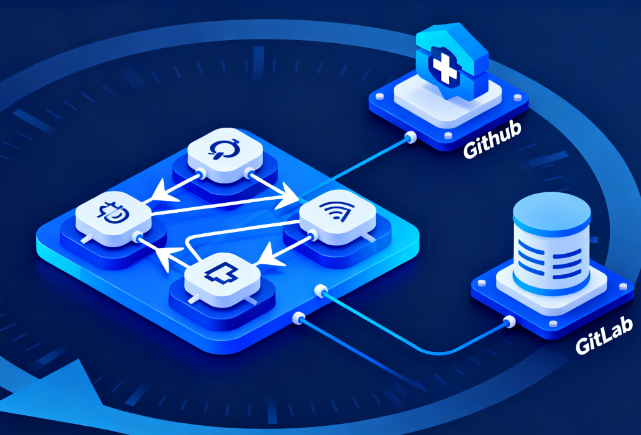
It supports workflow orchestration, parallelization, and conditional execution, covering the build, testing, artifact management, and deployment pipeline. It provides test sharding and caching acceleration, optimizing feedback speed for large repositories and multi-language projects. Orbs serve as reuse units, encapsulating commonly used jobs and commands for easy integration with container builds, cloud providers, and notification systems. It includes built-in Docker and machine executors, supporting custom and system images. It provides environment variable, context, and key management for unified control over credential usage and minimum permissions. It supports integration with GitHub and GitLab repositories, enabling automated pipelines triggered by push and merge requests.
2. Technical characteristics
The configuration-as-code architecture uses a YAML structure, supports parameterized and compound commands, and facilitates the sharing of best practices within the team. The self-hosted Runner provides resource classes and pooling mechanisms, can be deployed on Linux, macOS, and Kubernetes environments, and manages the job lifecycle through the Runner API. The cloud-based platform offers multi-specification resources and credit point billing, combined with tiered caching and tiered image caching to improve stability and speed. The platform provides auditing and observability components, including job logs, metrics, and artifact management, facilitating troubleshooting and compliance documentation.
IV. Pricing and Versions
It adopts a credit-based pay-as-you-go billing model, where cloud resources deduct credit points based on the number of execution minutes. Different CPU and memory specifications correspond to different unit prices. Examples include a small specification with one core and two gigabytes of memory corresponding to low credit point consumption, while larger specifications are billed in multiples. A free tier is provided, containing a certain number of monthly credit points and active user quotas; prepaid credit points can be purchased as needed and enjoy bulk discounts. Enterprises can choose higher quotas and private deployment options. Prices and benefits are subject to the official current page and contract and may be adjusted due to region and time.
V. Applicable Scenarios and Target Audience
Suitable for product and platform engineering teams seeking rapid feedback and stable delivery, covering monolithic and microservice projects, as well as multi-language and multi-repository projects. Organizations with high security and compliance requirements can execute sensitive operations on their own infrastructure through self-hosted Runners. Startups and small to medium-sized teams can control costs early on with free and pay-as-you-go options, upgrading resources and governance capabilities as they grow. Teams with strong ecosystem integration needs can leverage Orbs to quickly integrate testing frameworks, container registries, and cloud deployment processes.
VI. Frequently Asked Questions
Q: How does CircleCI improve the build and testing speed of large projects?
A: Reduce queuing and repetitive work by parallelizing workflows, sharding tests, and caching mechanisms, and shorten the overall time by combining appropriate resource specifications and image caching.
Q: Is it mandatory to use a cloud-based execution environment?
A: No need. Jobs can be run on a self-hosted Runner, and specific jobs can be directed to designated machines or clusters through resource classes and queue control to meet compliance and dedicated hardware requirements.
Q: How to quickly integrate common tools and services?
A: Use Orbs to reuse configurations and directly import community- or official encapsulations to complete integrations such as building, testing, deployment, and notifications, reducing the maintenance cost of custom scripts.
Q: How to calculate and optimize pricing?
A: Billing is based on credits per minute, and the larger the resource size, the higher the consumption; the overall cost can be reduced through prepayment discounts, reasonable size selection, and caching strategies.
Q: Which code hosting platforms are supported?
A: The official documentation provides integration capabilities with GitHub and GitLab. For other platforms and specific support, please refer to the current documentation, which may vary or be updated.