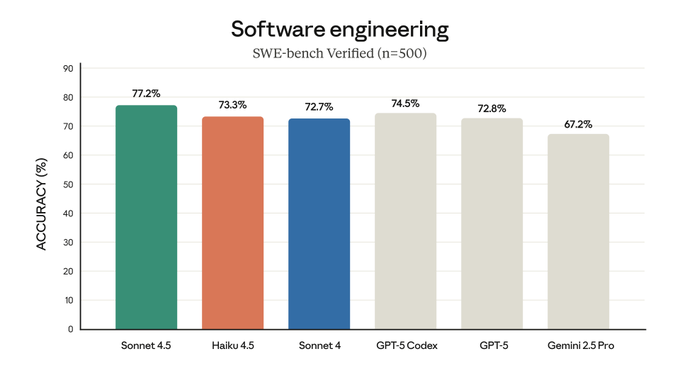
Anthropic announced the release of Claude Haiku 4.5 , a new, smaller language model. Officials claim its performance in core tasks like code generation is now approaching that of its flagship model , Claude Sonnet 4, released five months ago. Haiku 4.5 is reportedly designed for high-concurrency and cost-sensitive applications, running at just one-third the cost of Sonnet 4 while maintaining comparable performance. The model boasts over twice the inference speed.
Haiku 4.5 is now available on multiple platforms, including GitHub Copilot and Amazon Bedrock, and supports enterprise-grade deployments. The new model inherits the Claude series' multi-turn conversation capabilities and contextual understanding advantages while also being optimized for low-latency and high-throughput scenarios. Industry experts believe that the release of Haiku 4.5 signals Anthropic's accelerated development of its multi-layered model matrix, strengthening its market competitiveness through differentiated performance and pricing strategies.
Frequently Asked Questions
Q: Claude: What are the main improvements in Haiku 4.5?
A: While maintaining high-precision code generation performance, it achieves faster response and lower operating costs.
Q: Does Haiku 4.5 completely replace Sonnet 4?
A: The two have different positioning. Haiku 4.5 focuses on speed and cost, while Sonnet 4 is still suitable for complex reasoning and high-load tasks.
Q: What platforms is this model available on?
A: Access interfaces are currently provided on platforms such as GitHub Copilot and Amazon Bedrock.
Q: What is the pricing for Haiku 4.5?
A: Official pricing shows that the cost of inputting and outputting tokens is about one-third of Sonnet 4.
Q: What is the purpose of releasing this version?
A: Anthropic hopes to broaden application scenarios with efficient and lightweight models to meet enterprise-level and real-time reasoning needs.