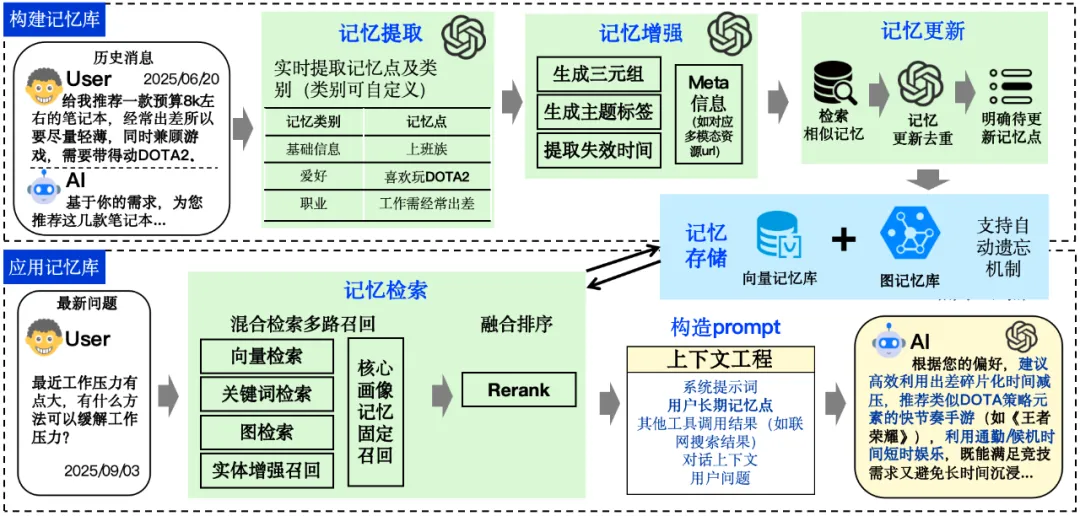
360 Brain recently announced the launch of its Mem360 memory solution, along with the open access to the 360 Brain API platform. Mem360's core focus is to provide "plug-in" long-term memory support for large models, rather than directly writing all memory into model parameters or relying on extremely long context windows. Its design emphasizes four "not, but" shifts: notepad-like plug-in storage, low-cost long-term memory rather than expensive long context, a multimodal, multi-layered architecture, and a persistent and controllable storage solution.
Mem360 officially claims to have outperformed several mainstream memory solutions (such as Mem0, MemU, and Zep*) on the LoCoMo benchmark set, achieving leading performance in metrics such as temporal reasoning, open-domain question answering, and multi-hop and single-hop reasoning. It also claims to have achieved leadership on the PersonaMem and LongMemEval benchmarks. 360 emphasizes that Mem360 can serve as a "semantic memory layer" between applications and models, providing long-term, auditable, and updateable memory capabilities for agents and AI applications.
Currently, no independent evaluations or open-source code comparisons have been found in publicly available materials. Mem360's true effectiveness, security design, and large-scale stability still require further verification. If properly implemented, its proposed "external memory architecture" could indeed play a key role in long-term AI interaction and agent systems. The industry and developers should continue to monitor its performance disclosures and user feedback.
Frequently Asked Questions
Q: Why is Mem360 called “plug-in” memory?
A: Because it does not write memory into model parameters, nor does it rely on long context accumulation, but rather an external memory layer with independent storage and modular call.
Q: In which evaluations does Mem360 claim to be leading?
A: The official mentioned the LoCoMo, PersonaMem, and LongMemEval benchmarks, among which the temporal reasoning indicator was particularly prominent.
Q: What memory types does this solution support?
A: Officially, there are three types of memory: episodic memory (events/scenes), semantic memory (facts/knowledge), and procedural memory (tools/workflows).
Q: How are security and privacy guaranteed?
A: The official claims that mechanisms such as data isolation, encrypted storage, full-link auditing, and controllable updates are used to ensure the controllability and privacy security of storage.
Q: What independent verification or open source data is currently available?
A: There is no authoritative third-party evaluation or open source implementation in the public information, and the project is still in the early public stage.