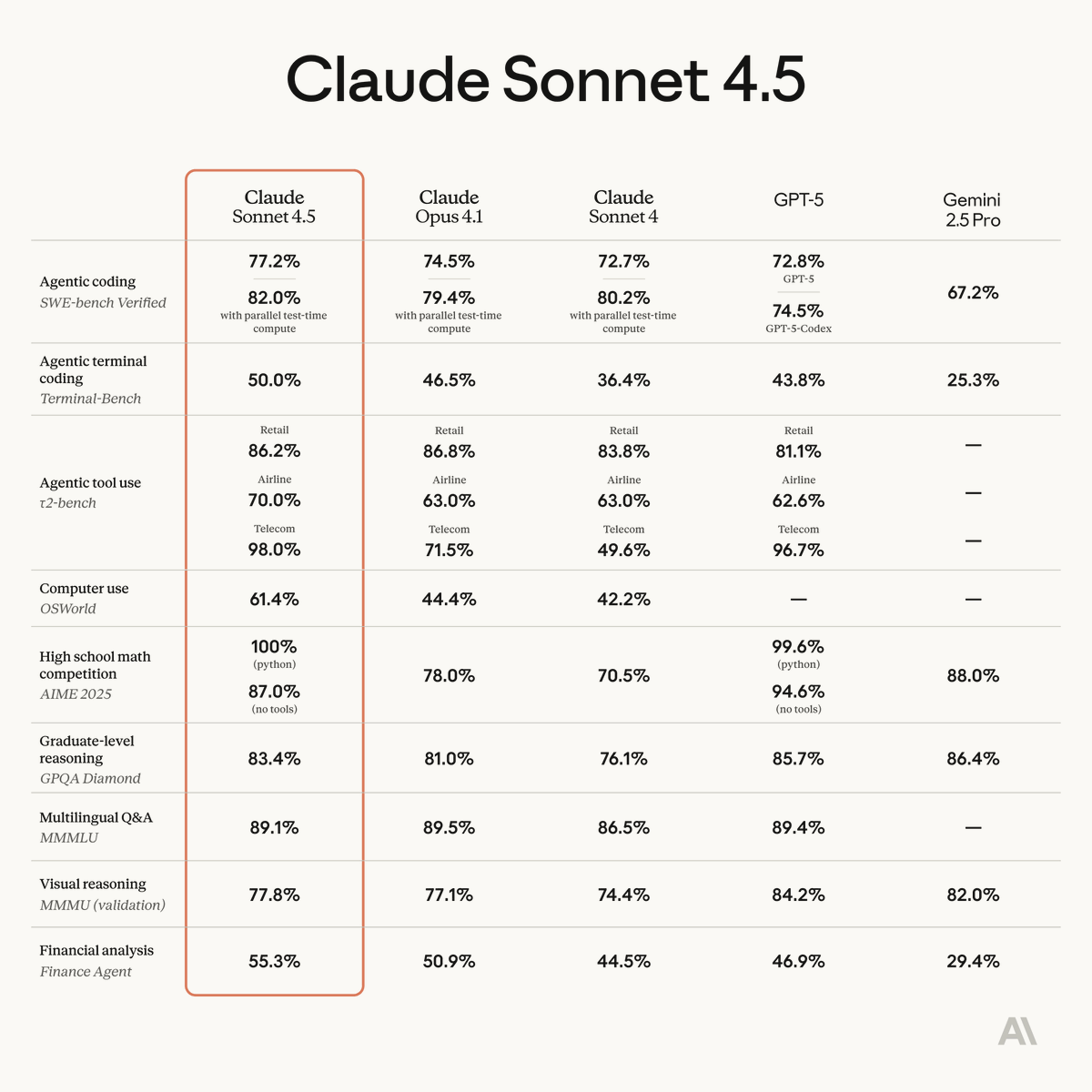
Anthropic has released its next-generation model , Claude Sonnet 4.5 , officially touted as the "world's best coding model," leading the way in building complex intelligent agents and computer operations, and achieving significant improvements in reasoning and mathematical assessments. Multiple media outlets and partners have revealed that Sonnet 4.5 can operate autonomously for approximately 30 hours in real-world engineering tasks, a significant increase over its predecessor, and also performs exceptionally well on benchmarks such as SWE-Bench.
On the ecosystem front, Sonnet 4.5 is being rolled out to enterprises and development tools. It has been integrated into the AWS Bedrock and GitHub Copilot public beta channels, and offers model selection in interfaces such as Claude Code and IDEs/CLIs. Officials claim it has also been hardened in terms of security and adversarial capabilities, aiming for long-term stable use in production environments.
Frequently Asked Questions
Q: What is the core attraction of Claude Sonnet 4.5?
A: Targeting production-level coding and complex agents, it emphasizes "computer-savvy" tool orchestration and long-term autonomous execution, and improves reasoning/mathematical performance.
Q: Is there any empirical data?
A: Official and media reports mentioned that it can continuously code independently for about 30 hours and set new scores on benchmarks such as SWE-Bench.
Q: Where can I use it?
A: It has been launched on Anthropic's own products and has entered the public beta and integration of AWS Bedrock and GitHub Copilot .
Q: What are the improvements compared to the previous generation?
A: The long-term autonomous operation has been increased from about 7 hours to about 30 hours, and the tool calling, computer operation and anti-robustness have been simultaneously strengthened.
Q: What scenarios is it suitable for?
A: Large code base maintenance, end-to-end application building, complex data processing and enterprise-level automated agents.