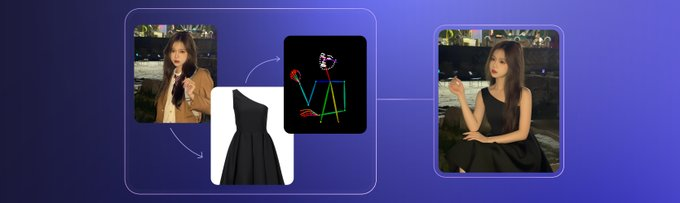
The Qwen team released Qwen-Image-Edit-2509, a monthly redesign of Qwen-Image-Edit that focuses on multi-image editing and single-image consistency. Multi-image mode allows users to drag in up to 1–3 reference images, such as "person + product" or "person + scene," to maintain subject and material consistency during model synthesis, minimizing misalignment and a "stitched" feel. In single-image editing, faces maintain identity across poses and styles, while products maintain key features in advertisements and posters. Text editing allows users to simultaneously modify content, fonts, colors, and textures, supporting the layout of long text and the integration of text and images.
This version natively supports ControlNet conditional inputs (depth, edges, keypoints, etc.), facilitating pose replacement and structural alignment. Official online experiences and open-source resources are available, including a QwenChat image editing portal, the Hugging Face model and demo, GitHub instructions, and a ModelScope image. Community discussions have also begun on GGUF quantization and ComfyUI adaptation. For specific capabilities and best practices, please refer to the official documentation and repository.
Frequently Asked Questions
Q: What are the core improvements compared to the previous version?
A: Added multi-image editing; significantly improved consistency between characters and products in a single image; text editing supports fine control over fonts/colors/materials, etc.
Q: What is the recommended input amount for multi-image editing?
A: Currently, 1-3 photos are the best, and combinations such as "people + people/people + products/people + scenarios" are supported.
Q: Is ControlNet built-in?
A: Yes, it natively supports conditional inputs such as depth, edges, and key points for posture and structure control.
Q: Where can I experience and obtain the model?
A: You can use the image editing portal in QwenChat; GitHub/Hugging Face/ModelScope provide weights, examples and online demos.
Q: Is this open source?
A: Model weights and sample codes are provided. The community has already implemented quantification and workflow adaptation. For specific authorization and usage, please refer to the platform pages.