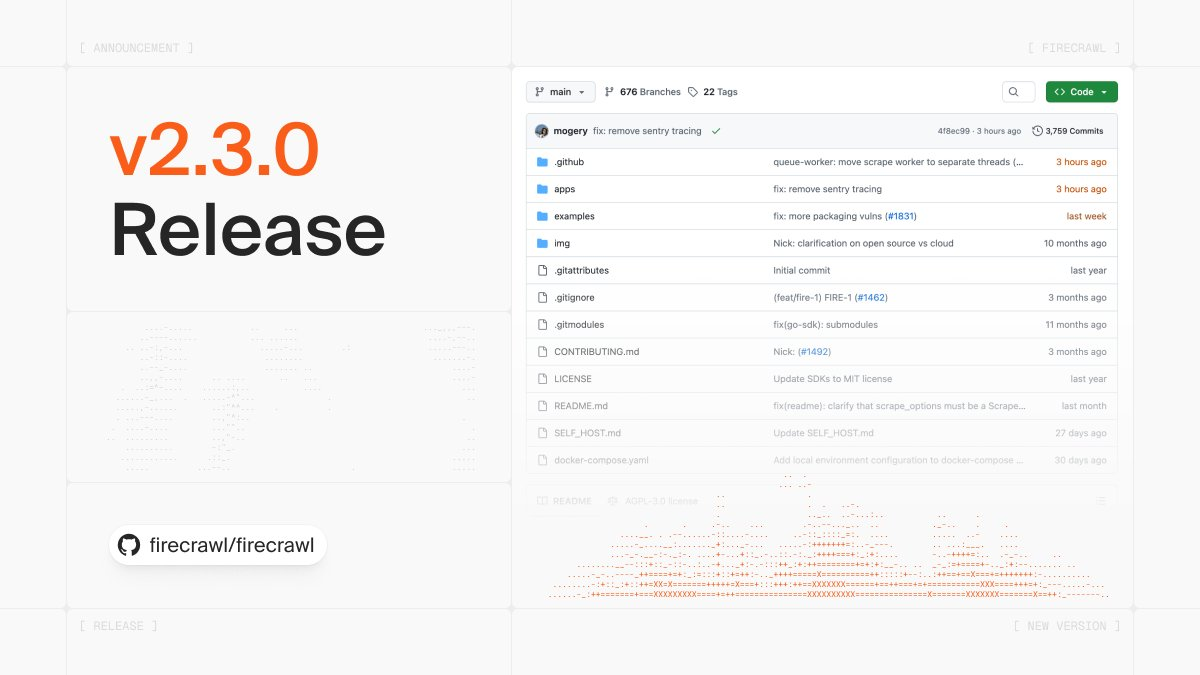
Firecrawl v2.3.0 features major upgrades for AI crawling and parsing: new YouTube support, ODT and RTF parsing, and an approximately 50x speedup for DocX parsing. It also includes Enterprise Auto-Recharge, an optimized Playground experience, and enhanced self-hosting, making it an immediate upgrade for AI agents, RAGs, and data pipeline teams. I. Core Update Overview: From "Capable" to "Fast" 1. YouTube Support AI crawling keywords: Firecrawl, YouTube, and audio/video-to-text. Video pages can now be directly crawled and converted into Language Library Manager-friendly markdown or structured data, facilitating summarization, key point extraction, chapter indexing, and multimodal question and answer. 2. Document parsing enhancements: ODT and RTF support, and DocX parsing speed improvements. AI parsing keywords: ODT, RTF, and DocX. New ODT and RTF parsing covers more enterprise legacy formats; Docx parsing speed is increased by about 50 times, and batch extraction of long documents and table extraction is significantly accelerated, suitable for knowledge base cold start and compliance archiving.
(1) Playground and Self-Hosting
AI Engineering Keywords: Playground, Self-Hosting. Playground interaction is smoother, facilitating prompt word and policy iteration; self-hosting improvements reduce deployment and operation friction, and are more stable in private scenarios.
II. Enterprise-oriented: Cost, Stability and Scalability
- Enterprise Auto-Recharge
AI Billing Keywords: Auto-Recharge, Enterprise Quota. Automatically replenishing quotas to avoid task interruptions is suitable for large-scale crawling, scheduled jobs and weekend peak traffic; combining rate limiting and queue strategies to ensure production line stability.
- Practical implementation of RAG and agents
AI application keywords: RAG, Agents, structured extraction. Combined with search and crawling, first use Firecrawl to obtain the full page, then use the extraction template to generate JSON fragments, and directly enter the vector library and relational library to achieve the "crawling-extraction-retrieval-question-answering" closed loop.
(1) Upgrade and compatibility suggestions
AI migration keywords: v2.3.0, API compatibility. The production environment first enables v2.3.0 in the grayscale project to evaluate the throughput, success rate and cost of YouTube and the new parser; retain the old version rollback strategy and retry queue to ensure task continuity.
Three typical usages: ready to use
- Content team
AI workflow keywords: video summary, chapter index. Batch crawl YouTube podcasts and lectures, output timestamp summaries, noun lists and citation segments, and improve secondary editing and distribution efficiency.
- Operations and Risk Control
AI monitoring keywords: brand public opinion, policy compliance. Monitor official website, forums and document updates, and use structured extraction to identify price changes, new terms and sensitive word hits.
(1) Enterprise Knowledge Base
AI data keywords: heterogeneous documents, batch storage. Unified parsing of docx, odt, rtf and web pages, cleaning to a unified schema, and launching RAG knowledge search and question-and-answer assistant.
Frequently Asked Questions (Q&A)
Q: What AI scenarios are suitable for Firecrawl v2.3.0's YouTube support?
A: Suitable for AI summaries, chapter navigation, knowledge cards and semantic retrieval. In conjunction with RAG, multiple rounds of question-and-answer and multi-source comparison can be directly performed.
Q: What value does the 50x acceleration for odt, rtf, and docx bring to enterprises?
A: AI-powered batch extraction speeds up batch processing, significantly shortens cold-start time for historical documents, and reduces costs for document compliance archiving and knowledge base construction.
Q: How does Enterprise Auto-Recharge control budget risks?
A: By setting upper thresholds, allocating quotas and rate limits by project, and combining failed retry and deduplication strategies, we ensure "continuous orders without loss of control."
Q: Does the self-hosting enhancement facilitate private compliance?
A: Easier deployment and monitoring, combined with the company's intranet and data desensitization policies, meets strict requirements for data sovereignty and auditing.