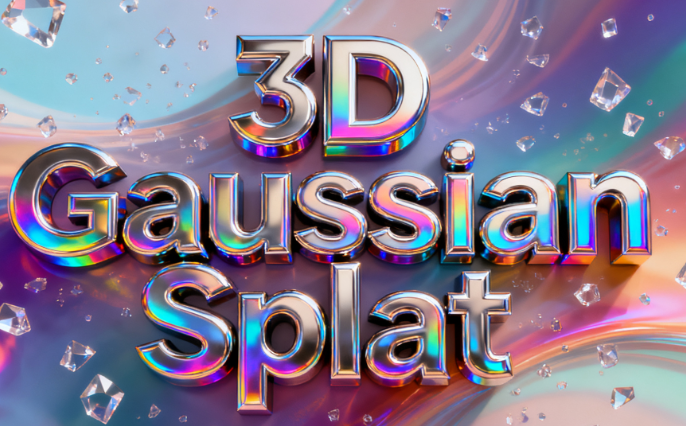
Generative 3D Gaussian Splat is pushing the bar for "transforming video into interactive 3D" to the limit: a single scene can generate up to 50 million splats, creating a near-photographic-quality fly-through effect. However, V2V post-processing can still result in inconsistent stitching and exposure jumps. Using AI toolchains and data normalization, these artifacts can be minimized to acceptable levels.
1. Why These Large Scenes "Don't Look Fake"
1. The Essence of 3D Gaussian Splat
Keywords: 3D Gaussian Splat uses anisotropic Gaussian volumes instead of voxels or meshes, enabling fast training and real-time rendering, making it naturally suited for large scenes and free-viewing angles. Compared to Nerf, it offers more adaptive density, allowing for detailed incorporation through densification and scale control.
2. A New Path to Generative 3D
Keywords Generative 3D uses diffusion models and Splat expressions to support direct scene generation from images or videos, and can selectively convert them into Mesh and textures for engine implementation and editing.
(1) Why can there be over 50 million splats?
Keywords Large scenes
The core is block training and hierarchical rendering: splitting city blocks or long corridors into sub-blocks, and then performing global alignment and cropping, making video memory and frame rate more controllable.
(2) The source of v2v stitching artifacts
Keywords v2v post-processing
It may introduce color drift, stitching misalignment and time inconsistency. The root cause is camera trajectory jitter, exposure inconsistency and feature matching drift.
II. Turning “stunning” into “usable”: Three-step purification from acquisition to training
1. Data side: stable trajectory and unified exposure
Keywords Generative 3D First perform lens calibration and trajectory smoothing; long video slices maintain overlapping frame rates, unify white balance and shutter, and reduce subsequent color cast and stitching.
2. Training side: layer density and cropping
Keywords 3D Gaussian Splat First perform low-density global and then local densification; mask or threshold crop irrelevant sky and distant scenery, leaving splats for important structures.
(1) Consistency regularization and color calibration
Keywords v2v Add neighboring block color constraints and boundary overlap area weights during optimization, and perform local tone mapping after training to reduce boundary “zippering”.
(2) Publishing side: LOD and interactivity
Keywords Large scenes Output multi-level LOD and partitioned packages; Web or client-side uses distance and frustum clipping to ensure real-time interaction.
III. AI tool chain: From "video to scene"
1. The shortest closed loop between acquisition and reconstruction
Keywords Generative 3D Use multi-view reconstruction tools to provide camera poses, access Splat training and automatic clipping; when necessary, convert to Mesh with one click for mapping and collision.
2. Automatic quality inspection and repair
Keywords v2v Use proxy scripts to batch detect seams, color jumps, and holes, automatically re-inject small areas for retraining; and provide "reshoot or recalculate" prompts for texture jitter.
(1)Music and Demonstration
Keywords Large Scene When releasing a demo, it is recommended to fix the camera path and rhythm to reduce the flickering caused by fast panning, making the "incredible" more stable and smooth.
(2)Engine-oriented landing
Keywords 3D Gaussian Splat Combine with engine plug-ins or convert to Mesh, unify coordinates and units, add light probes and reflection probes, and achieve "what you see is what you use".
Frequently Asked Questions (Q&A)
Q: Will 50 million splats be too heavy to run in real time?
A: Keywords Large Scene Using block loading and LOD, multi-viewport cropping can maintain smoothness on mid-to-high-end graphics cards; mobile terminals can use downsampling and regional streaming.
Q: How do I fix inconsistent v2v stitching?
A: Keywords: v2v performs color matching and overlap training at boundaries; adds smoothing to camera trajectories and uniform exposure; performs local tone mapping and flicker removal before release.
Q: What is the difference between generative 3D and "photo reconstruction"?
A: Keywords: Generative 3D can complete invisible faces and stylized details, but requires consistency constraints to prevent structural drift; photo reconstruction is more "faithful" geometry but has limited stylistic constraints.
Q: How do I import Splat assets into a game engine?
A: Keywords: 3D Gaussian Splat can be directly rendered using the Splat rendering plugin, or converted to Mesh and PBR textures. For large scenes, it is recommended to retain Splat for preview and Mesh for final delivery.