Magistral Small 1.2 and Medium 1.2 have been officially released, adding a new visual encoder and supporting multimodal analysis of text and images. They deliver over 10% performance improvement over 1.1 on benchmarks like AIME and LiveCodeBench. Enhanced tools like web search, code interpretation, and image generation provide clearer and more natural output, making them ideal for knowledge work and engineering scenarios. I. Upgrade Highlights: Why 1.2 is Worth It 1. Multimodality: Native Integration of Text and Images Magistral 1.2 features a built-in visual encoder that enables reasoning and answering based on document screenshots, formula images, and code snippets with accompanying images. This capability covers high-frequency tasks such as product reviews, table recognition, and chart Q&A. This capability has been confirmed in the official documentation and announcement.
2. Performance Improvement: Mathematics and Programming are More Stable
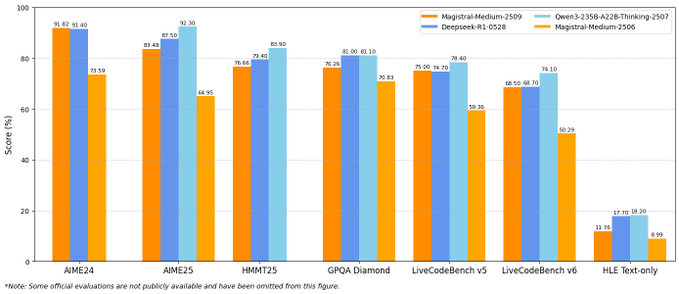
Magistral 1.2 achieves approximately 15% improvement over 1.1 on benchmarks such as AIME 24 and AIME 25, and LiveCodeBench v5 and v6. Complex reasoning and long chain problem solving are more reliable, making it suitable for teaching, research, competitions, and code generation scenarios.
(1) Better reasoning chain reinforcement and convergence
Based on a combination of supervised fine-tuning and reinforcement learning, 1.2 makes fewer mistakes in long-step derivations, provides more readable answers, and supports finite generation to suppress "infinite continuation".
(2) Optimized tone and formatting
More natural responses, more standardized Markdown and LaTeX expressions, and easier to paste directly into knowledge bases, paper drafts, and technical documents.
II. Engineering Practice: Connecting 1.2 to Real Workflows
1. Smarter Tool Calling
Magistral 1.2 is more proactive in scheduling web page search, code interpreter, and image generation. It can automatically split subtasks, pull data, and verify it in the code sandbox, and then merge it into a structured answer, reducing manual round-trips.
2. Database and Knowledge Base Integration
In R&D documents, requirement libraries, and defect libraries, multimodal question-answering is first used to extract key points, and then programming tools are used to check the consistency of interfaces and sample codes, and finally a review list and change suggestions are produced.
(1) Mathematical Scenario Implementation
For AIME-type problems, 1.2 can first provide a solution framework, and then gradually derive the formula and self-check; an equivalent transformation explanation is given for the Latex results to reduce errors.
(2) Coding Scenario Implementation
Under the LiveCodeBench paradigm, natural language questions are converted into test cases. The code interpreter is run to verify the pass rate. Failures are detected using binary location and rollback prompts.
III. Selection Recommendations: Small vs Medium and Deployment Key Points
1. How to Choose
Small 1.2 is more computationally efficient and suitable for local or small- to medium-scale reasoning; Medium 1.2 pursues higher steady-state accuracy and is suitable for server-side centralized reasoning and complex project review.
2. Deployment and Governance
After quantization, Small 1.2 can run on a single GPU or a high-memory, lightweight device. In production, it is recommended to configure request timeouts, maximum number of steps, and tool whitelists, and record thought chain summaries for auditing.
(1) Prompt word template
Solidify the template for multimodal tasks, clarify the input structure, output format and tool permissions, and reduce drift.
(2) Evaluation regression
Create a regression set that includes subsets of AIME and LiveCodeBench. Compare the accuracy, execution time and number of tool calls for each upgrade to quantify the benefits.
Frequently Asked Questions (Q&A)
Q: What practical uses can Magistral 1.2's multimodality provide?
A: You can extract requirements from product screenshots, reconstruct formulas and solve problems from problem images, locate stack information from error screenshots, and then use the code interpreter to reproduce and fix problems. Q: Compared to 1.1, what are the core benefits of Magistral 1.2? A: The dual improvements in multimodality and mathematical programming benchmarks, along with more stable tool invocation and improved typography, make it more suitable for direct integration into production workflows. Q: Can Small 1.2 be deployed locally for private data? A: Yes. After quantization, it can run on a single GPU or a high-memory lightweight device. Combined with an offline toolchain, it enables disconnected reasoning while retaining controllable search and execution. Q: How can I verify that the 15% performance improvement applies to my scenario? A: We created a small benchmark using team tasks, covering mathematical reasoning, code generation, and search and question answering. We ran the same prompts and tool permissions on 1.1 and 1.2, recording the difference in accuracy and latency.