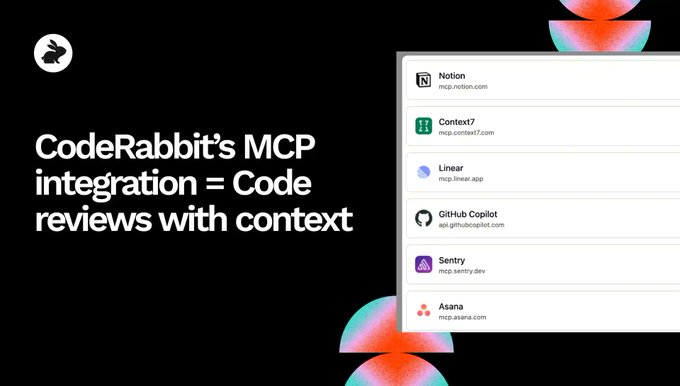
CodeRabbit announced the launch of MCP integration, enabling AI code review to aggregate context from GitHub, issues, documentation, and operations tools, achieving a comprehensive review perspective encompassing "business + technology + organization." Officially, this is the first AI code review platform to orchestrate global context within the development ecosystem, supporting a unified experience across multiple platforms: PR, IDE, and CLI. I. Core Upgrades and Value 1. MCP orchestrates context, enabling AI code review to better understand the business. CodeRabbit leverages MCP to integrate requirements, change logs, and monitoring metrics into review conversations. AI can leverage CodeRabbit's review engine to reference evidence across multiple sources, reducing misjudgments due to "looking only at the code but not understanding the intent."
2. Full-link implementation: PR, IDE, and CLI collaboration
Automatically generate high-quality suggestions in PR, conduct instant self-checks in IDE, and perform batch review and local verification in CLI, forming a closed loop of "before submission, during submission, and after submission", significantly compressing the feedback loop.
(1) Technical context
Dependencies, configurations, environment variables, and build scripts are all included in the review.
(2) Business context
Associate requirements, acceptance criteria, and risk tags to avoid deviations.
(3) Organizational context
Generate customized suggestions based on team specifications and code ownership.
II. How to get started quickly
1. Source selection and whitelist
Specify trusted servers and data sources for MCP, and only expose the minimum fields required for review.
2. Templates and Metrics
Maintain review templates and quality gates to track defect detection and rework rates.
3. Phased rollback and rollback
Enable gradually by repository and team, retaining manual takeover and rule-based rollback.
a. Security
Least privilege, key tiering, and operation traceability.
b. Performance
Cache hot context to reduce duplicate requests.
c. Cost
Dynamically allocate inference intensity based on PR size and risk.
Frequently Asked Questions (Q&A)
Q: What are the fundamental changes that MCP brings to CodeRabbit? A: CodeRabbit aggregates cross-tool context through MCP, allowing AI code reviews to go beyond syntax and style and provide actionable recommendations based on business objectives and the operating environment. Q: How does this improve over traditional "diff-only" reviews? A: Traditional methods lack requirements and deployment context. CodeRabbit + MCP unifies requirements, dependencies, and runtime signals, reducing errors and missed reviews, and improving review pass rates and first-time approval rates. Q: How do you control privacy and permissions? A: Set up data whitelists and field desensitization for MCP, using least-privilege keys and audit logs. Initially implement a grayscale release for sensitive repositories, rolling back to local context whenever necessary. Q: Recommended path for team implementation? A: Start with a pilot on a key service: connect to a minimal number of MCP data sources → define quality gates → observe defect and rework metrics for two weeks → then expand to all repositories and multiple teams.