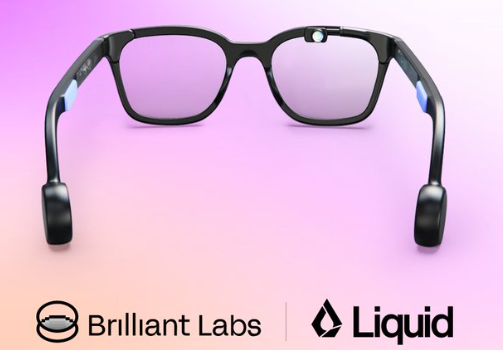
Brilliant Labs announced a collaboration with Liquid AI to bring efficient multimodal models to the Halo open-source AI glasses platform, advancing "personal intelligence" without sacrificing privacy or openness. This long-term collaboration will integrate model innovations into Halo's local reasoning and long memory capabilities, serving the developer and creator ecosystem. I. Why This Collaboration is Noteworthy 1. Multimodal Personal Intelligence, Prioritizing Privacy and Openness Liquid AI's lightweight multimodal models are a natural fit with Halo's local reasoning design, enabling open-source AI glasses to achieve faster, more stable, and more power-efficient AI reasoning for complex inputs like camera and voice, while maintaining an open-source and scalable development paradigm.
2. A "programmable" glasses platform for developers
Halo has formed an open source hardware and software stack, combined with an AI assistant with long memory and natural dialogue, which can precipitate scene understanding, information retrieval and task orchestration into reusable apps and workflows, lowering the entry threshold of wearable AI.
(1) Product-side value: from recognition to understanding
The multimodal model converts video frames and ambient sounds into indexable semantic summaries, supporting character recognition, text understanding and spatiotemporal association, and improving the usability of recording and recall.
(2) Engineering-side value: local and edge-first
Key perception and reasoning are completed on the device side, which not only reduces cloud costs, but also enhances offline usability and data minimization.
(3) Ecological-side value: open platform drives innovation
Open source and extensible interfaces attract third-party models and applications to join, forming a positive cycle of "hardware-model-application".
II. How to implement it in real scenarios
1. Three-step approach to building your glasses AI workflow
Determine the target task, assemble the required models and resources, connect the output to the memory and retrieval loop, and quickly verify the closed loop from "seeing-understanding-action".
2. Developer-first application list
Media recording, conference assistant, real-time translation, object and name memory, local navigation and retrieval, etc. can all be implemented and iterated in an open source manner on Halo.
(1) Capability combination recommendation
Visual understanding + dialogue planning + long-term memory, prioritize making a minimum viable version that is "explainable and replayable".
(2) Evaluation and iteration
Continuously fine-tune strategies and models with task success rate, response latency, energy consumption, and privacy compliance as core indicators.
(3) Team Collaboration and Distribution
Share capabilities through open source repositories and plug-in mechanisms to promote secondary development and scenario expansion.
a. Privacy Baseline
Local processing by default, cloud participation only when the user allows; provide deletable and exportable data capabilities.
b. Performance and Battery Life
Select lightweight models and resolutions according to scenarios, and use event-driven rather than continuous reasoning.
c. Accessibility and Usability
Optimize subtitles, screen reading, and touch interactions to allow more people to benefit from wearable AI.
Frequently Asked Questions (Q&A)
Q: What direct improvements can the collaboration with Liquid AI bring to Halo open source AI glasses?
A: More efficient multimodal understanding, faster local reasoning, and stronger long-memory orchestration, covering core links such as recognition, summarization, and retrieval.
Q: How can personal intelligence be achieved without sacrificing privacy?
A: Process images and voice with a local-first reasoning path, call the cloud only when authorized, and provide auditable and removable personal data control.
Q: What does this mean for developers?
A: An open and scalable wearable AI platform that can quickly integrate visual language models and semantic memory, turning experimental prototypes into distributable applications.
Q: Compared to general-purpose smart glasses, what are the differences between open source platforms?
A: Open hardware and software interfaces, replaceable models and components, transparent privacy policies, and greater suitability for community co-creation and vertical scenario customization.