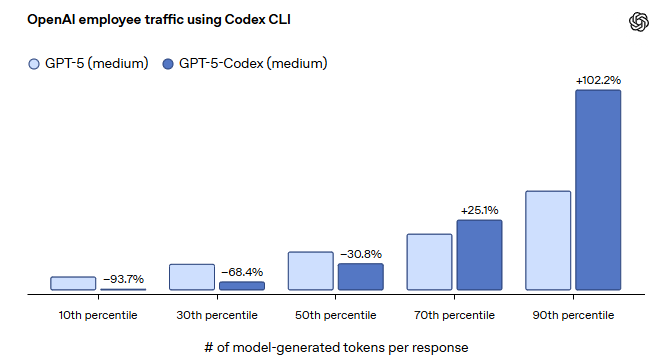
OpenAI announced a major upgrade to Codex: the introduction of GPT-5-Codex, significantly improved speed and stability, enhanced real-time collaboration and autonomous execution, covering multiple scenarios such as terminals, IDEs, web pages, and mobile phones. For developers, AI code assistants are evolving from "conversational completion" to "deliverable agentic coding" teammates.

1. List of upgrade points: speed, reliability, and collaboration are comprehensively enhanced
1. Core capabilities are upgraded
The keyword of OpenAI Codex is "faster, more stable, and collaborative." The upgraded Codex is fully optimized in terms of response latency and execution reliability, making it suitable for continuous agentic coding processes, including task decomposition, implementation, and regression. Higher quality model routing makes Codex less prone to complex modifications and multi-file changes.
2. Special optimization of GPT-5-Codex
Thenewly added GPT-5-Codex is deeply optimized for code scenarios. Compared with general models, it is closer to the engineering context in terms of refactoring, single test completion, fault localization, and specification alignment, allowing OpenAI Codex to run more steadily in the real warehouse, reducing round-trip communication and invalid iterations.
(1) Collaboration and Code Review
OpenAI Codex enhances the multi-person collaboration and code review experience, supporting structured suggestions, change explanations, and follow-up fix plans in existing workflows, helping teams complete consistency checks and security baseline checks before PR integration.
(2) Multi-terminal workflow coverage
Theupgraded OpenAI Codex can work seamlessly in terminals, IDEs, web pages, and mobile phones, maintaining context consistency and task continuity, and is suitable for quick review and hot repair in mobile scenarios.
2. Practical value to developers: from "able to write" to "able to deliver"
1. Improving efficiency and quality
Thecombination of OpenAI Codex and GPT-5-Codex makes agentic coding more like an "engineering colleague": it can generate specifications around requirements, Implement and validate step by step to reduce rework. This stable output is particularly critical for frequent refactoring and legacy system governance.
2. Typical landing scenarios
(1) Incremental development: generate skeleton code for new features, associate single tests and document descriptions
(2) Legacy code remediation: batch upgrade dependencies, unified error handling and log style
(3) quality and security fixes : Identify risk points, generate patches, and provide verification steps
(4) Best practice tips
a. Let OpenAI Codex produce "executable specifications" first, and then implement them in batches
b. Stage reviews for large tasks to limit context noise and improve success rate
c. Share context between IDE and terminal to reduce duplicate interpretation costs
3. Suggestions for getting started and selecting
1. Getting started Path
Use the Codex CLI or IDE extension to access the upgraded OpenAI Codex; Web and mobile apps can be used for quick review and emergency repair. Incorporating commonly used repositories and scaffolding into the default context significantly reduces the prompt burden.
2. Model selection strategy
Conventional coding and review give priority to the Codex default route. For high-complexity tasks or critical release branches, switch GPT-5-Codex for more stable agentic coding performance, ensuring delivery cadence and quality baselines.
Frequently Asked Questions (Q&A)
Q: What is the difference between OpenAI Codex and GPT-5-Codex?
A: OpenAI Codex is the overall product and workflow, and GPT-5-Codex is a model variant that is deeply optimized for code tasks, with stronger performance in refactoring, debugging, and specification alignment, making it suitable for critical delivery.
Q: How does the upgraded OpenAI Codex improve collaboration efficiency?
A: It provides structured change notes and fix suggestions in code reviews, maintaining consistency across multiple contexts, allowing the team to complete the quality closed loop during the PR stage and reduce rework.
Q: When should I choose GPT-5-Codex?
A: When tasks involve multi-file refactoring, complex dependency migration, and strict quality and security requirements, GPT-5-Codex is preferred. Daily increments and quick patches are more time-saving with default routes.
Q: Does OpenAI Codex support scenarios outside of terminals and IDEs?
A: Yes. The upgraded OpenAI Codex covers terminals, IDEs, web pages, and mobile phones, making it convenient for temporary review, hot repair, and on-duty response in mobile scenarios.