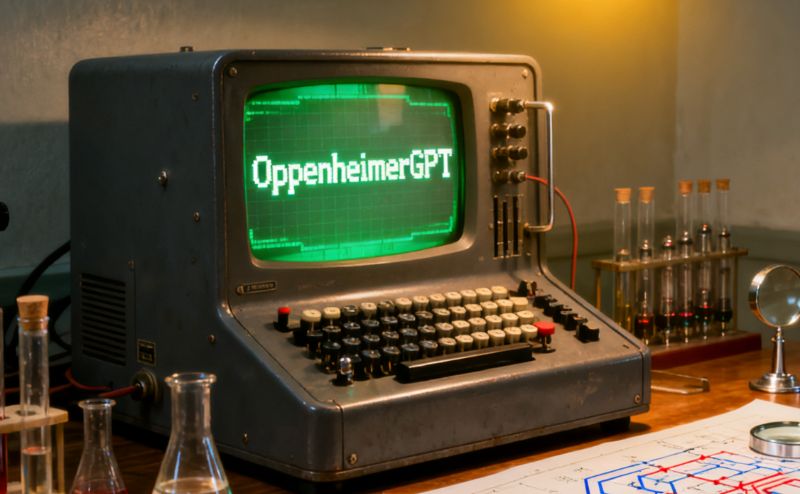
If you often need to use ChatGPT and Gemini to compare answers, do quick research or polish your writing, then OppenheimerGPT is definitely worth a try. This is an AI tool for the macOS menu bar, and the biggest highlight is "one input, two engines answer side by side". I actually used OppenheimerGPT to mirror the same prompt to both ends in the topic selection research, and in 5 minutes, I got a comparable answer and automatically sorted out the key points, which improved efficiency by about 2.5 times.
1. What is OppenheimerGPT
? In short, OppenheimerGPT is a macOS menu bar tool that puts multiple AI assistants (such as ChatGPT, Gemini, Bing, etc.) into the same interface and supports side-by-side comparison. Developed by the OppenheimerGPT team, it mainly helps users "single input, multi-engine response" and avoid switching tabs back and forth. Compared with traditional methods, OppenheimerGPT's advantages are: side-by-side comparison, eliminating the need for copy-pasting, global shortcut summoning, and support for multiple independent windows to work simultaneously.
Core features include:
- Side-by-side comparison: The same prompt is mirrored to multiple AI models, and the results are placed horizontally, making the advantages and disadvantages visible at a glance.
- Menu bar ready-to-use: No need to open the browser, call out at any time, support independent window/multi-panel parallelism.
- Shortcut keys and templates: Customize global shortcuts, frequently used prompt templates, and quickly copy and merge outputs.
2. Who needs OppenheimerGPT the most
1. Content creators and self-media
If you are a writer/video script creator who often needs to find angles, titles, and beginnings, OppenheimerGPT can submit prompts at once, obtain two versions of different styles, and quickly assemble the "strongest paragraph". For example, the same topic "Urban Renewal Topic Selection Direction" is directly combined with highlight statements after side by side comparison.
2. Product managers and researchers
For those who do competitive product research and solution comparison, OppenheimerGPT is simply worry-free. It presents the answers of "Idea A/Idea B" side by side, and then uses merge prompts to quickly summarize the pros and cons, compressing the process that would have required switching between multiple tabs into a single panel.
3. Cross-language office and translation optimization
When doing localization or bilingual communication, OppenheimerGPT allows the two models to generate translations and polishing versions respectively, and then automatically merge and refine them into "best expressions", with more stable quality and speed.
3. OppenheimerGPT's killer function
1. Mirror prompt + side-by-side comparison
This function is amazing! You only need to write a prompt once in the input box, and OppenheimerGPT will send it to multiple AI models at the same time. In fact, I used "give me 3 titles, each with subheadings and highlight summaries" as the topic selection, the left side is more creative, and the right side is more structured; Read side-by-side and directly learn from each other.
2. Instantaneous call out of the menu bar + multi-window parallelism
Inspiration comes and goes quickly in writing, OppenheimerGPT supports instant call from the menu bar, and a shortcut key can be opened; When you need to compare multiple topics, open two new independent windows and place them side by side to avoid overwriting the current document.
3. Template and merge output
Set the commonly used "summary outline", "brand tone" and "writing style" as templates, and use them immediately; Then "merge output" with one click, automatically combine the advantages of the two models into one draft, reducing the time of manual splicing.
4. Charges
Free version:
- Includes features: quick access to the menu bar, basic side-by-side comparison, and a single independent window.
- Usage limitations: Limited number of windows, low update frequency, and unavailability of some experimental features.
- Suitable for: personal experience, lightweight writing and daily error checking and sentence correction.
Paid version:
- Price: The Pro version is a one-time buyout of about $4.99 (based on the actual page).
- Unlocked features: unlimited independent windows, side-by-side panel enhancements, over-the-air updates and bug fixes, and more model source support.
- Cost-effective analysis: If you only use it occasionally, the free version is enough; If you need to open multiple panels at the same time for systematic research or perennial writing, the Pro one-time buyout is very cost-effective.
5. Practical skills
1. "Scoring matrix" prompt word
input:
"Give 0–10 points from the four dimensions of [factual accuracy|clear structure|readability|executability], and explain their respective improvement suggestions; Finally, a comprehensive version of the answer (≤ 200 words) is generated.
This way you not only get the answer at both ends, but also automatically get the "best synthesis".
2. Dual-engine division of labor is more efficient
Position one model as "idea brain" (creative) and the other as "engineering brain" (structure/verification). The role is clear in the prompt, and the quality is more stable when merging.
3. Fixed system prompt words
Add brand tone, target audience, and list of prohibited words to the template, and OppenheimerGPT will carry these "rules" with you every time you mirror it, making the output style more consistent.
6. Comparison of similar tools
with MacGPT: The advantage of OppenheimerGPT is "multi-engine side-by-side comparison + mirror input", which is more suitable for research and learning from each other's strengths; MacGPT is lighter in terms of single-engine direct access and ecological coverage.
Compared to ChatHub (browser extension): OppenheimerGPT eliminates browser restrictions and is ready to use with the menu bar; However, ChatHub's web extension is easy to cross-platform (Windows/ChromeOS).
Compared with Raycast AI/Peek: Raycast AI has more comprehensive integration efficiency tools and a strong ecosystem. Peek focuses on free and easy; OppenheimerGPT is more focused on "side-by-side comparison and multi-window research".
Overall, OppenheimerGPT is best suited for people who often need to compare different AI answers, conduct data rapid research, and create long-form articles, especially for heavy writers, product/research, operations, and translation localization positions.
7. Summary
OppenheimerGPT is indeed an efficient AI tool. It is most suitable for users who use "comparing the advantages and disadvantages of different models" as their daily work method, especially in the scenario of "topic selection research, scheme comparison, and bilingual polishing".
If you are a content creator, it is highly recommended to use it to "side by side to complement each other";
If you are a light user, the free version will suffice;
If you are a heavy researcher/writer, upgrade Pro to get multiple windows and update maintenance, which is more worry-free in the long run.
Final reminder: OppenheimerGPT itself does not replace each account and quota, if you use the official web version of the source, you still need to abide by the usage and login rules of the corresponding platform.
Frequently Asked Questions (Q&A)
Q: Does OppenheimerGPT need to be connected to the Internet and log in to various AIs?
A: Yes. It is responsible for aggregation and side-by-side display, and you still need to log in to the corresponding service accounts such as ChatGPT and Gemini as required.
Q: What platforms are supported? Does Windows work?
A: Currently, the main macOS menu bar is the form, emphasizing quick outbound calls and multiple windows; Windows and Linux are not yet available in native versions.
Q: Is the Pro version a subscription or a buyout?
A: It is a one-time buyout mode (about $4.99), and you can enjoy feature updates and bug fixes in the future; the specific page display shall prevail.