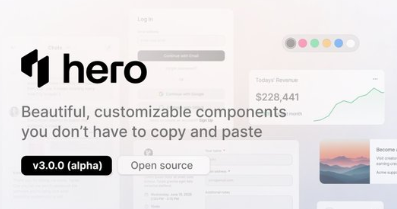
HeroUI v3 Alpha released with a focus on "beautiful, lightweight, customizable, and accessible". Based on Tailwind v4 and React Aria, it comes with Figma design drafts and native CSS animations, making it suitable for AI dashboards, AI SaaS, and marketing stations to quickly implement front-ends, and no longer copy outdated code.
1. Core Highlights
1. More beautiful components and more unified system
HeroUI v3 unifies the design token and variants, and commonly used buttons, cards, navigation and other components are ready to use to meet the high consistency requirements of AI product interfaces.
2. Synchronous update of the Figma suite
HeroUI v3 provides the Figma component library and design token, and shares the same set of colors, spacing, and typography for design and development, reducing delivery deviations and making it suitable for fast-paced AI projects.
3. Lightweight and fast, native CSS animation
HeroUI v3 uses native CSS to achieve dynamic effects, reduce runtime overhead, and make page interaction smoother. It is still stable on the edge and low-end devices.
4. Deeply customizable, Tailwind v4 friendly
HeroUI v3 supports Tailwind v4 theming, and can also be overridden with native CSS or existing style systems, making it easy to access existing design systems and multi-brand themes.
5. React Aria Built-in Accessibility
HeroUI v3 is based on React Aria components, with default keyboard operation, focus management, and screen reading support, meeting barrier-free compliance and enterprise-level accessibility standards.
2. How to land AI scenarios
1. AI dashboard and evaluation platform
(1) Build a model evaluation panel with tables, tags, and progress components
(2) Present model health and delay with state variants
(3) Display reasoning and task progress feedback with native animations
2. RAG knowledge product front-end
(1) Reduce screen reading barriers with accessible input areas and result areas
(2) Present citation and evidence chains with cards and folding components
(3) Quickly switch between dark and light colors and brand colors through theme tokens
3. Marketing landing page and document station
(1) Hero Area animation and scrolling reveal maintain high performance
(2) Component variables are unified, and team output is no longer style drift
(3) Figma to code one-click alignment to accelerate iteration
3. Migration and quality assurance
1. Three steps to migrate from v2 to v3
(1) Unify the design token and Tailwind v4 configuration
(2) Replace core components and proofread interaction state
(3) Align with visual regression and accessibility check
2. Performance and volume control
(1) Introduce and shake trees on demand to reduce unused components
(2) Prioritize the use of native CSS for animation to reduce main thread usage
(3) Establish LCP and CLS Threshold alarm with interaction latency
3. Team collaboration specifications
(1) Figma and code sharing naming
(2) Component variants converge into reusable mode
(3) Maintain accessibility acceptance checklist
for complex pages Frequently Asked Questions (Q&A)
Q: What is the biggest front-end benefit of HeroUI v3 compared to v2?
A: HeroUI v3 is lightweight and customizable, with smoother native CSS animations, and React Aria makes accessibility "out of the box", making it ideal for AI applications that require a high-quality experience.
Q: How does HeroUI v3 work with Tailwind v4 to make themes?
A: Configure design tokens in the theme layer of Tailwind v4, and HeroUI v3 reads and maps them to semantic variables, enabling one-click switching between multiple brands and dark and light colors.
Q: What practical benefits does the Figma suite bring to R&D?
A: Figma components are synchronized with the code structure to reduce handover errors. Design draft changes can be directly mapped to variables and variants, reducing the time from design to go-live.
Q: Does React Aria require additional checks for built-in accessibility?
A: Contrast, focus order, and keyboard path verification still need to be done according to the scene, but HeroUI v3 already provides basic capabilities that can significantly reduce rectification costs.