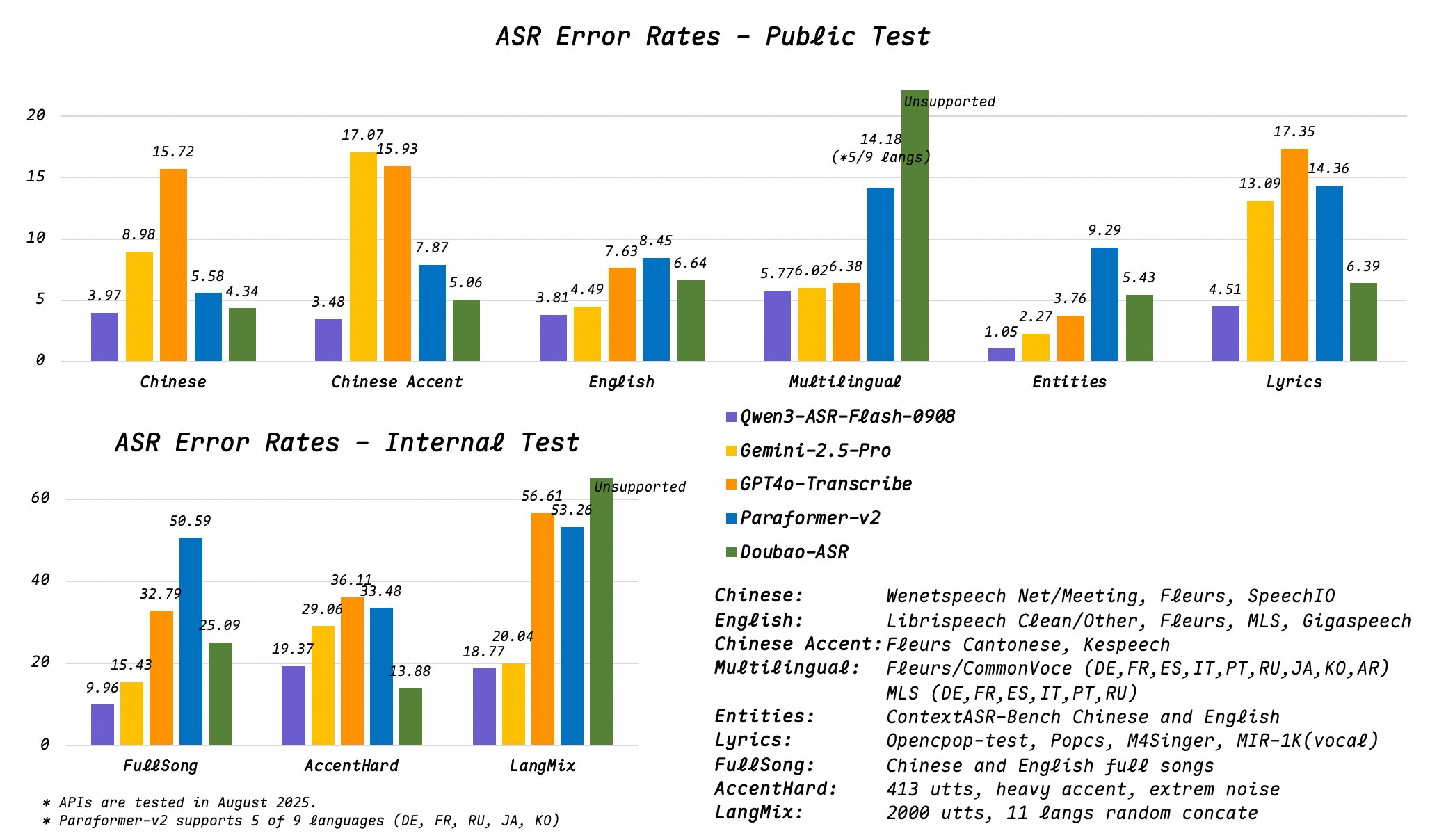
Qwen3-ASR is an integrated AI speech recognition model launched by Alibaba Tongyi Qianwen, which supports Chinese, English and nine common languages, has automatic language detection capabilities, and still maintains a typo rate of less than 8% in songs, rap, BGM, noisy and far-field scenes, and supports custom contextual vocabulary, which greatly improves the recognition effect of proper nouns, and is suitable for education, media, customer service and other industries.
1. Core advantages of Qwen3-ASR
1. Multilingual and automatic detection
Qwen3-ASR supports a total of 11 languages, including Chinese, English, Arabic, German, Spanish, French, Italian, Japanese, Korean, Portuguese, and Russian, and AI automatically recognizes languages. There is no need to manually switch models, significantly improving the efficiency of cross-language scenarios.
2. Robust performance in complex acoustic environments
Qwen3-ASR can maintain a typo rate of less than 8% even in songs, rap, background music, noisy and far-field speech. This makes it ideal for live subtitle generation, multilingual interview transcription, and UGC short-form video scenarios.
3. Custom context capability
Userscan directly paste proper nouns, personal names, place names or industry terms as contextual prompts, and Qwen3-ASR will prioritize these words to improve recognition accuracy. This feature is particularly suitable for educational content, enterprise customer service, product SKU identification, and other needs.
2. Industry application value
1. Educational scenarios
In online education and recording classrooms, Qwen3-ASR can automatically generate transcripts and output more accurate notes and summary of key points in combination with subject-specific vocabulary lists, greatly reducing manual proofreading.
2. Media Scenarios
For multilingual interviews and UGC videos in noisy environments, Qwen3-ASR can maintain stable recognition accuracy and combine it with reverse text standardized output subtitles to reduce post-editing workload.
3. Customer service and quality inspection
Enterprises can transcribe call center voices in batches, and improve the accuracy of product name and process vocabulary recognition through customized contexts, and realize the closed loop of "transcription-quality inspection-FAQ linkage" in combination with the knowledge base.
3. Access methods and evaluation points
1. Access path
Enterprises can quickly access the production environment through the official API, or they can test the audio recognition effect in the online demo first, and then migrate to large-scale applications.
2. Key points of evaluation
a. Establish a WER baseline for multiple languages
b. Test stability under different conditions such as noise, far-field, BGM
c. Use industry terminology to verify the effect of contextual functions
d. Combine latency, cost and accuracy to choose the appropriate deployment scheme
Frequently Asked Questions (Q&A)
Q: What languages does Qwen3-ASR's AI speech recognition support?
A: It supports Chinese, English, and 11 languages, including Arabic, German, Spanish, French, Italian, Japanese, Korean, Portuguese, and Russian, and can automatically recognize the language.
Q: How accurate is AI speech recognition in songs or noisy environments?
A: Qwen3-ASR can still maintain a typo rate of less than 8% in song, rap, BGM, and far-field environments, ensuring usability in multiple scenarios.
Q: How can I use custom context to enhance AI speech recognition?
A: Users can paste personal names, terms, SKUs, or special words into the context area, and the model will recognize these words first, greatly reducing the misidentification rate.
Q: How does Qwen3-ASR compare to ASR tools like Whisper?
A: Whisper prefers open source local deployment, while Qwen3-ASR provides official APIs and online demos, which are more suitable for enterprises to quickly implement and carry out large-scale applications.