On July 9, 2026, Google Research released the wearable health foundational model SensorFM. It was pretrained on data from 5 million users who agreed to participate in the study, covering more than 100 countries and more than 20 Fitbit and Pixel Watch devices, with a total data volume exceeding one trillion minutes. Google's goal is not to create another model that predicts only individual metrics, but to learn a transferable set of human physiological representations, providing a common foundation for cardiovascular, metabolic, sleep, mental health, and lifestyle tasks.
This study is noteworthy because the most common problem with wearables is not "no data," but fragmented data, significant individual variation, and expensive medical labels that are difficult to complete. In the past, many models could only be trained independently around a clear endpoint, and after switching equipment, audiences, or tasks, they often had to be rebuilt.
How does SensorFM handle missing data in reality?
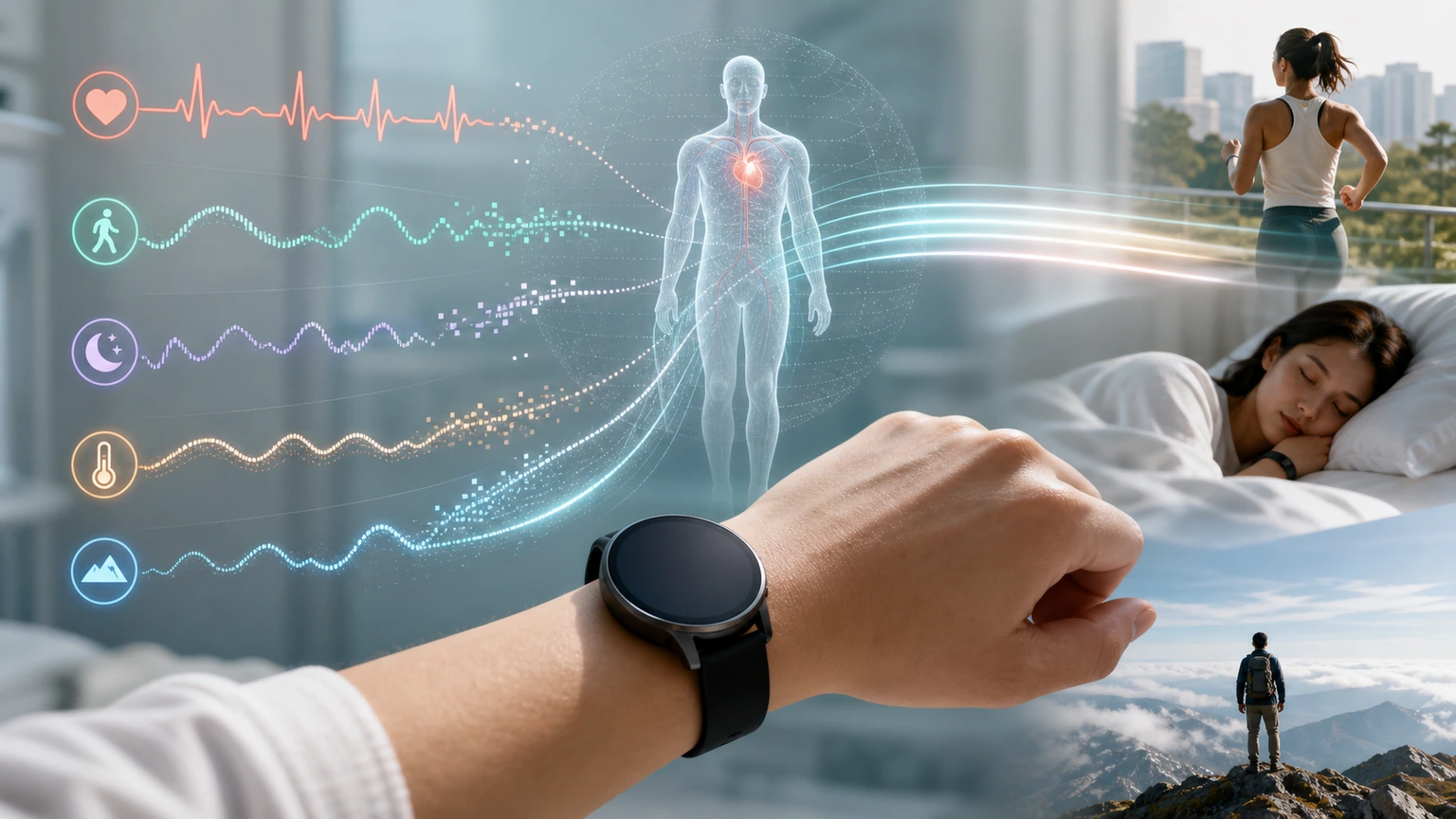
SensorFM receives 34 minute-aggregated features from five types of sensors: photoplethysmic, acceleration, electrical activity, skin temperature, and height. It can detect continuous signals such as heart rate and its variations, blood oxygen, sleep stages, exercise, step count, skin electricity, and temperature.
The model adopts self-supervised reconstruction and introduces an AIM-friendly mechanism for missing cases. Device removal, power saving, restart, or intermittent sensor operation all leave real gaps; Traditional practices are usually to fill in gaps or discard incomplete fragments; the former may introduce bias, while the latter can cause sample loss. SensorFM processes real-world missing signals with signals actively masked during training, allowing the model to learn directly from incomplete records.
After scaling up, improvements are not limited to pre-training metrics
Google conducted experiments across four orders of magnitude in terms of data volume and model scale. The largest SensorFM-B reduced reconstruction losses by 31% compared to the smallest version, achieving the best results on 33 out of 35 downstream tasks. After freezing the encoder, only the lightweight prediction head was trained, indicating that the model exceeded the supervised baseline based on artificial features on 34 tasks, indicating that the model did not learn a single disease label.
The research team also had multiple large language model agents compete and collaborate to write predictive head code, exploring over 30,000 solutions. Out of 20 classification tasks, 16 outperformed simple linear probes, and 12 out of 15 regression tasks achieved improvement. This means that after basic representation, task adaptation may shift from manual tuning to automatic search.
How far is it from becoming a true personal health assistant?
Google integrated SensorFM into the personal health agent and generated health summaries from 31 real participant profiles. Clinicians completed 1,860 scores in blind review, and after adding SensorFM prediction, the abstract outperformed the baseline without model prediction in context, relevance, interpretability, personalization, and potential harm.
But these are still research findings and do not mean that Fitbit or Pixel Watch has gained new medical diagnostic capabilities, nor should model predictions be taken as lab tests or doctors' conclusions. Truly entering consumer products still requires clinical validation, regional regulation, privacy authorization, and ongoing error monitoring. The practical significance of SensorFM is to prove that long-term, fragmented wearable data can be trained into general health representations; It opens up a more personalized path for health intelligence and elevates data governance and medical responsibility to a more important position.