Nano Banana Beginner Tutorial: The Secret to Creating Personalized Images
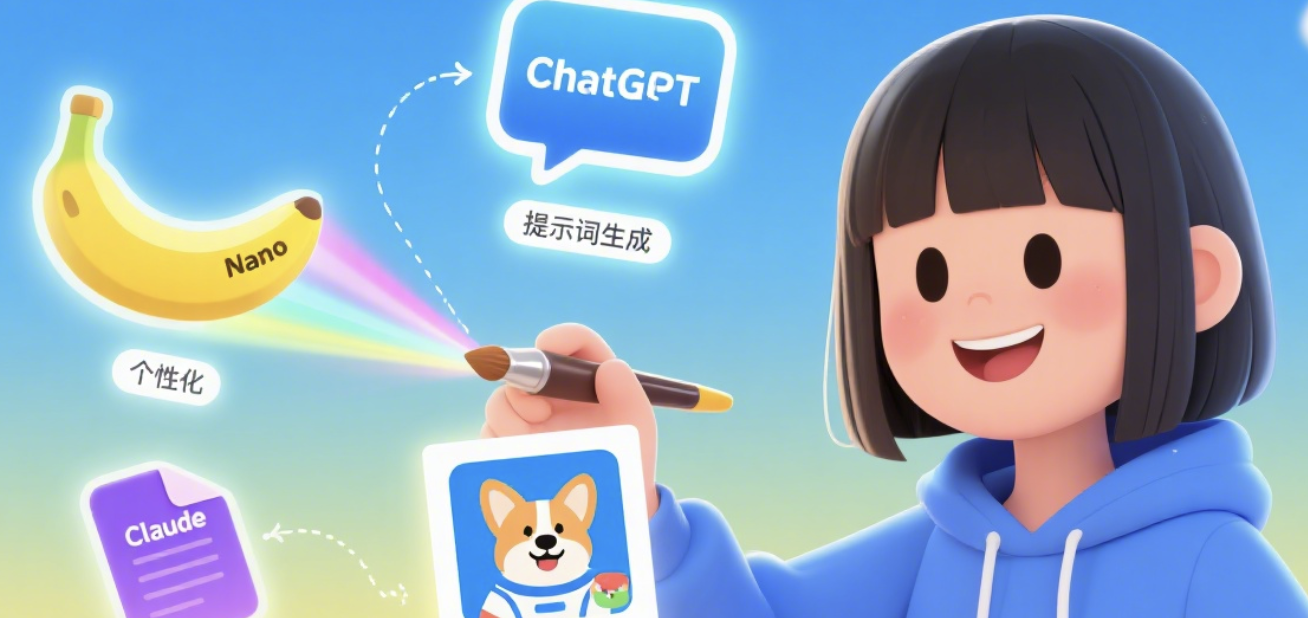
Brief description: Nano Banana uses artificial intelligence and large models as the core, focusing on character consistency, controllable editing, and text rendering. With ChatGPT, Claude, and standardized prompt engineering, AI tools can also be used to create personalized, intelligent, and automated high-quality images from scratch.
1. Understand the model first: the three major abilities determine the upper limit
1. Character consistency (AI, ChatGPT, Claude)
Keeping the character's facial features, hairstyle and color scheme unchanged in multiple rounds of editing is the prerequisite for personalization. Combine ChatGPT and Claude to generate "character cards" and "style cards" to solidify key information into prompt templates and reduce style drift.
2. Controllable editing and re-rendering (AI tools, automation)
For operations such as dressing up, adding props, changing backgrounds, etc., Nano Banana will recalculate light and shadow, occlusion and reflection, so as to obtain more realistic material details, suitable for e-commerce main images and brand KV.
3. Text rendering is consistent with graphics and text (large model, intelligent) Writing
and labeling in the picture are more stable. Through "font style + layout instructions", the model is rendered according to brand specifications, forming a reusable design language.
2. Three steps to get started: stable workflow from zero to one
1. Prepare materials and constraints (AI, ChatGPT, Claude)
Collect clear face photos, profile photos and posture references; Use ChatGPT or Claude to generate standardized "person cards, style cards, and lens cards" to clarify hair color, skin tone, clothing, light position, and scene.
2. Prompt template (machine learning and engineering)
Write the six slots of subject, material, lighting, lens, background, and text into a template, fix the unchanged fields, and only replace the theme and scene. Templates can significantly reduce token volatility and failure rates.
3. Execution and iteration (AI tools, automation)
Produce frames first, and then refine: local editing→ overall unification→ plus copywriting → export. Each step retains the version number and parameters for easy rollback and comparison.
3. "Secret List" for Personalized Images
(1) Style binding
Write tones, grain, and post-LUTs into fixed paragraphs to ensure consistency across multiple images.
(2) Lens lock
Unified focal length, camera position and scene to stabilize the proportions of the characters.
(3) Prop thesaurus
Commonly used props are whitelisted to avoid random errors.
4. Quality and cost: make the results controllable and reproducible
1. Three-index quality inspection (AI, automation)
subject restoration, material detail, layout consistency, automatic resampling below the threshold.
2. Three-piece set of cost reduction (large model, ChatGPT, Claude) caches
common templates, A/B parameter comparison, and batch parallel rendering.
3. Compliance and traceability (AI tool governance)
Portraits and trademarks need to be authorized; Retain prompts, versions, and timestamps to form a closed audit loop.
5. Advanced gameplay: from image to video and multimodality
1. Continuous short videos (AI, ChatGPT, Claude)
use the same character card and lens card as the anchor to generate 8–12 second shot segments, and finally unify the color tone.
2. Productization landing (large model, intelligence)
Encapsulate templates and review rules into mini programs or scripts to form an automated assembly line of "uploading→generation→ quality inspection→ and publishing".
Frequently Asked Questions (Q&A)
Q: How to use ChatGPT and Claude to make "character cards" and "style cards" (AI, large models)?
A: Divide age, hairstyle, skin tone, clothing, tone, grain, lens, etc. into slots, let ChatGPT or Claude generate a standard template, and then fix the fields and replace only the theme.
Q: Why do people "swap faces" after generating multiple photos (AI tools, automation)?
A: The unlocked camera position, lights, and character descriptions are incomplete. Complete the "lens card", put the facial features and hair color in the first part of the prompt to increase the weight, and use the same reference map to improve consistency.
Q: How to stably write brand copy into the screen (AI, ChatGPT, Claude)?
A: First, let ChatGPT generate alternatives and typesetting short sentences, and then render them with Nano Banana text. If it is distorted, change to the two-step "set aside the rectangular card first→ and then paste the word".
Q: How to control costs (large models, automation)?
A: Use template cache and parallel queue; Set Failed Sample Recovery + Automatic Resampling. ChatGPT and Claude are placed at both ends for instruction specifications and result review to reduce invalid generation.
Q: How to expand from images to short videos (AI tools, intelligence)?
A: Using frame fixing as the anchor, the same character card and lens card are used to output 3-5 shots in a storyboard, and then the color tone and subtitles are unified to keep the characters and materials consistent.