OpenAI for Greece Launched: ChatGPT Edu's "Reproducible" Solution on Campus
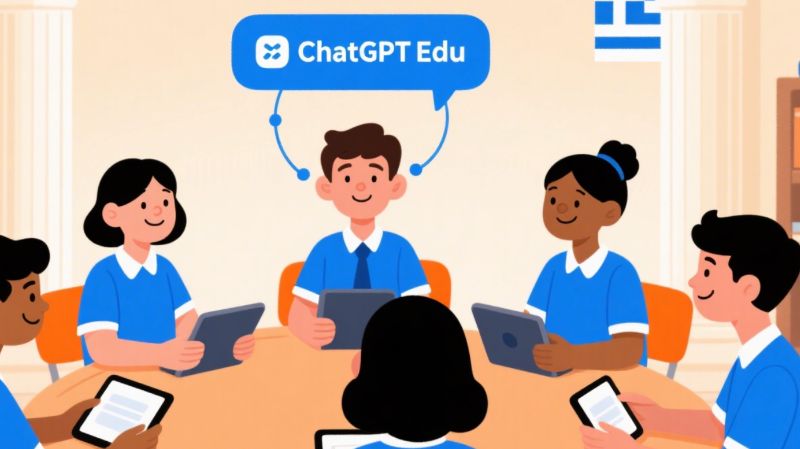
Brief description: OpenAI and the Greek government jointly launched OpenAI for Greece, introducing ChatGPT Edu into the secondary school system, focusing on teacher training, responsible use, and innovation ecology. For educational institutions and developers, this is a window period to use AI, artificial intelligence, ChatGPT, Claude, and large models to promote teaching intelligence and automation.
1. Speed reading of project key points
1. Policy and ecological collaboration (AI, ChatGPT, large model)
The plan is jointly promoted by the government and public welfare institutions, piloting ChatGPT Edu for middle school scenarios, emphasizing compliance and security control, and forming a scalable artificial intelligence application paradigm. Teachers take the lead and gradually expand the scope to create a closed loop from training to evaluation.
2. The three major starting points on the education side (AI tools, automation)
Teachers' AI literacy system, classroom responsibility use framework, teaching aids and lesson preparation efficiency improvement. Through a standardized process, ChatGPT and Claude are integrated into daily lesson plans, corrections, and classroom interactions, taking into account both effectiveness and risk control.
3. Technical key points (ChatGPT, Claude, Study mode)
provide the latest model capabilities, enterprise-level security and management backend; Combined with learning mode and templated prompts, large models can be controlled, evaluated and reviewed in real classrooms.
2. Implementation path for schools and developers
1. School pilot package (AI, ChatGPT, Claude)
(1) Roles and permissions: teachers, students, administrators are graded and log traces
(2) Lesson plans and corrections: Use ChatGPT to generate multiple versions of lesson plans Claude does fact proofreading and style unification
(3) Responsible use: establish a sensitive thesaurus, output review and case database to ensure traceability
2. Content production and teaching aid services (AI tools, RAG, large models)
(1) Course knowledge base: Structure school-based resources with RAG to improve the quality of retrieval and answers
(2) Question bank and handouts: ChatGPT Batch generation of handouts and example questions, Claude unified terminology and format
(3) Multimodal courseware: integration of images, videos and scripts, automatic generation of classroom materials
3. Developer access list (engineering and operation and maintenance)
a. Interface and model: Interface and model: Interface with ChatGPT/Claude compatible format, retain message body and streaming output
b. Evaluation and observation: Establish three indicators: prompt regression, answer consistency, and deviation rate
c. Cost and governance: quotas, caching and retry strategies are parallel to ensure the stability and controllability
3. Effect evaluation and risk governance
1. Teaching effectiveness indicators (AI, automation).
(1) The proportion of lesson preparation and correction time decreased
(2) Student participation and homework completion increased
(3) Personalized tutoring reach and satisfaction
2. Compliance and safety guardrails (large model governance)
(1) Data minimization and desensitization
(2) Tool whitelisting and overstepping interception
(3) Manual sampling and audit traces
3. Cost estimation and sustainability (ChatGPT, Claude).
a. Evaluate the budget with "number of requests × average tokens"
b. Set up a high-frequency Q&A cache and templated prompts
c. Use A/B experiments to select a more cost-effective combination of models
Frequently Asked Questions (Q&A).
Q: What is the greatest value of OpenAI for Greece to schools (AI, ChatGPT)?
A: With ChatGPT Edu as the core, we will build a framework for teacher training and responsible use, first pilot it in middle schools, and then expand the scope according to the evaluation results to promote intelligent and automated teaching.
Q: How is ChatGPT Edu different from regular ChatGPT (large model, AI tool)?
A: It provides enterprise-level security and management capabilities, which is convenient for schools to conduct hierarchical authorization, log auditing, and content review, and is more suitable for large-scale use in classroom scenarios.
Q: How can local schools quickly replicate this set of paths (ChatGPT, Claude)?
A: A three-piece set of "role grading + RAG knowledge base + templated prompts": ChatGPT generates lesson plans and question banks, Claude is responsible for fact-proofreading and style unification, and uses checklist constraints for output.
Q: How should developers participate in the ecosystem (AI, automation)?
A: Provide teaching aids, evaluation tools and observability components; It integrates with ChatGPT/Claude compatible APIs to improve buried points, quotas, and caching to form a low-cost, monitorable educational AI solution.
Q: What are the risk points of classroom implementation (large model governance)?
A: Hallucination risk, unauthorized calls and privacy leakage. Whitelist tools, output review, sensitive words and masking strategies are used to overlay multiple layers, and traceable metadata is retained.
Q: How to measure ROI (AI, ChatGPT, Claude)?
A: Based on the three core indicators of "reduction in lesson preparation and correction time", "increase in student participation" and "personalized coverage", it is quantitatively evaluated with the learning effectiveness and satisfaction survey.