Back to AI is open source
Xiaomi MiMo-V2.5 Open Source Interpretation: MIT Protocol, 1M Context, and Native Multimodal Capabilities

Xiaomi MiMo-V2.5 Open Source Interpretation: MIT Protocol, 1M Context, and Native Multimodal Capabilities

AI is open source Admin 371 views

1. Abstract

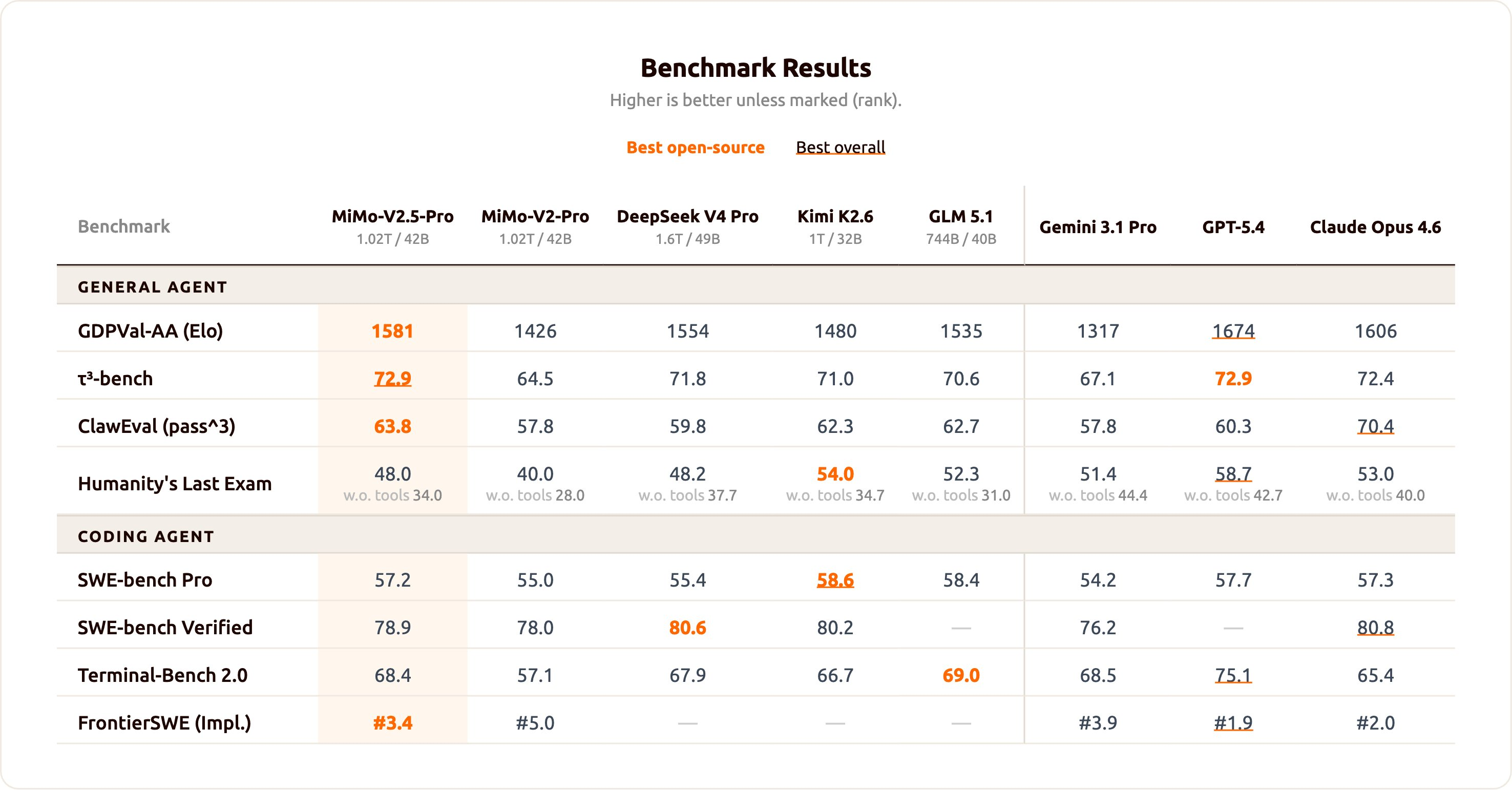
The Xiaomi MiMo-V2.5 series has been officially open source, using the MIT License, and the weights and model cards are published on Hugging Face. The series includes MiMo-V2.5 and MiMo-V2.5-Pro, both of which are aimed at 1M-token long context scenarios. MiMo-V2.5 is partial native multimodal, covering text, image, video, and audio understanding. MiMo-V2.5-Pro is aimed at complex agents, code engineering, and long-range tasks, and is officially said to have outstanding performance in open source model evaluations such as GDPVal-AA and ClawEval.

2. Core features

  1. Long context: Both master models support up to 1M-token context, which is suitable for long documents, code repositories, and multi-round tool calls.
  2. MoE architecture: MiMo-V2.5 is 310B total parameters and 15B activation parameters; Pro is 1.02T total parameters, 42B activation parameters.
  3. Multimodal capability: MiMo-V2.5 supports unified understanding of text, images, video, and audio.
  4. Agent and code: The Pro version enhances complex software engineering, tool calls, and long-distance task execution.
  5. Inference optimization: The model card mentions mixed attention and MTP design to reduce the pressure of long context KV cache and improve generation efficiency.

3. Installation

  1. Access the Hugging Face collection and select MiMo-V2.5 or MiMo-V2.5-Pro weights.
  2. Install SGLang or vLLM according to the model card, and enable recommended parameters such as trust_remote_code and FP8 quantization.
  3. Before production deployment, it is recommended to use small batches of tasks to verify the stability of memory, throughput, context length and tool call.

4. Typical use cases

  1. Code repository analysis: Understand the structure of large projects, generate patches, and perform code reviews.
  2. Agent workflow: Combine tool calls to complete multi-step retrieval, planning, execution, and summary.
  3. Multimodal Q&A: Process mixed input of images, videos, audio and text.
  4. Enterprise knowledge base: read contracts, documents, logs and technical data in a long context.
  5. Continue training: Based on the MIT protocol for industry data fine-tuning or internal capability enhancement.

5. Ecology and competing products

  1. Ecology: Officially provides Hugging Face weights, blogs, API Platform, AI Studio, and gives SGLang and vLLM deployment examples in the model card.
  2. Competing products: Compared with open source models such as DeepSeek, Kimi, Qwen, and GLM, the difference point of MiMo-V2.5 is in the 1M long context, native multimodality, and complex agent task combination. The specific effect should still be subject to the retest of business data.

6. Limitations and precautions

  1. The model scale is large, and long-context deployment requires high requirements for GPU, video memory, network, and inference frameworks.
  2. The 1M context does not mean that all long tasks can be completed stably, and still need to be blocked, retrieved, and evaluated.
  3. Multimodal understanding may be affected by input quality, language, noise, and scene.
  4. The MIT protocol is relatively loose, but data sources, compliance requirements, and third-party dependencies should still be reviewed before commercial use.

7. Project address

https://huggingface.co/collections/XiaomiMiMo/mimo-v25

8. Frequently asked questions

Q: Does the Xiaomi MiMo-V2.5 support commercial deployment?

A: The model page is marked with an MIT license, which can usually be used for commercial deployment, continued training, and fine-tuning, but enterprises still need to do their own compliance review.

Q: What is the difference between MiMo-V2.5 and MiMo-V2.5-Pro?

A: MiMo-V2.5 is more native multimodal understanding, while Pro is more complex agent, code engineering, and long-range tool calls.

Q: Is MiMo-V2.5 suitable for on-premises deployment?

A: It can be deployed, but the model volume is large, so it is recommended to refer to the SGLang or vLLM configuration in the official model card first.

Q: What tasks is the 2.5M context of the MiMo-V1 suitable for?

A: It is suitable for scenarios such as long document Q&A, large codebase analysis, long videos, or multi-round agent trajectory understanding.


Xiaomi MiMo-V2.5 Open Source Interpretation: MIT Protocol, 1M Context and Multimodal Capabilities Xiaomi MiMo-V2.5-Pro released: an open-source model for complex agent and code tasks MiMo-V2.5 Getting Started Guide: Hugging Face Weights, Deployment Methods, and Application Scenarios MiMo-V2.5 vs MiMo-V2.5-Pro: How to choose between multimodal model and agent model? Xiaomi MiMo-V2.5 technical analysis: long context, MoE architecture and MTP optimization What does MiMo-V2.5 mean for open source: commercial deployment, continued training, and fine-tuning analytics Xiaomi's open-source MiMo-V2.5:1M-token context model is worth paying attention to MiMo-V2.5-Pro In-Depth Interpretation: Complex Software Engineering and Long-Range Mission Capabilities MiMo-V2.5 Multimodal Capability Analysis: Unified understanding of text, images, video, and audio Open source large model MiMo-V2.5: Full analysis from model specifications to landing deployment Is MiMo-V2.5-Pro a good choice for code agents: capabilities, costs, and limitations? Xiaomi MiMo-V2.5 model card interpreted: parameter scale, context, and deployment recommendations MiMo-V2.5 Commercial Deployment Guide: Opportunities and Considerations under the MIT License MiMo-V2.5 Long Context Capability Analysis: What problems can 1M token solve? MiMo-V2.5-Pro vs. the open-source code model: a new choice for agent scenarios MiMo-V2.5 Native Multimodal Model Analysis: A new option for enterprise AI applications Xiaomi MiMo-V2.5 series released: Detailed differences between Pro and base models MiMo-V2.5 Deployment Practice: SGLang, vLLM, and FP8 Inference Essentials MiMo-V2.5 Open Source Authority Where to Download: Hugging Face User Guide MiMo-V2.5-Pro review interpretation: How do GDPVal-AA and ClawEval perform? What business scenarios is the Xiaomi MiMo-V2.5 open source model suitable for? MiMo-V2.5 Enterprise Implementation Analysis: Knowledge Base, Code Review, and Agent Workflow MiMo-V2.5 compared to DeepSeek, Kimi, and Qwen competitors What are the features of the MoE architecture of the Xiaomi MiMo-V2.5? MiMo-V2.5-Pro 1.02T Parametric Model Analysis: What 42B Activation Parameter Means MiMo-V2.5 310B Multimodal Model Analysis: 15B Activation Parameters and Deployment Threshold MiMo-V2.5 Long Document Q&A Application: The Value and Limitations of 1M Context MiMo-V2.5 Code Repository Analysis Capability: Is it suitable for large-scale project understanding? MiMo-V2.5-Pro Agent Capability Interpretation: Tool Call and Long-Distance Task Execution MiMo-V2.5 Open Source License Analysis: What the MIT Protocol Means for Developers MiMo-V2.5 Continuing Training Guide: What to Focus on Before Fine-Tuning Enterprises MiMo-V2.5 Multimodal Agent: From Perception Understanding to Task Execution Is MiMo-V2.5-Pro a good alternative to the closed-source model? Xiaomi MiMo-V2.5 Open Source Ecosystem: API, AI Studio and Model Weights MiMo-V2.5 Technical Science: How Mixed Attention Supports Long Contexts Interpretation of MiMo-V2.5 MTP Mechanism: Optimization of Inference Efficiency and Training Efficiency MiMo-V2.5-Pro software engineering task capability analysis MiMo-V2.5 model deployment costs: Memory, throughput, and context length considerations MiMo-V2.5 Open Source Release: How Developers Should Get Started What is the relationship between MiMo-V2.5-Pro and MiMo-V2-Flash What applications does MiMo-V2.5 audio and video understanding fit for? The application value of MiMo-V2.5 in enterprise knowledge bases MiMo-V2.5 Long Context Agent: Benefits, Risks, and Best Practices The impact of MiMo-V2.5-Pro on the code agent ecosystem after open source Detailed explanation of Xiaomi MiMo-V2.5 model parameters: how to see the total parameters and activation parameters Where is the gap between MiMo-V2.5 and the closed-source multimodal model? MiMo-V2.5 Must Read Before Actual Operation: Deployment, Evaluation, and Compliance Considerations Full analysis of the MiMo-V2.5-Pro open-source model: from specifications to applications Is MiMo-V2.5 worth paying attention to: a technical interpretation for developers Xiaomi MiMo-V2.5 Chinese interpretation: New variables for open source large models

Recommended Tools

More