1. Abstract
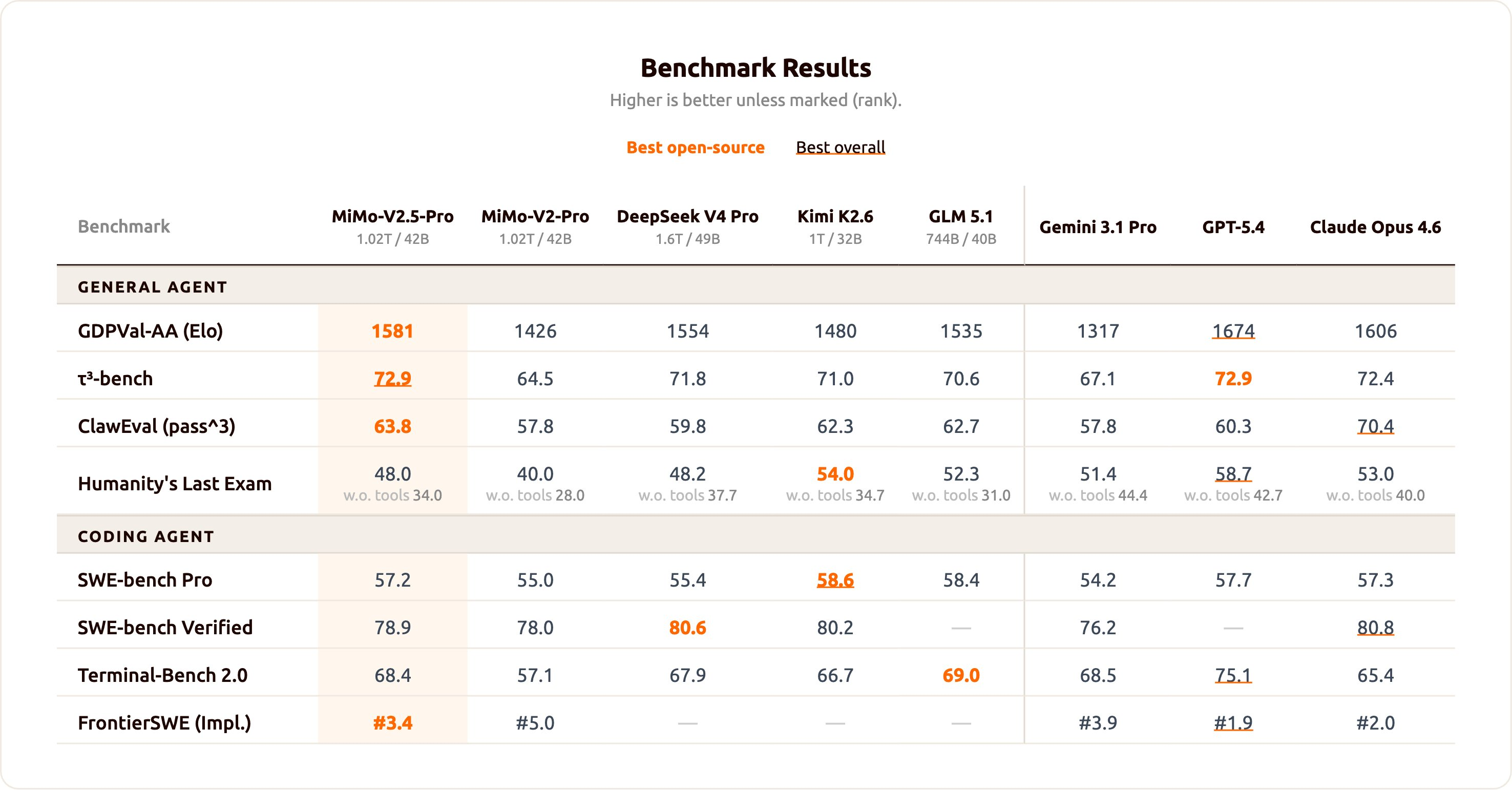
The Xiaomi MiMo-V2.5 series has been officially open source, using the MIT License, and the weights and model cards are published on Hugging Face. The series includes MiMo-V2.5 and MiMo-V2.5-Pro, both of which are aimed at 1M-token long context scenarios. MiMo-V2.5 is partial native multimodal, covering text, image, video, and audio understanding. MiMo-V2.5-Pro is aimed at complex agents, code engineering, and long-range tasks, and is officially said to have outstanding performance in open source model evaluations such as GDPVal-AA and ClawEval.
2. Core features
- Long context: Both master models support up to 1M-token context, which is suitable for long documents, code repositories, and multi-round tool calls.
- MoE architecture: MiMo-V2.5 is 310B total parameters and 15B activation parameters; Pro is 1.02T total parameters, 42B activation parameters.
- Multimodal capability: MiMo-V2.5 supports unified understanding of text, images, video, and audio.
- Agent and code: The Pro version enhances complex software engineering, tool calls, and long-distance task execution.
- Inference optimization: The model card mentions mixed attention and MTP design to reduce the pressure of long context KV cache and improve generation efficiency.
3. Installation
- Access the Hugging Face collection and select MiMo-V2.5 or MiMo-V2.5-Pro weights.
- Install SGLang or vLLM according to the model card, and enable recommended parameters such as trust_remote_code and FP8 quantization.
- Before production deployment, it is recommended to use small batches of tasks to verify the stability of memory, throughput, context length and tool call.
4. Typical use cases
- Code repository analysis: Understand the structure of large projects, generate patches, and perform code reviews.
- Agent workflow: Combine tool calls to complete multi-step retrieval, planning, execution, and summary.
- Multimodal Q&A: Process mixed input of images, videos, audio and text.
- Enterprise knowledge base: read contracts, documents, logs and technical data in a long context.
- Continue training: Based on the MIT protocol for industry data fine-tuning or internal capability enhancement.
5. Ecology and competing products
- Ecology: Officially provides Hugging Face weights, blogs, API Platform, AI Studio, and gives SGLang and vLLM deployment examples in the model card.
- Competing products: Compared with open source models such as DeepSeek, Kimi, Qwen, and GLM, the difference point of MiMo-V2.5 is in the 1M long context, native multimodality, and complex agent task combination. The specific effect should still be subject to the retest of business data.
6. Limitations and precautions
- The model scale is large, and long-context deployment requires high requirements for GPU, video memory, network, and inference frameworks.
- The 1M context does not mean that all long tasks can be completed stably, and still need to be blocked, retrieved, and evaluated.
- Multimodal understanding may be affected by input quality, language, noise, and scene.
- The MIT protocol is relatively loose, but data sources, compliance requirements, and third-party dependencies should still be reviewed before commercial use.
7. Project address
https://huggingface.co/collections/XiaomiMiMo/mimo-v25
8. Frequently asked questions
Q: Does the Xiaomi MiMo-V2.5 support commercial deployment?
A: The model page is marked with an MIT license, which can usually be used for commercial deployment, continued training, and fine-tuning, but enterprises still need to do their own compliance review.
Q: What is the difference between MiMo-V2.5 and MiMo-V2.5-Pro?
A: MiMo-V2.5 is more native multimodal understanding, while Pro is more complex agent, code engineering, and long-range tool calls.
Q: Is MiMo-V2.5 suitable for on-premises deployment?
A: It can be deployed, but the model volume is large, so it is recommended to refer to the SGLang or vLLM configuration in the official model card first.
Q: What tasks is the 2.5M context of the MiMo-V1 suitable for?
A: It is suitable for scenarios such as long document Q&A, large codebase analysis, long videos, or multi-round agent trajectory understanding.