1. Abstract
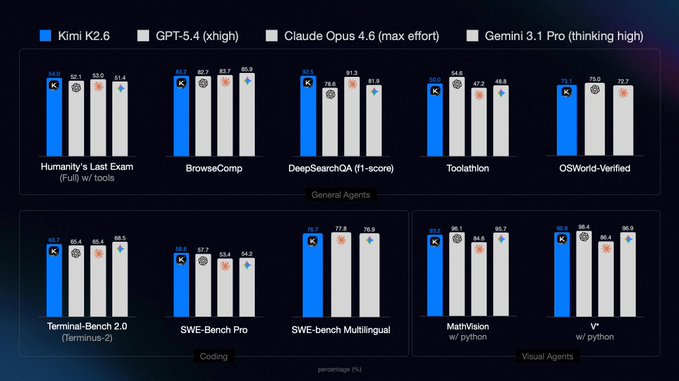
Kimi K2.6 is an open source multimodal, agile model released by Moonshot AI, focusing on "long-term coding + tool invocation + multi-agent orchestration." The official disclosed that it has reached the lead in open source on multiple public benchmarks, and emphasized that it can complete the closed loop from requirements disassembly, generation of multi-file code to operation verification in one task, facing real software engineering and automated operation and maintenance scenarios.
2. Core features
- Long-term coding and tool chain: supports 4,000+ tool calls, continuous execution for more than 12 hours, and can migrate between languages such as Rust/Go/Python and front-end, DevOps, performance optimization and other tasks.
- Motion effects and front-end generation: The construction of web pages that are biased towards "motion", such as hero video, WebGL shader, GSAP/Framer Motion, Three.js 3D, etc.
- Agent Swarm Capacity Expansion: It can parallel 300 sub-agents and run 4,000 steps in a single time, covering the project scale of "one instruction generates 100+ files".
- Active Agent: Used for 7×24-hour autonomous operation (such as OpenClaw, Hermes Agent and other ecosystems).
- Ultra-long context and tool strategy: Official documents emphasize 256K context; research blog posts disclose that greater growth and context management strategies can be adopted under specific evaluation forms.
3. Install
- Get weights: Pull the Kimi-K2.6 weights and code from Hugging Face, and choose the reasoning/deployment method according to the warehouse instructions.
- Local reasoning: Refer to the deployment guidance of the warehouse, and give priority to the mainstream reasoning engine (actual parameters need to be tuned based on memory and throughput).
- API call: Access it through the Moonshot open platform document in the "OpenAI compatible interface" mode, and turn on/off thinking and tool calling as needed.
4. Typical use cases
- Software engineering repair: Based on the issue/test failure log, automatically locate, change multiple files and run through verification.
- Front-end page construction: Generate animation pages and component library skeletons from product copywriting and reference styles.
- DevOps automation: generate scripts, CI configuration, containerization and release processes, and combine tool execution and return results to make self-correction.
- Multi-language refactoring and performance optimization: Output reproducible optimization patches after cross-language migration and hotspot analysis.
5. Ecology and competing products
- Ecology: Chat mode and Agent mode are available online;"Kimi Code" is for production-level coding workflows; APIs and documents are provided on the open platform.
- Competitors: Similar open source coding models focus more on code completion/repair, and the differences in K2.6 are more "long-term autonomy + large-scale multi-agent + front-end dynamic effect generation." The evaluation results need to be comprehensively judged based on task distribution, tool setting and replication experiments.
6. Limitations and precautions
- Long-term and multi-agent costs: Parallel agents and long contexts will significantly amplify computing power and expense pressure.
- Tool security boundary: Sandboxing, minimum permissions, audit logs and rollback schemes are required when browsing, executing and writing files.
- Evaluation portability: Publicizing benchmark results is not equal to the true benefits of your business. It is recommended to use representative warehouses and CI processes for A/B verification.
- Front-end dynamic maintainability: Automatically generated animations and shaders require manual review of performance, accessibility and cross-end compatibility.
7. Project address
https://huggingface.co/moonshotai/Kimi-K2. 6
Eight, Frequently Asked Questions
HTML_TA@_73Q: How to obtain and deploy Kimi K2.6 open source weights?
A: Get the weights and warehouse files directly from Hugging Face, and refer to the warehouse deployment guidance to select the inference engine and parameters.
Q: How to use the 256K long context of Kimi K2.6 in the API?
A: Access the corresponding model name through the Moonshot open platform document, and control the input scale according to the document context and charging rules.
Q: What tasks are "4,000+ tool calls, 12 hours of continuous execution" suitable for?
A: It is more suitable for end-to-end engineering closed loop (repair-run-self-test-iteration), but requires sandbox and permission control, otherwise the risk is higher.
Q: How does Agent Swarm of Kimi K2.6 be implemented into the team process?
A: Use a single entry prompt to drive task disassembly, and then align key nodes (requirements, changes, tests, releases) to your existing CI/CD and code review process.