1. Abstract
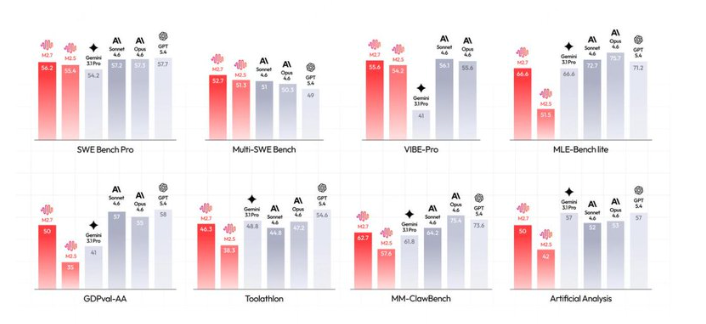
MiniMax M2.7 is an officially open-source text model of MiniMax, and currently provides model pages and access portals on Hugging Face. According to official information, it is aimed at software engineering, terminal tasks, office productivity and agent scenarios, reaching 56.22% on SWE-Pro and 57.0% on Terminal Bench 2. From the perspective of positioning, MiniMax M2.7 emphasizes complex task execution, self-evolution capabilities, and multi-tool collaboration, making it suitable for teams that focus on code, automated processes, and intelligent agent applications.
2. Core features
- Software engineering capabilities: covering tasks such as code understanding, defect troubleshooting, refactoring, debugging and complex system analysis.
- Terminal and tool calling: Emphasize task execution capabilities in the terminal environment, suitable for automation scenarios that require multi-step operations.
- Agent collaboration: Supports multi-skill combinations, complex workflows, and multi-agent collaboration, suitable for long-link task decomposition.
- Flexible deployment method: Models can be obtained through Hugging Face, or they can be accessed in combination with common inference frameworks or APIs.
- Clear model positioning: For high-complexity tasks, the focus is not only on text generation, but also on project execution and process collaboration.
3. Installation
- Visit the Hugging Face page to get the MiniMax M2.7 model weight and model card information.
- According to the official instructions, select a suitable inference framework for deployment, such as Transformers, vLLM, or other compatible solutions.
- If you need to call it online, you can access the corresponding model capabilities through the MiniMax API platform.
- Before official deployment, it is recommended to confirm the video memory, storage, network bandwidth and dependency environment to avoid large model loading failures.
4. Typical use cases
- Code development assistant: used for code completion, problem positioning, refactoring suggestions and engineering document generation.
- Terminal automation: Perform multi-step tasks in a command-line environment, such as environment configuration, log analysis, and script processing.
- Agent workflow: Combine tool calls to complete task disassembly, information retrieval, execution, and result sorting.
- Office scenarios: Support document writing, summary and refinement, structured organization and multiple rounds of Q&A.
- Complex task execution: suitable for business processes that need to understand context, invoke tools, and process multiple subtasks continuously.
5. Ecology and competing products
- In terms of ecology, MiniMax M2.7 covers both open source model acquisition and platform API access, taking into account research and trial and business integration.
- Compared with general text models, MiniMax M2.7 has more outstanding software engineering, terminal execution and agent collaboration capabilities.
- Compared with similar open source code models, its difference is that it emphasizes the completion of tasks in the real engineering process, rather than just the generation of code snippets.
- When selecting specific types, it is still necessary to comprehensively judge the context length, inference cost, deployment conditions, framework compatibility and business objectives.
6. Limitations and precautions
- Large-parameter models usually have high requirements for computing power, video memory, and deployment environment, and may not be suitable for lightweight local devices.
- The official benchmark results can be used as a reference, but the real effect still needs to be verified by specific business scenarios.
- In terminal execution, tool calling, or automated operation scenarios, permission control, logging, and manual review mechanisms should be added.
- For teams with high requirements for stability, cost, and response speed, it is recommended to do small-scale testing before entering the formal access stage.
- The open source model is suitable for privatization attempts, but in the enterprise environment, it is still necessary to pay attention to licenses, data security, and operation and maintenance costs.
7. Project address
https://huggingface.co/MiniMaxAI/MiniMax-M2.7
8. Frequently asked questions
Q: Is the MiniMax M2.7 already open sourced?
A: Yes, the MiniMax M2.7 has been officially provided on the Hugging Face page, which can be used to view model information and obtain usage portals.
Q: What are the core benefits of the MiniMax M2.7?
A: Its key advantages lie in software engineering capabilities, terminal task execution, multi-tool calls, and agent collaboration scenarios.
Q: How can I use the MiniMax M2.7?
A: You can get the model for local or server deployment through Hugging Face, or you can access it online through MiniMax API.
Q: Who is the MiniMax M2.7 suitable for?
A: It is more suitable for developers, AI Agent application teams, enterprise users who focus on automated execution capabilities, and large model scenarios that require complex task processing.
Q: Is MiniMax M2.7 suitable for direct on-premises deployment?
A: It depends on the local hardware conditions. For large-parameter models, strong GPU, storage, and engineering deployment capabilities are often required.