Qwen Code has been continuously updated from v0.14.0 to v0.14.2, pushing the AI coding assistant from "able to write code" to "manageable, orchestrated, and divided". The new version covers several core aspects of remote control, scheduled tasks, model allocation, and planned execution, with a clear goal: to allow developers to hand over more repetitive operations to AI, opening a closed loop between mobile phones, servers, and local workflows.
The remote channel begins to enter the real operation and maintenance scenario
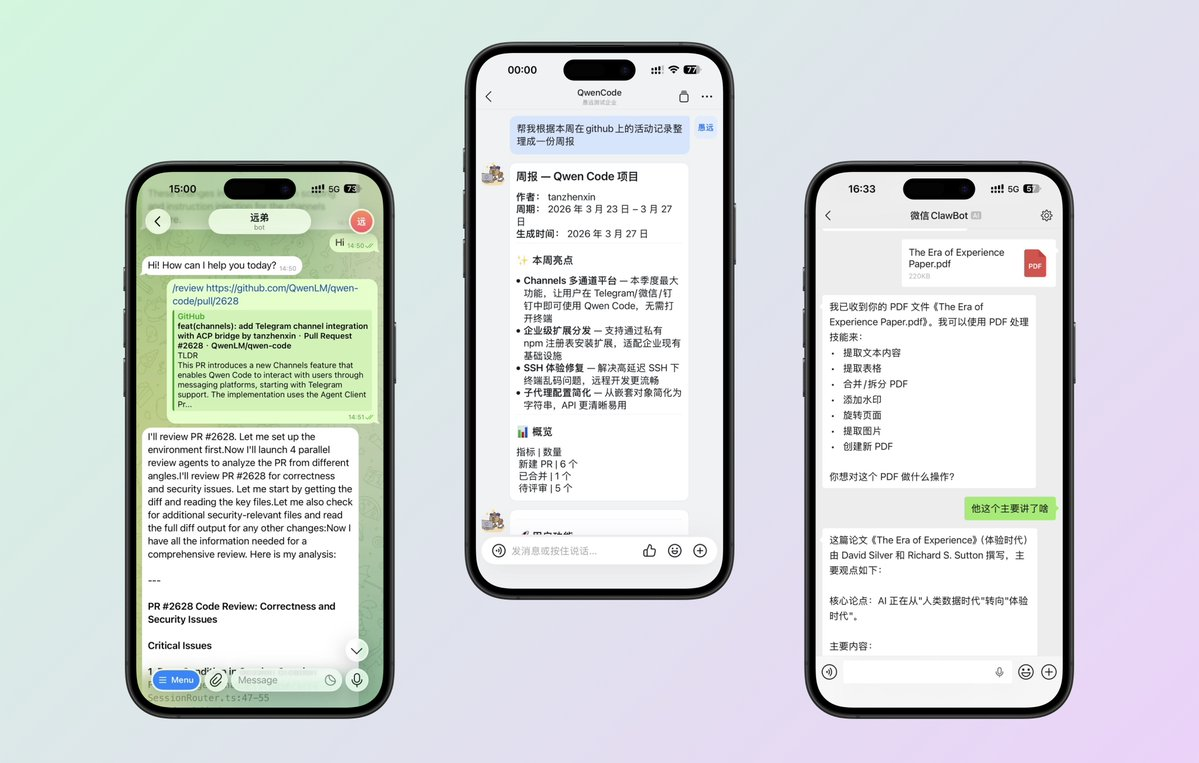
The most practical change this time is that Channels supports remote control of Qwen Code through Telegram, DingTalk, and Enterprise WeChat. Developers can send messages on their mobile phones, and the server side can perform corresponding tasks, which is suitable for handling temporary troubleshooting, log viewing, and simple deployment.
This means that AI coding tools are no longer limited to in-IDE dialogs and are starting to connect to team collaboration links. For DevOps and automated duty scenarios, AI Agents are becoming an action portal that can be invoked at any time.
Cron Jobs turns AI from a question and answer tool into a resident process
The new addition of Cron Jobs allows Qwen Code to execute tasks on a fixed cycle, such as running tests every 30 minutes, pulling builds every morning, and checking logs regularly. This type of capability may seem traditional, but the real change is that the executive agent becomes a contextually understandable model.
When AI periodically reads codebases, logs, and build results, its role shifts from a one-time assistant to a continuous process node. For teams, automated testing, build monitoring, and anomaly detection all have the opportunity to be further taken over by AI.
The model is used in layers and begins to pursue cost efficiency
v0.14.0 to v0.14.2 also introduce Sub-agent Model Selection, which can assign different models to different sub-agents: the main task uses a stronger model, and the subtasks are given to the faster model. Coupled with the 1 million token context and 1,000 free requests per day provided by Qwen3.6-Plus , it is clear that the product is enhancing the usability of complex engineering tasks.
Behind this is a reality in the AI Coding track: not all steps are worth handling with the most expensive models. Model hierarchical scheduling is becoming a standard action for AI programming products to control latency and token costs.
Plan first and then execute, and the product form is more like an engineering assistant
/plan mode allows the model to sort out the files and execute the steps first, and then wait for confirmation before starting work; Follow-up Suggestions will proactively give suggestions for the next step after the task is completed; Adaptive Output Tokens and Ctrl+O dynamically switch the output length and information density.
Together, these updates point to a trend: AI programming tools are moving from a single round of code generation to task orchestration, human-machine collaboration, and long-process experiences. Whoever can string together "plan-implement-review-continue" will be closer to the entrance of the next-generation development environment.