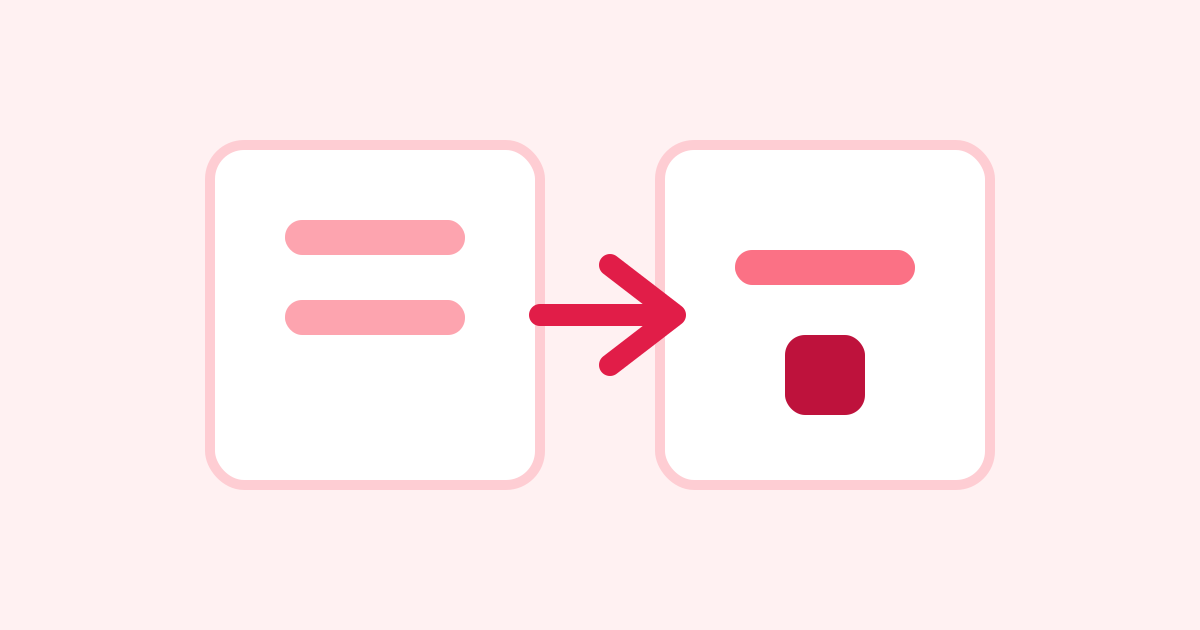
Prompt caching refers to caching the recurring prompt prefixes in the model request, and then trying to reuse the processing results directly when encountering the same or highly consistent prefixes in the future, rather than counting them from scratch every time. The reason why it has become more and more popular in the past two years is not because of the advanced name, but because more and more products have finally realized that fixed system prompts, tool definitions, long rules, and long document backgrounds are the real bulk of many AI costs and delays.
Many people confuse Prompt Caching with Context Caching, which are indeed close but not exactly the same focus. Prompt Caching emphasizes the "prompt prefix", especially in scenarios where the first half of each request is about the same and only changes in the second half. For example, customer service agents, code assistants, and enterprise knowledge assistants often have to be stuffed with fixed system rules, tool descriptions, and format constraints first, and the only real change is the user problem.
Why is it particularly suitable for multi-wheel agents? Because once an agent gets into tool calls and multi-step inference, it carries a lot of repetitive context. If you feed the model with a full list of tools, long system tips, and fixed workflow instructions every step you take, it will be slow and the bill will be ugly. The value of the caching mechanism is to dilute these recurring costs as much as possible.
But Prompt Caching is not a silver bullet that "automatically saves a lot when you turn it on". It relies heavily on prefix stability. As long as you change one or two positions of the system prompt every time, shuffle the order of examples, and let the tool definitions change back and forth, the hit rate will drop significantly. Many teams have poor caching effects, not because the model does not support it, but because the prompt project itself is written too loosely and has no reusable stable prefixes at all.
There are generally three categories of content that is really suitable for Prompt Caching. The first category is long-term unchanging system rules, such as roles, tones, boundaries, and security constraints. The second category is highly multiplexed block descriptions, such as knowledge base index descriptions, format schemas, and tool lists. The third category is templated tasks that are recurring across sessions. On the contrary, those user-personalized fields, real-time data, and search results that change every time are not suitable for the cache space in front.
It also has a misunderstood point: caching saves preprocessing and prefix computational costs, which does not mean that the results will be exactly the same, nor does it mean that the model "remembers all the history". The quality of the answer still depends on subsequent inputs, sampling parameters, tool returns, and whether the context is correct. Caching solves repetitive labor, not reasoning correctness.
So now you see API documentation like OpenAI and Anthropic starting to emphasize prompt caching, essentially telling developers one thing: prompts are no longer one-time text, but optimizeable system assets. Whoever can stabilize the static part, move the dynamic part back, and improve the hit rate will be more likely to run long prompts and agent scenes faster and more economically.