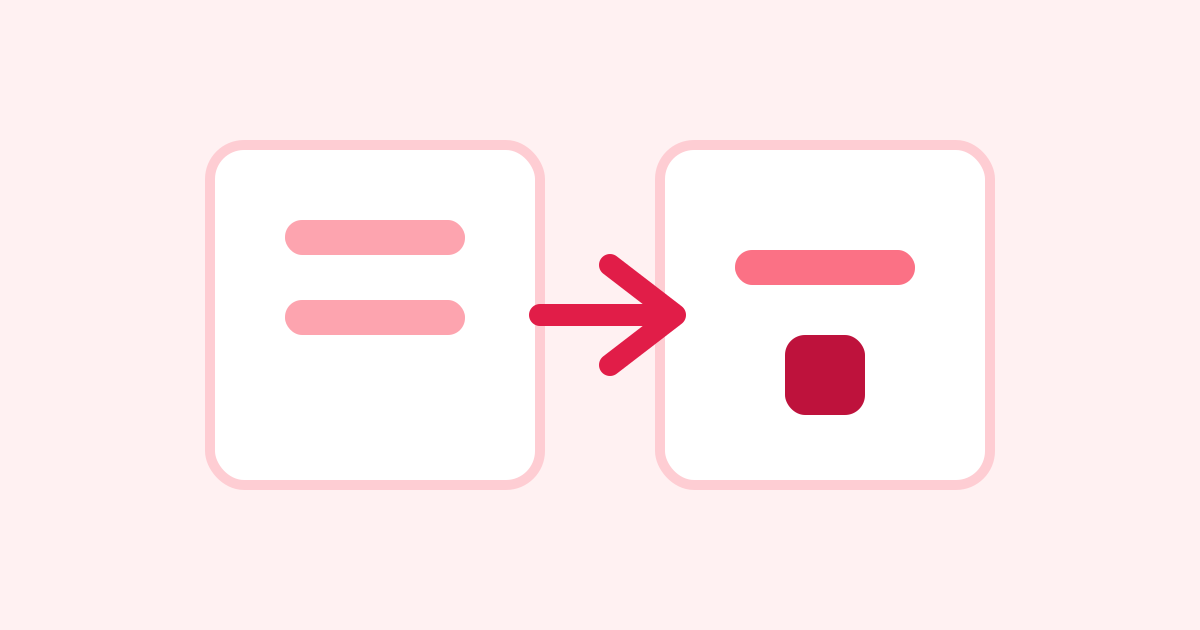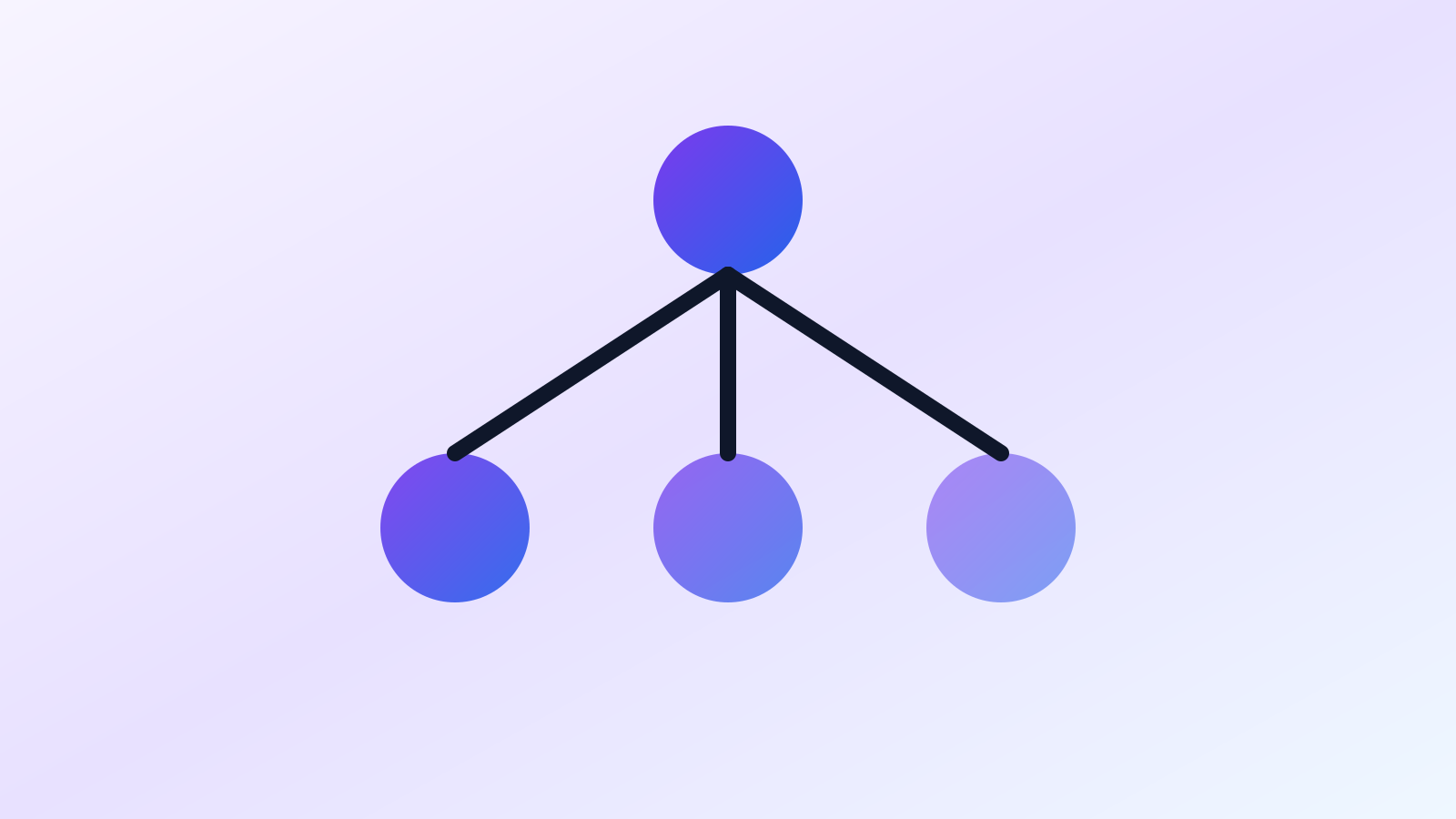
Mixture of Experts (MoE) is a model architecture that "doesn't put the whole model together every time". Its most important feature is that some layers of the model are divided into multiple expert modules, and then a router determines which experts the current token should take. In this way, the total parameters of the model can be made very large, but the parameters that actually participate in the calculation at one time are not so large, so you will see many popular models with dozens or hundreds of B parameters written on them, but the actual activation parameters are much smaller.
If you think of the ordinary dense model as a company that has every all-staff meeting, the MoE is more like "first see which department the problem belongs to, and then call relevant experts into the meeting room". Not all experts handle every input. For the model, this means that capacity can expand, but the computation of a single inference does not necessarily spike linearly.
This is also the fundamental reason why MoE has been hot for the past two years. Everyone wants to make the model bigger, increase the knowledge capacity and task limit, but also don't want the inference cost to get out of control. The MoE provides an intermediate route: the parameter scale is increased, and the activation calculation is as close as possible. The reason why models like Mixtral can drive MoE discussions is because it allows more people to see that "total parameters" and "active parameters" are not the same thing.
However, MoE does not mean giving performance in vain. Its key difficulty lies in the routing. The router needs to decide which expert to find for each token, not only to allow the experts to form their own expertise, but also to prevent a situation where a few experts are full every day and other experts are idle. To avoid this imbalance, load balancing is often added during training. The real difficulty of many MoE models is not in the concept, but in the training stability and engineering efficiency.
Another point that MoE is easily misunderstood is that it mainly saves "calculation per activation", not the difficulty of deployment. With more experts, memory occupancy, distributed communication, and inference scheduling will become more complex. Especially in a multi-card environment, how experts cut, synchronize, and reduce communication overhead often determine whether MoE improves efficiency or adds congestion.
So when you see a model that says it's an MoE, don't just stare at the parameter numbers. Three things are more worth asking: each token activates several experts; whether training and reasoning are stable; Does the team have the corresponding infrastructure to run? Without these conditions, the MoE's accounts may not be counted.
MoE is also not suitable for being deified. It is not a one-way replacement that is "more advanced than a transformer", but a scaling strategy in the Transformer system. Many models use MoE in some layers, and the rest are still conventional structures. In other words, it is more like an engineering answer to solve the scalability and cost contradiction in the era of large models.
The reason why MoE is still a hot word today is not only because there are many papers, but also because everyone has finally begun to seriously calculate inference costs and deployment benefits. As the model gets bigger and the computing power becomes more and more expensive, "which parameters really participate in this calculation" itself becomes the most realistic problem.