If you just want to make a lightweight local knowledge base chat tool, RAGFlow isn't necessarily the most hassle-free option; But if your focus is on complex document parsing, enterprise-grade knowledge bases, and scalable RAG workflows, then it's really one of the open source projects worth taking a serious look at right now. RAGFlow officially positions itself as an open-source RAG engine in the README, not only for retrieval enhancements, but also for agent capabilities and a more complete context layer, so it is more like a "knowledge system base" rather than a simple Q&A shell.
Why is it repeatedly mentioned by many teams?
The core reason is not that "it can also chat", but that it is significantly more involved in document processing. The official documentation and README all put deep document understanding, template-based chunking, and agent templates at the forefront. In other words, it's not about making the interface look good, but about making complex PDFs, forms, scans, structured and unstructured data more usable. This will be critical for scenarios such as enterprise knowledge bases, research reports, contract documents, and internal SOPs.
Why it's more suitable for teams, not necessarily for all individual users
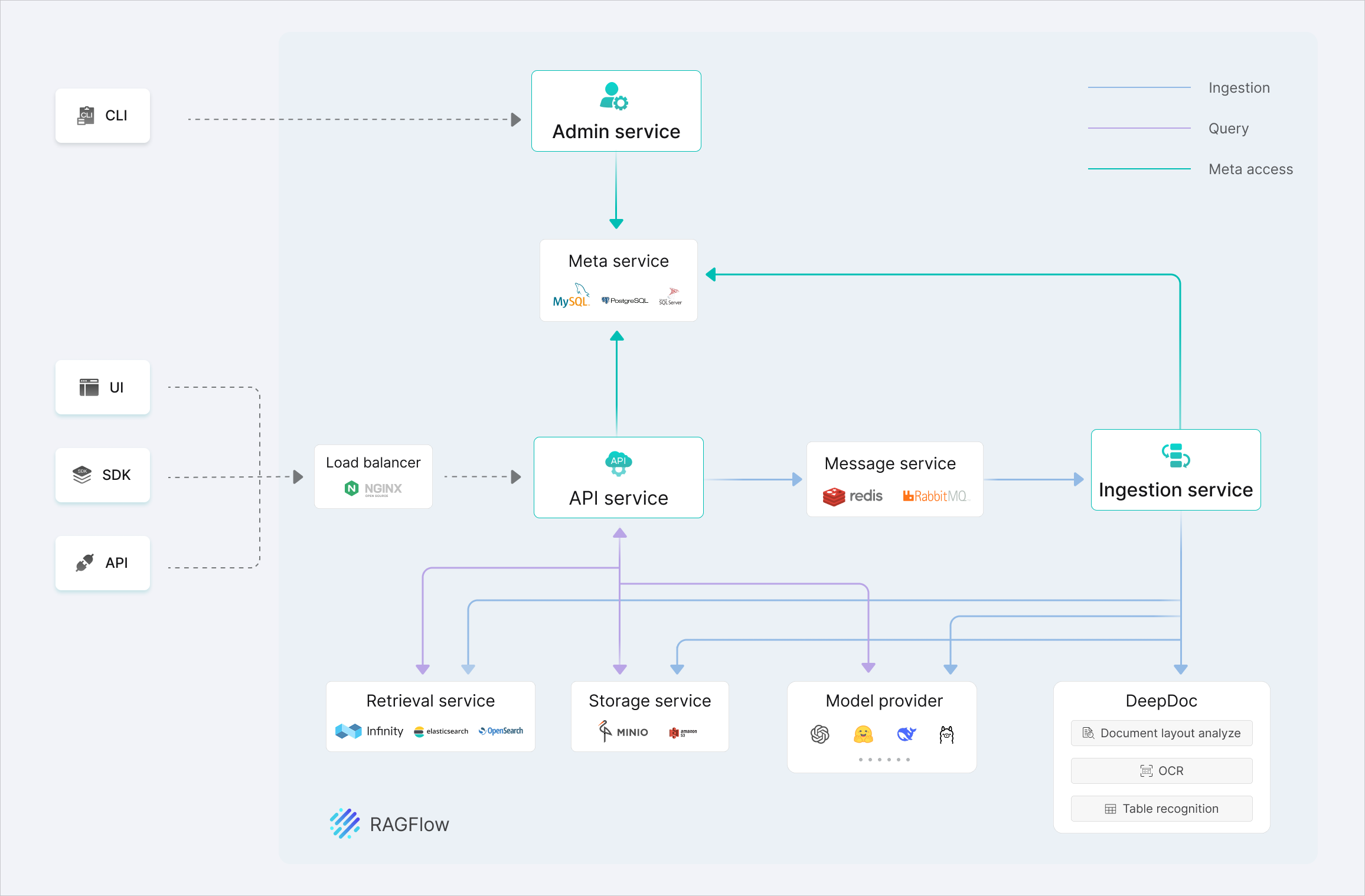
RAGFlow is worth deploying, but it's not light. Although the official fast start route supports Docker, the default dependencies are not few, and the README directly lists backend services such as MinIO, Elasticsearch, Redis, and MySQL. In other words, it is more suitable for teams that "I'm serious about building a long-term system" rather than lightweight users who "try it tonight". If you just want to throw a few PDFs in and try Q&A, many lighter options will save you time.
A more accurate way to judge
- If you value complex document understanding, enterprise data governance, and subsequent workflow expansion, RAGFlow is worth it.
- If you care more about one-click running, personal use, and less dependence, then it may be more important.
- If you need an open source license with clearer boundaries for commercial use, its Apache 2.0 will also be more friendly than many projects where the source code is visible but restrictive.
Official open source address
- GitHub:https://github.com/infiniflow/ragflow
- Official site: https://ragflow.io/
- Official documentation: https://ragflow.io/docs/dev/
So if you ask what team RAGFlow is suitable for, the most direct answer is: it is more suitable for teams that really want to make knowledge base, retrieval, document parsing, and subsequent agent workflows into a long-term system; If you just want a lightweight local Q&A tool, it may be heavier than you need.