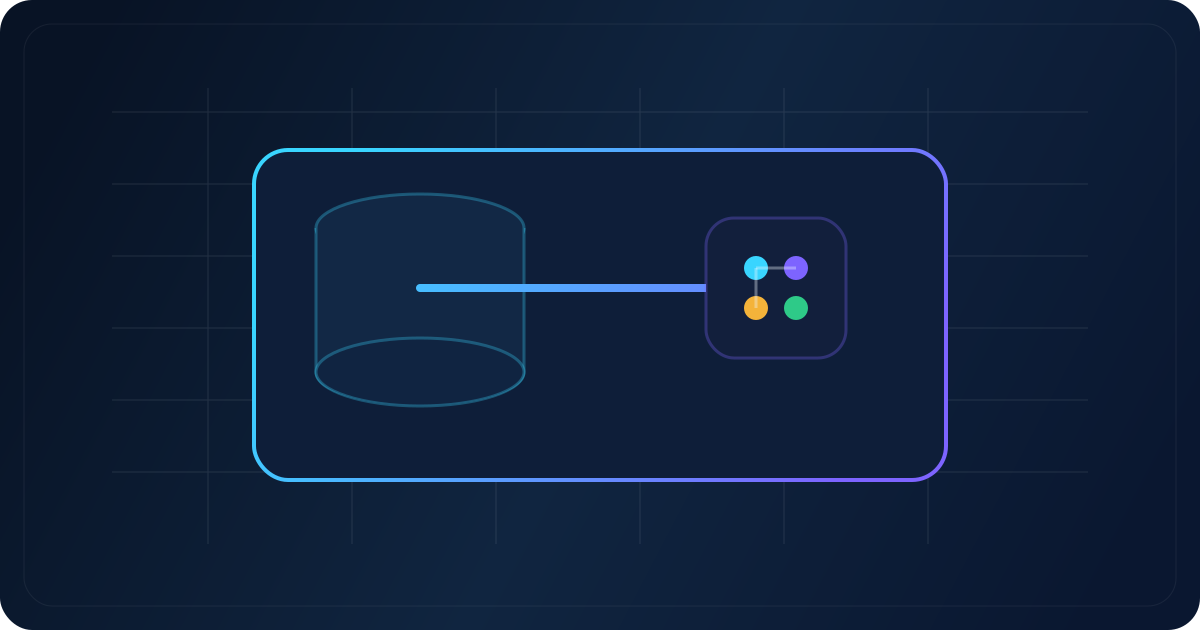
Vector databases have become almost a high-frequency word in RAG solutions, and many people think it's a heavy infrastructure. In fact, from a functional point of view, it is not mysterious. The core function of vector databases is to store vector representations of text, images, or other content, and to support efficient similarity retrieval. It is precisely because it is good at "finding the most similar content" that it always appears with RAG.
If you are doing a general keyword search, a traditional database is sufficient; But once the system understands the problem of "similar meanings but different words", simple string matching is not enough. The purpose of vector databases is to allow the system to quickly find the most semantically relevant paragraphs from a large amount of content, rather than just searching for the same words.
The biggest difference between it and ordinary databases
ordinary databases are better at precise conditional querying, such as filtering by time, number, and status; Vector databases are better at similarity searches, such as "finding the content that is closest to the meaning of this passage". The two are not substitutions, but different problems they solve.
Why RAG needs it so often
RAG typically recalls relevant snippets from the knowledge base before generating answers. The most important thing here is not "whether the information can be stored", but "whether the relevant information can be accurately identified". Vector databases with embedding can put user questions and document fragments in the same semantic space and find the closest result, which is the foundation of many RAG systems.
Is it necessary to upload a vector database to RAG?
- Not necessarily, the amount of data is very small, and a simple solution can run first.
- However, as more information becomes more and more demanding, vector databases usually become more necessary.
- Its value is not in "sounding advanced", but in "whether the retrieval is accurate and fast enough".
So, a vector database isn't all about RAG, but it's often a key part of RAG's instability. As long as your system needs to do semantic-level search, it will most likely be included in the candidate scheme.