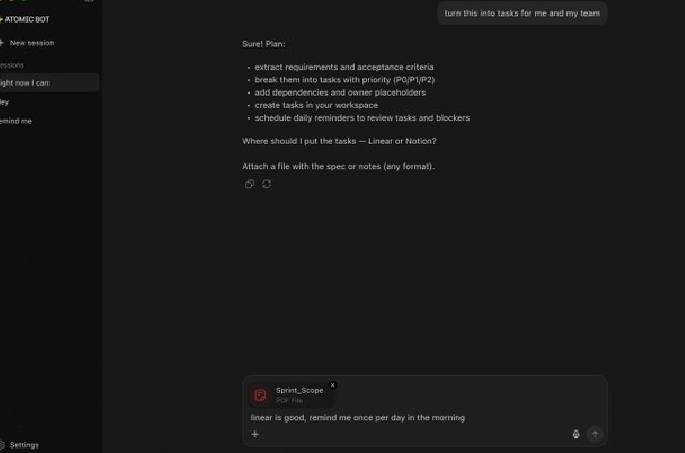
After the recent update of Atomic Bot, it is now easier for users to run OpenClaw locally. The core change is straightforward: support the use of API keys or tokens to configure the assistant. After selecting the local model, the entire local AI assistant can only run on personal hardware, and no longer use the cloud as the default link. This makes OpenClaw from a "developer project" more like a personal AI product that can be dropped to the desktop.
OpenClaw localization threshold is falling
In the past, when talking about local AI, many people's first reaction was command-line, dependent installation and model configuration. Atomic Bot takes this layer of complexity down, not focusing on the new model, but on making agent-based products like OpenClaw a desktop software experience.
The key signal of this update is that users can directly select the local model and use their own API key or token to take over the configuration process. For people who value privacy and control, this makes more practical sense than "supporting local deployment."
Local AI assistants began to move from chatting to execution
What is really valuable is not to stuff the model into the computer, but to let the personal AI assistant run on your device for a long time. The imagination of products like OpenClaw is to combine chat, automation and local execution capabilities rather than just making an offline dialog box.
Atomic Bot chose to simplify OpenClaw's local running path, indicating that the local AI market is moving from geek tools to a wider range of users. Whoever makes installation, key management and model switching smooth first will be more likely to receive the next wave of desktop AI assistant dividends.
macOS and Windows mean a larger user base
This is a critical step. As long as we cross system support, OpenClaw has the opportunity to move from a niche self-managed circle to a wider range of personal office and development scenarios.
For the AI industry, such updates are also reminding the market: the cloud model is still the mainstream, but the combination of "local model + desktop agent + own key" is forming another product route. It sells not stronger parameters, but lower risk of leakage and higher autonomy.
Local AI is no longer just a performance discussion, but has begun to become a battle for product form. If tools such as Atomic Bot continue to lower the threshold for OpenClaw, personal AI assistants are likely to scale out in privatization scenarios first.