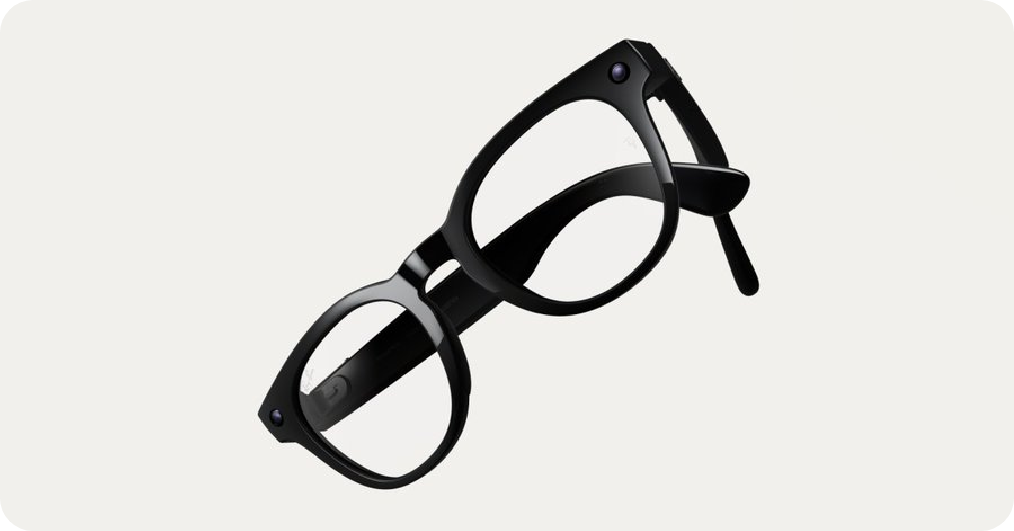
Meta is pushing AI glasses from "early adopter equipment" to "daily vision tools." The newly released two new products, Ray-Ban Meta Blayzer Optics and Scriber Optics, put prescription adaptation into the product center for the first time, while continuing to superimpose Meta AI's voice, messaging and navigation capabilities. For AI hardware tracks, this is not a simple shell change, but a competition for higher-frequency wearing periods and a more stable user entrance.
Prescription lenses have become the new threshold for AI glasses
In the past two years, the biggest difficulty for AI glasses has not been whether they can take photos. Listening to music or connecting to an assistant is whether you can enter a truly all-weather use scenario. The answer given by Meta this time is very direct: first solve myopia, farsightedness and the comfort of wearing it all day, and then talk about the penetration of AI functions. Blayzer Optics and Scriber Optics are both new models designed around prescription needs, supporting prescription adaptations that are close to full coverage, and also add adjustable temples, replaceable nose pads and structural designs that are more suitable for long-term wear.
From the perspective of price and channels, Meta is also promoting this type of products into the regular glasses market. The two new products have been pre-sold in the United States, starting at US$499. They will enter optical retail channels in the United States and some international markets on April 14. This action is critical because once AI glasses enter the optometry, optometry and store retail systems, the competitive logic is no longer just consumer electronics, but gradually approaches the daily glasses market.
Meta AI is stuffed into higher-frequency scenes
Neural Handwriting is worth taking a look. It allows users to reply to messages by writing with their fingers on any surface and will also support iMessage. Coupled with in-lens display, voice assistant and camera, this means that Meta is trying to incorporate input methods into the glasses system. AI glasses used to be more like an output device, but now they are beginning to fill in the input link and move closer to a more complete portable computing terminal.
AI glasses begin to compete for daily entrance
This release also brings a new Ray-Ban Meta and Oakley Meta color matching and lens combination, but what really deserves attention is not the color, but the product strategy has changed. In 2025, Meta will still emphasize batteries, video capture and real-time translation; by 2026, the product narrative has been cut to "prescription adaptation + life scene AI." This shows that Meta judges that the winner or winner in the next stage of AI glasses is not to add more hardware parameters, but who can first occupy the habit of wearing them all day long.
This is a more realistic route for the entire AI hardware industry. The head display is too heavy, the brooch and pendant feel too weak, and the mobile phone is not specifically designed for continuous sensing and hands-free operation. Glasses are naturally suitable for voice assistants, navigation, reminders, message processing and lightweight visual understanding. If prescription fit, battery life and wearing comfort are gradually replenished, AI glasses will not just be "what can be done", but "can they be worn all the time?"
Meta's release did not throw out exaggerated new concepts, but it did a more important thing: make AI glasses closer to ordinary glasses and farther away from showdown hardware. Whether this product line can come out next depends not only on model capabilities, but also on whether it can truly enter the infrastructure of opticians, retail and daily life.