The core of this ChatGPT file library update is not simply to add a file storage portal, but to truly connect AI file management, AI knowledge reuse, and AI office collaboration. The content uploaded or created by users such as PDFs, tables, and images has begun to change from one-time conversation materials to sustainably invocated AI knowledge assets, which are crucial for content creation, data collation, research analysis, and team work.
- Why the ChatGPT file library is worth paying attention to
- AI file management has changed from "temporary upload" to "long-term precipitation"
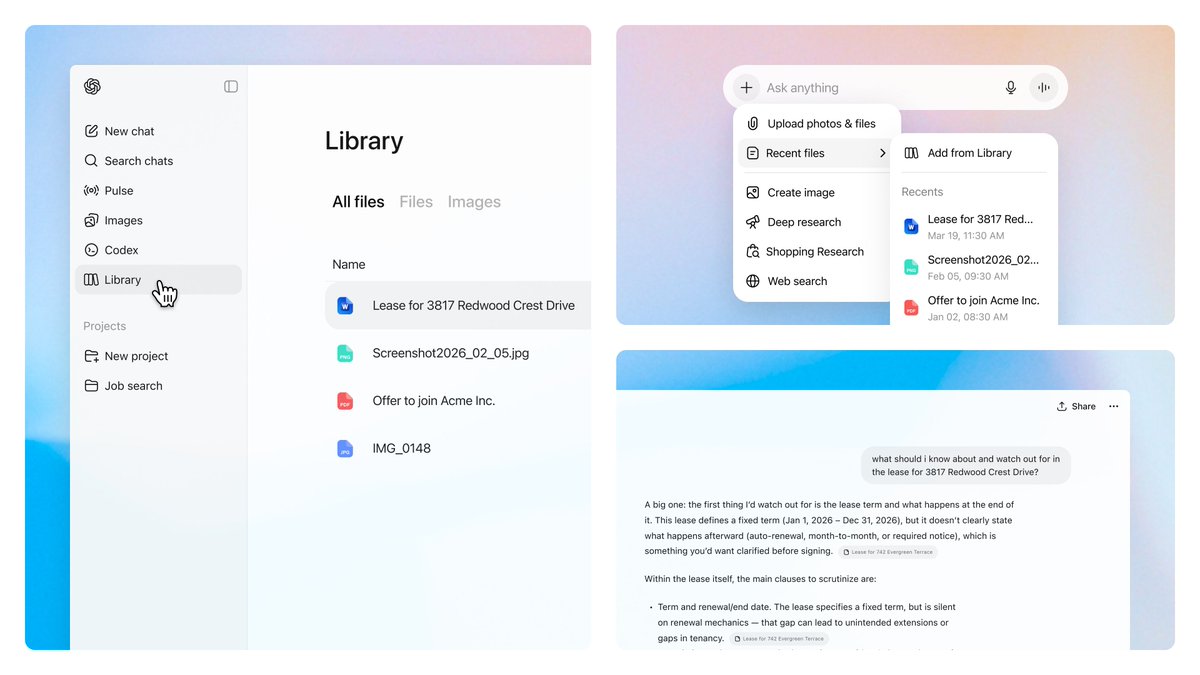
The biggest change in the ChatGPT file library is the unified precipitation of documents that were scattered in different conversations in the past. In the past, users uploaded a document and often only played a role in the chat. Now the file will enter the Library, and you can continue to call, ask questions, and continue to process it in the future. For those who use AI frequently, this means that the efficiency of AI file management has been significantly improved.
- The ability of AI knowledge reuse begins to become stronger
AI knowledge reuse has always been the most valued ability for many users. Now you can not only quickly reference recent files in chat, but also directly ask ChatGPT to review the content of your previously uploaded documents. AI is no longer just about "looking at a document once" but is closer to "continuously working around the document", which brings the value of AI assistants closer to the personal knowledge base.
- AI office flow begins to form a closed loop
From uploading files, asking questions, generating content, to subsequently reusing materials, this update makes the AI office flow more complete. In particular, people who make reports, write plans, organize contracts, and analyze industry data will clearly feel that ChatGPT is not just a chat tool, but an upgrade to an AI workbench.
- What specific problems does this ChatGPT file library update solve?
- The recent file entry is faster, reducing repeated uploads
The most annoying thing about AI file management is that the same information is repeatedly found and transmitted. Recent files now allow users to recall recently used files faster in conversations, reducing repetitive operations. This step is practical for people who often deal with weekly reports, meeting minutes, product plans.
- Library makes document retrieval clearer
In the past, many users were worried that the information uploaded to ChatGPT would not be found in a few days. Now Library is equivalent to adding a file portal to ChatGPT. AI file management no longer relies on remembering "which conversation I passed it in at that time", but can be browsed centrally, which is more suitable for long-term use.
- AI continues to understand and generate around the file
The real value of this update is not "can be saved", but "can continue to be used". You can continue to summarize, focus, rephrase, contrast, and refine around old documents.
(1) Content creation scenarios
AI can quickly refine ideas, generate rewritten versions, and extend them into new content based on old documents.
(2) Office analysis scenarios
AI can summarize, compare, and summarize historical materials, reducing manual rummaging time.
(3) Learning and research scenarios
AI can continue to answer questions based on past uploaded papers, courseware, and notes to improve data utilization.
- Who will benefit the most and what do you think of future trends?
- Content creators will rely more on AI knowledge bases
For self-media, SEO editors, and operation personnel, the ChatGPT file library makes it easier to precipitate the material library, topic selection library, and case library. In the future, AI writing is not just temporarily generated, but continuously optimized based on historical data.
- Enterprise users will pay more attention to AI data assetization
Business users are included in the first batch, indicating that OpenAI is already strengthening the direction of AI office and team collaboration. What enterprises value most is not a single Q&A, but whether documents, processes, and experiences can be continuously reused. The more complete AI file management is, the faster AI can enter the daily workflow.
- AI product competition will shift from "answering" to "managing data"
Next, the competitive focus of AI tools will become more and more inclined towards document understanding, knowledge precipitation, cross-session reuse, and workflow collaboration. Whoever allows users to truly keep, find, access, and continue to use the data will be more likely to become a high-frequency AI entrance. The ChatGPT file library step is essentially seizing the core position of AI knowledge management.
- Frequently Asked Questions (Q&A)
Q: How does ChatGPT file library directly help AI office?
A: ChatGPT file library can reduce the action of repeatedly uploading files, and can also allow ChatGPT to continue summarizing, rewriting, and analyzing based on historical data, which is suitable for scenarios such as report collation, contract reading, and plan writing.
Q: What is the difference between AI file management and regular folder management?
A: Ordinary folder management is more about storage, while AI file management emphasizes understanding and reuse. AI tools like ChatGPT don't just save files, they can continue to answer questions around the file, refine key points, and generate new content.
Q: How can content creators use ChatGPT file library to improve AI writing efficiency?
A: Content creators can put topic selection materials, old articles, interview records, and industry reports into the ChatGPT file library, and then let AI summarize, rewrite, generate outlines, and extend opinions, so that AI writing will be more continuous and contextual.
Q: Will this ChatGPT file library update be available immediately in all regions?
A: No. Currently, Plus, Pro and Business users are opening up globally, but users in the European Economic Area, Switzerland and the United Kingdom will have to wait a little longer, which is within the scope of the upcoming launch.