1. Abstract
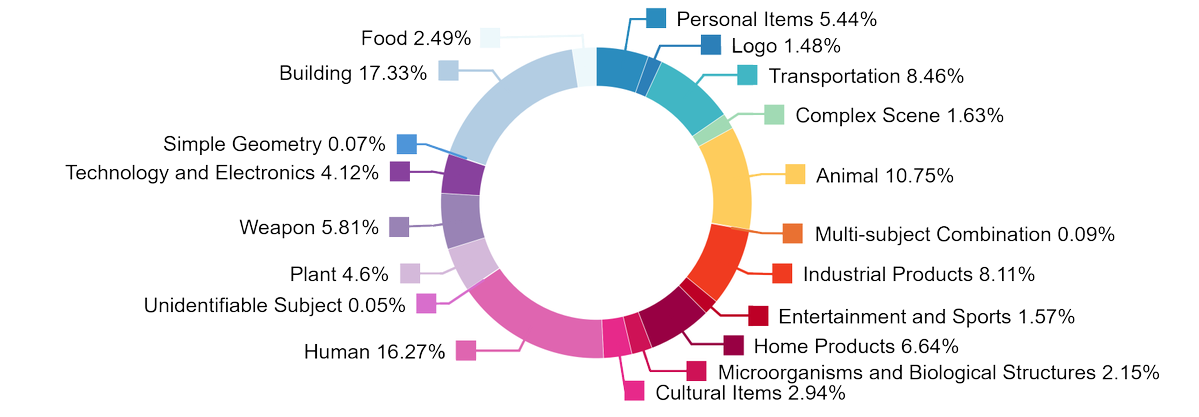
HY3D-Bench is an open-sourced unified 3D asset data ecosystem by Tencent's Hunyuan team, with the goal of alleviating the common pain points of "data scarcity, high noise, and inconsistent evaluation" in the field of 3D generation. The project publishes three types of complementary data subsets at once: Full-level (252K+ complete objects), Part-level (240K+ component-level structural decomposition), and Synthetic (125K+ AIGC synthetic long-tail categories), and provides a lightweight and reproducible baseline model, Hunyuan3D-Shape-v2-1 Small (0.8B).
2. Core features
- Training-ready quality: The mesh is cleaned, normalized, and watertight/manifold treated to reduce training noise such as non-manifold and hole-breaking.
- Unified format and metadata: Different subsets are more consistent in file organization and fields, making it easier to build data pipelines and evaluation processes.
- Full-level complete objects: including watertight meshes, multi-view renderings and sampling points, suitable for single-view to 3D, reconstruction and generation training.
- Part-level component-level decomposition: Provide component labels, component independent meshes and component assembly rendering, and support fine-grained controllable generation, structure editing and robot operation-related research.
- Synthetic long-tail completion: Covers 1,252 fine-grained subclasses, targeting category imbalance and long-tail generalization, suitable for data augmentation and zero-shot evaluation supplementation.
- Lightweight Baseline: Provides a 0.8B scale DiT shape baseline (2048/4096 tokens version) to lower the threshold for reproducibility experiments.
3. Installation
- Environment preparation: It is recommended to use Linux + Python (with PyTorch/common deep learning stacks) and reserve enough disks (Full about 11TB, Part about 5TB, Synthetic about 6.5TB).
2. Get data (recommended): After installing the Hugging Face CLI, use hf download to pull the full amount or download in subset increments.
- Baseline reproduction: Clone the repository, install dependencies according to the baselines directory description, and configure the data path to start the training/evaluation script.
4. Typical use cases
- 3D generation training set: a unified training data source for 3D generation models such as diffusion/GAN/autoregression.
- Single/multi-view to 3D: Reconstruction and evaluation with standardized rendering perspective and geometric supervision.
- Controllable editing and structural consistency: use component-level grids and labels to "generate/replace/reassemble by part".
- Robot and simulation asset library: support affordability learning, grasping planning, and interactive simulation with component decomposition.
- Long-tail and category balance: use synthetic assets to complete rare categories to improve robustness and explainability of generalization comparison experiments.
5. Ecology and competing products
- Ecology: GitHub provides data descriptions and baseline code; Hugging Face provides dataset hosting and baseline weight downloads for easy community reproducibility.
- Competing products/controls: common 3D asset libraries or large-scale 3D datasets are sufficient in scale, but there may be problems such as noise, insufficient structural granularity, and different evaluation calibers. The difference between HY3D-Bench lies in the combination of "training-ready cleaning + component-level structure + synthetic long-tail completion + reproducible lightweight baseline". The actual merits and demerits are still recommended based on your task indicators and ablation experiments.
6. Limitations and precautions
- High storage and bandwidth costs: The full data volume is large, so it is recommended to download and train in stages by subset/on-demand.
- Licensing and compliance: Data may come from multi-source processing and redistribution, so be sure to read the repository license file and the source/distribution instructions for each subset to confirm the boundaries between commercial use and redistribution.
- Scope of application of component labeling: component definition and granularity may vary with different categories, and the design indicators should be carefully designed when doing cross-class generalization or structural consistency evaluation.
- Synthetic data bias: AIGC assets may bring about style distribution shifts, and it is recommended to ablate them together with real data mixing ratios and category resampling strategies.
7. Project address
https://github.com/Tencent-Hunyuan/HY3D-Bench
8. Frequently asked questions
Q: What subsets (Full-level/Part-level/Synthetic) are included in the HY3D-Bench dataset?
A: Full-level provides 252K+ full watertight objects with rendering/sampling points; Part-level provides 240K+ part-level decomposition and assembly rendering; Synthetic offers 125K+ synthetic assets across 1,252 fine-grained subclasses.
Q: How can I download HY3D-Bench to save space?
A: Prefer to use Hugging Face's per-path include method to pull only full/**, part/**, or synthetic/**, and start with a small subset or validation set.
Q: What is the relationship between Hunyuan3D-2.1-Small / Hunyuan3D-Shape-v2-1 Small baseline?
A: The paper mentions using Hunyuan3D-2.1-Small for empirical verification; The data page also provides a lightweight shape baseline weight (0.8B) based on full-level training. It is recommended to choose the reproduction experiment settings based on the repository baselines description.
Q: Can part-level data be "generated/edited by part"?
A: It can be used as a training supervision and evaluation benchmark (part label + part mesh + assembly rendering), but the difference in part definition and category will affect the controllable effect, and it needs to be coordinated with the task design and indicators.
Q: Is the Synthetic subset suitable for direct master training sets?
A: The more common usage is to fill in the long tail and do data enhancement; If it is used as the main training set, it is recommended to pay attention to the distribution bias and mix it with the real subset for control experiments.