Back to AI is open source
Chroma 1.0 released: the world's first open-source end-to-end real-time speech-to-speech model

Chroma 1.0 released: the world's first open-source end-to-end real-time speech-to-speech model

AI is open source Admin 38 views
  1. Abstract

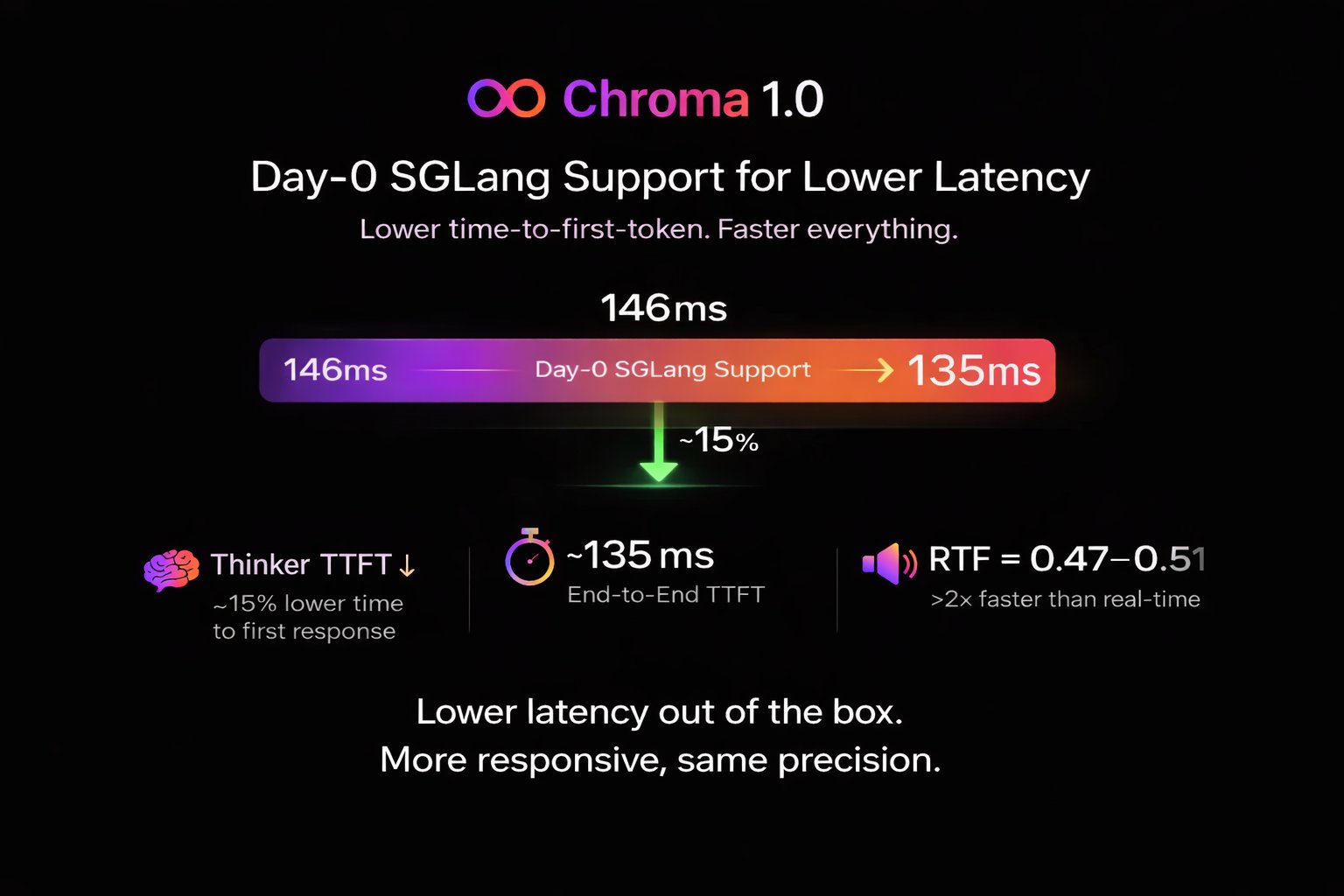
Chroma 1.0 is an end-to-end real-time speech-to-speech model trained by FlashLabs and fully open-sourced, enabling personalized voice cloning. The model eliminates the need for traditional ASR→LLM→TTS pipelines, and can complete end-to-end responses in about 150ms, positioning it as a research-grade, landable real-time dialogue solution and serving as an open-source alternative to OpenAI's Realtime model.

  1. Core features
  2. End-to-end native voice: direct voice input to voice output, reducing delay and error accumulation.
  3. Real-time performance: End-to-end TTFT < 150ms, about 135ms after SGLang is enabled.
  4. Voice cloning: Generate high-fidelity personalized voices in just a few seconds of reference audio.
  5. Evaluation indicators: SIM reached 0.817, an increase of about 10.96% from the human baseline of 0.73.
  6. Model size: about 4B parameters, striking a balance between reasoning and dialogue ability.
  7. Installation
  8. Get the inference code from GitHub and install the dependencies.
  9. Download Chroma 1.0 weights through Hugging Face.
  10. Launch the real-time inference service using the official example or SGLang configuration.
  11. Typical use cases
  12. Real-time voice assistants and conversational robots.
  13. Cross-language or cross-character voice dubbing and content generation.
  14. Low-latency voice interaction system for conferences and customer service.
  15. Speech understanding and generation experiments in research scenarios.
  16. Ecology and competing products
  17. Ecosystem: Model weights, inference code, and support for SGLang inference framework.
  18. Competing products: Compared with OpenAI Realtime, Llama series, and multimodal voice models, Chroma 1.0's advantages lie in its fully open source and end-to-end real-time capabilities; Different solutions have their own trade-offs in terms of latency, sound quality, and computing power requirements.
  19. Limitations and precautions
  20. Real-time inference has high requirements for GPU and system optimization.
  21. Voice cloning involves privacy and compliance issues and requires authorization.
  22. The evaluation indicators are based on public benchmarks, and the actual effect needs to be verified in combination with specific scenarios.
  23. Project address

https://github.com/FlashLabs-AI-Chroma

  1. Frequently asked questions

Q: Is Chroma 1.0 fully open source?

A: Yes, both the code and model weights are open source.

Q: Is it mandatory to use SGLang?

A: No, but using SGLang further reduces latency.

Q: How long is the reference audio required for voice cloning?

A: It usually takes only a few seconds to generate high-fidelity sound.
FlashLabs open-source Chroma 1.0 real-time voice conversation 150ms challenges OpenAI Realtime Chroma 1.0 end-to-end speech-to-speech open-source alternative to OpenAI Realtime FlashLabs releases Chroma 1.0 4B parameter real-time speech model to support voice cloning Chroma 1.0 eliminates the need for ASR to LLM to TTS pipeline and 150ms direct speech FlashLabs Chroma 1.0 launched an end-to-end real-time voice model, attracting attention Chroma 1.0 TTFT is less than 150ms and focuses on low-latency voice assistants Chroma 1.0 enables SGLang to reduce latency to 135ms, which has a clear advantage FlashLabs says Chroma 1.0 is ready for real-time conversations and is completely open source Chroma 1.0 enables high-fidelity voice cloning with reference audio in a few seconds Chroma 1.0 Voice Cloning and Real-Time Conversation Combine to Lead to Privacy Compliance Controversy Chroma 1.0 reviews SIM 0.817 beyond human baseline 0.73 FlashLabs used SIM 0.817 to demonstrate the improvement in Chroma 1.0 voice similarity Chroma 1.0 4B parameters are a trade-off between reasoning efficiency and dialogue ability The open-source end-to-end voice model Chroma 1.0 is benchmarked against OpenAI Realtime Whether Chroma 1.0 can be implemented in industry as a research-level solution is the focus FlashLabs open source weight and inference code Chroma 1.0 ecosystem has just been completed Chroma 1.0 supports the SGLang inference framework to further compress TTFT Chroma 1.0 real-time voice assistant use cases cover low-latency scenarios for conference agents Chroma 1.0 is used to generate cross-language dubbed content end-to-end, making it more time-saving Chroma 1.0 end-to-end voice reduces error accumulation and improves stability FlashLabs Chroma 1.0 Installation Guide GitHub Code with HuggingFace Weighting Chroma 1.0 inference requires high GPU performance as a threshold Chroma 1.0 voice cloning only takes a few seconds to sample a discussion of security risks FlashLabs says Chroma 1.0 is completely open source but requires a license for compliant use Chroma 1.0 has the advantages of multimodal voice over Llama in end-to-end real-time The difference between Chroma 1.0 and OpenAI Realtime is that open source and latency are the key Chroma 1.0 does not have to use SGLang, but it has lower latency when enabled FlashLabs reinvents real-time conversational architecture with end-to-end voice routing Chroma 1.0 integrates voice input and output to reduce system complexity Chroma 1.0 end-to-end voice model may become a new base for open source voice assistants FlashLabs Chroma 1.0 features a 150ms response that is suitable for real-time interaction Chroma 1.0 selects real-time priority in the sound quality delay hashrate triangle Chroma 1.0 has impressive evaluation indicators, but real-world scenarios still need to be verified FlashLabs emphasizes that Chroma 1.0 can be implemented as a research level to attract developers' attention The key is whether the voice interaction of Chroma 1.0 customer service conferences can be stable Chroma 1.0 voice cloning high-fidelity brings copyright and privacy disputes Chroma 1.0 open-source alternative to OpenAI Realtime to promote competition in the voice ecosystem FlashLabs Chroma 1.0 provides examples and configurations with a lower barrier to entry Chroma 1.0 end-to-end real-time voice conversation has become a new trend in open source Chroma 1.0 4B parameter scale balance performance and cost introduction The announcement of the address of the FlashLabs open source Chroma 1.0 project attracted onlookers Chroma 1.0 deploys real-time inference from GitHub to HuggingFace with one click The comparison between Chroma 1.0 and multimodal speech models depends on the latency and sound quality The Chroma 1.0 speech understanding and generation experiment provides researchers with new tools FlashLabs Chroma 1.0 claims an end-to-end response of 150ms, but requires system optimization Chroma 1.0 does not use ASR pipelines, reduces drift, and improves dialogue coherence Chroma 1.0 open-source weighted inference code makes real-time voice assistants easier to reproduce FlashLabs Chroma 1.0 voice cloning takes only a few seconds to sample, but must be licensed

Recommended Tools

More