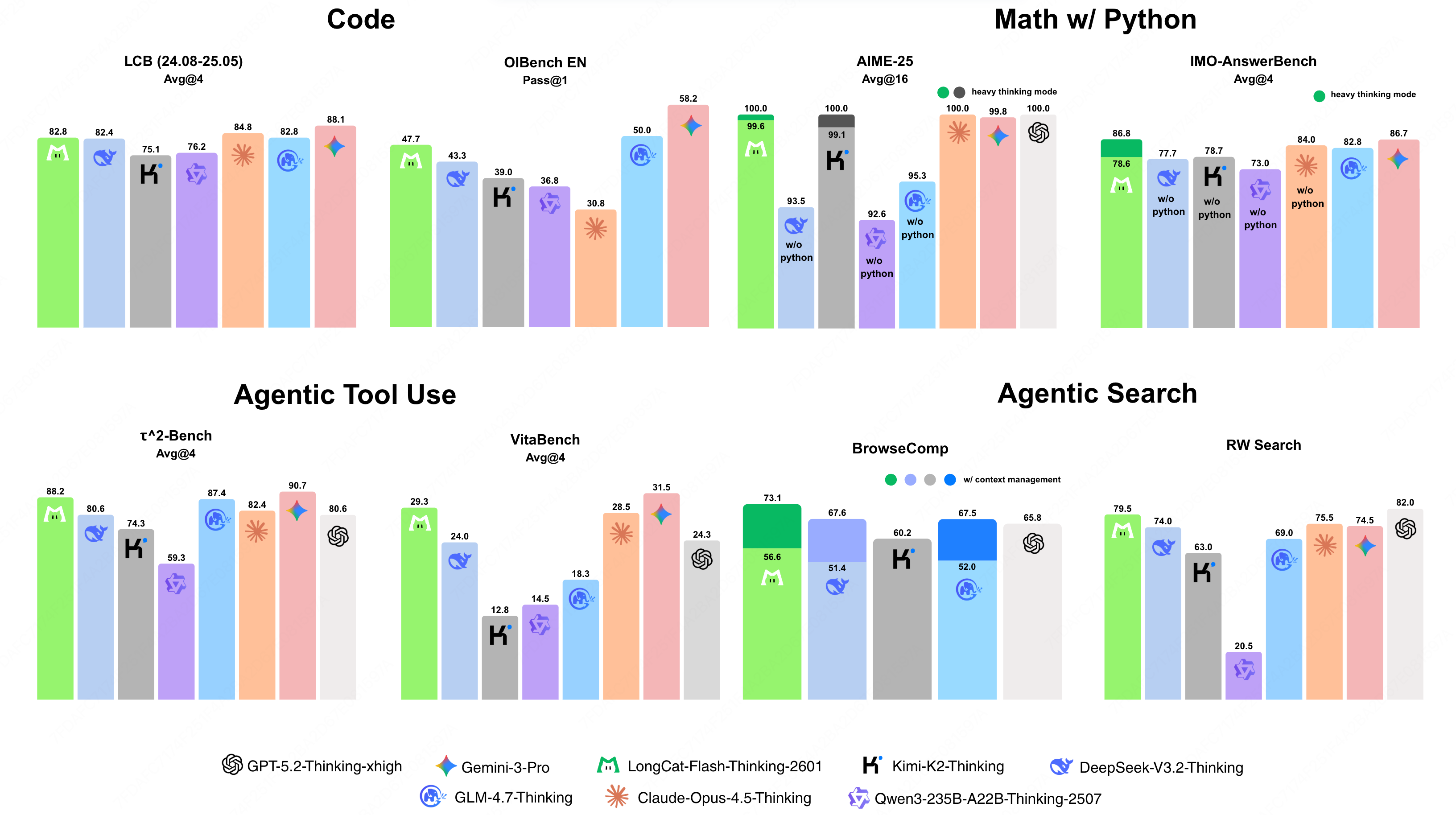
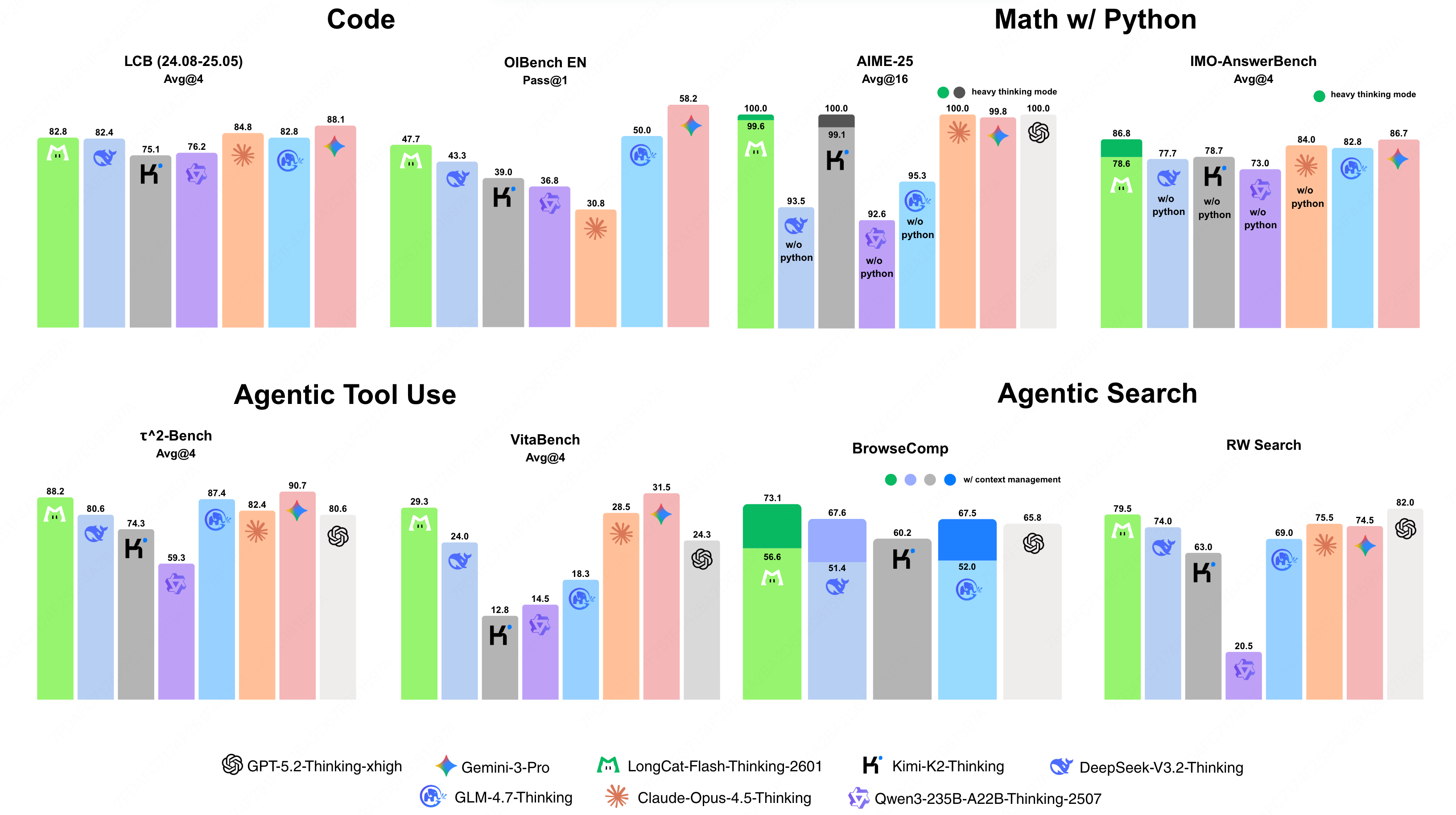
Meituan's LongCat team released and launched "LongCat-Flash-Thinking-2601", which is positioned as a version for "deep and general agent thinking", focusing on high scores in tasks such as Agentic Search, Agentic Tool Use and tool integration reasoning, and claiming to have stronger generalization capabilities in random and complex tasks. This version has provided a web trial and API access, and relevant materials are released simultaneously on Hugging Face and GitHub.
The model introduction emphasizes three routes: first, to improve agent capabilities through multi-environment expansion and multi-environment reinforcement learning (based on DORA infrastructure expansion); second, the introduction of noise analysis and course-based training to enhance robustness for "chaotic and uncertain" real scenarios; The third is to launch the "Heavy Thinking Mode", which expands the breadth of the path with parallel thinking, and then synthesizes the output of the summary model and supports the iterative reasoning loop. The team also announced that it will promote the contextual capability of about 1 million tokens through "Zigzag Attention (LoZA)", but the specific launch time and availability range still need to be further explained.
FAQs
Q: What is the LongCat-Flash-Thinking-2601?
A: It is an updated version of the LongCat-Flash-Thinking series, focusing on strengthening agent thinking, tool use, and complex task generalization.
Q: Where can I get a free trial of LongCat-Flash-Thinking-2601?
A: The official provides a web portal for conversational experience, and explains that this version also provides API access.
Q: What exactly does Heavy Thinking Mode do?
A: It explores in parallel through multiple independent reasoning tracks, and then integrates the answers by the summary model, and can be iterated in cycles to deepen the reasoning.
Q: Is the 1M-token context already open?
A: The official statement is "coming", which is related to Zigzag Attention (LoZA), and the specific landing position is still unclear.
Q: How should this model be understood as "the strongest in network security"?
A: It is more inclined to describe the understanding and localization capabilities of codebase risk points and vulnerability clues, and the actual effect still depends on the cooperation of data, testing and security processes.