Back to AI information
Google Labs updates Stitch: Gemini 3 Flash focuses on high-speed mapping and multi-solution exploration

Google Labs updates Stitch: Gemini 3 Flash focuses on high-speed mapping and multi-solution exploration

AI information Admin 75 views

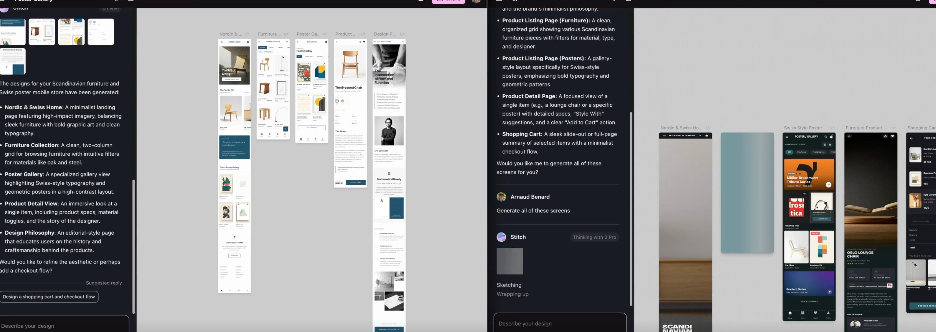
Stitch, an experimental design tool owned by Google Labs, announced the introduction of Gemini 3 Flash to its design agency capabilities, positioning it as the default choice for "rapid iteration", allowing users to generate and rewrite UI solutions with lower latency, and find the final design faster through multiple attempts, divergence and convergence. The official promotional content also reminds you that when tasks require stronger reasoning and more complex planning, you can switch to Pro mode.

In terms of usage, Flash focuses more on high-frequency generation and comparison: multiple sets of layouts, components, and style variations are produced at once, and then quickly branched and adjusted based on feedback; Pro is more suitable for scenarios that require longer link inference, such as more complex user flows, more restrictive interaction instructions, or more systematic product policy combing. Since feature and model pushes are usually launched in batches, there may be differences in availability, default models, and portal displays for different accounts and regions.

Stitch is a UI generation and front-end code assistance tool launched by Google Labs, which can generate interfaces with text or images/wireframes, and supports further iteration and prototyping capabilities. Previously, Google announced that it would bring Gemini 3 series capabilities to Stitch to improve UI generation quality, and this time it emphasized Flash as a speed-first option, aiming to shorten the design feedback loop.

FAQs

Q: What problems does Gemini 3 Flash connect to Stitch solve?

A: It focuses on "generating more scenarios faster", reducing the waiting time for each round of iterations and facilitating quick comparison and adjustment.

Q: How should I choose between Pro and Flash in Stitch?

A: It is more suitable for Flash when you need to produce multiple versions of the UI at high speed and do a lot of fine-tuning. Pro is better suited when it involves complex reasoning, long process planning, or strong constraint decisions.

Q: What does Gemini 3 Flash do in Stitch?

A: Common uses include generating multiple page layouts and style variations, revising based on feedback, optimizing copywriting and component levels, and assisting in the formation of demonstratable interface solutions.

Q: Will Stitch's model updates be seen by all users at the same time?

A: Usually pushed in batches, and there may be time differences or default items between different accounts, regions, and device entries.

Q: What are the risks associated with using Stitch to generate design and code?

A: Automatically generate details that may be missing business constraints or availability, and should be checked and manually reviewed before exporting to engineering or design systems.
Google Labs Stitch introduces Gemini 3 Flash to focus on extremely fast iterations By default, Stitch uses Gemini 3 Flash's low-latency generation UI solution Gemini 3 Flash enters Stitch design agent speed priority discussion Google Labs says Stitch uses Flash to diverge first and then converge to shorten the loop Stitch Flash mode produces multiple versions of UI comparison at once, making the design finalized faster Stitch reminds that complex reasoning should be cut to Pro mode, Flash is not a panacea Gemini 3 Flash is in charge of in-depth planning in Stitch Google Labs Stitch uses Flash to generate layout components, which are more intensive in style variations After Stitch connected to Gemini 3 Flash, multiple rounds of attempts were cheaper, but constraints were easy to leak How to choose Stitch Pro and Flash Google Labs gives speed and reasoning division of labor Gemini 3 Flash becomes Stitch's default model, and designers are worried about quality trade-offs Google Labs Stitch pushes Gemini 3 Flash to compress the design feedback cycle Stitch uses Gemini 3 Flash to rewrite UI copy and hierarchies faster Stitch uses Flash to batch branch adjustments, but complex user processes still rely on Pro The Google Labs Stitch model pushes entry in different regions in batches or is inconsistent Gemini 3 Flash login Stitch availability differences have caused users to complain Stitch generates UI and front-end code Gemini 3 Flash acceleration, but requires manual review Google Labs Stitch has made Gemini 3 Flash the default choice for rapid iteration Stitch's Flash mode reduces latency but may ignore business constraints Gemini 3 Flash allows Stitch to produce multiple sets of prototypes with one click, which is more conducive to A/B selection Google Labs Stitch emphasizes that Flash is better suited for a lot of fine-tuning and quick comparison Stitch Pro is for strong constraint interaction, and Flash is for fast production and multi-version Gemini 3 Flash improves Stitch UI generation speed, but the depth of inference is still limited Stitch introduced Gemini 3 Flash and diverged and then converged into a new workflow Google Labs Stitch uses Flash for quick exploration and Pro for system strategy sorting Stitch's Gemini 3 Flash low latency advantage doesn't sacrifice consistency Gemini 3 Flash outputs multiple schemes in Stitch to make design decisions more transparent Stitch checks the specification before exporting code, and Google Labs warns that Flash will be missing Google Labs Stitch pushes Gemini 3 Flash as a speed-first entry Stitch uses Flash to generate wireframes to the interface faster, but usability details need to be checked Gemini 3 Flash access to Stitch makes the UI revamp like chat, but the risk is the wrong constraint Stitch Pro lowers the toggle threshold and Gemini 3 Flash is responsible for fast-paced iterations Google Labs Stitch experimental tool upgrades Gemini 3 Flash to get started Stitch supports text or image generation in UIGemini 3 Flash, making trial and error more frequent Gemini 3 Flash allows Stitch to compare multiple layouts on the same screen to shorten the selection time Stitch's default model is different from regions, and the Gemini 3 Flash push rhythm is questionable Google Labs Stitch explains that Flash is suitable for rapid iteration and Pro is suitable for complex planning Stitch's Gemini 3 Flash focuses on divergent output Pro, which is responsible for convergence decisions Gemini 3 Flash is increasing production capacity at Stitch, but design system alignment is still manual Stitch uses Flash to generate component hierarchies and style variants, but the interaction logic requires Pro Google Labs Stitch brings Gemini 3 Flash to the design agent to reduce latency Stitch's Flash and Pro dual modes put the game of speed and quality on the table After Gemini 3 Flash is added to Stitch, the design feedback loop is compressed to the minute level Stitch uses Gemini 3 Flash for quick revisions, but complex constraints may be overlooked Google Labs Stitch promoted the Gemini 3 series and then emphasized the Flash speed strategy Stitch uses Gemini 3 Flash for rapid prototyping, but must be accepted before it goes live Gemini 3 Flash in Stitch has helped many attempts but may bring noise solutions Stitch emphasizes divergence and then convergence of Gemini 3 Flash as an accelerator Google Labs Stitch update entry differences Gemini 3 Flash is not visible to everyone Stitch introduced Gemini 3 Flash to make UI generation faster, but planning is still inseparable from Pro

Recommended Tools

More