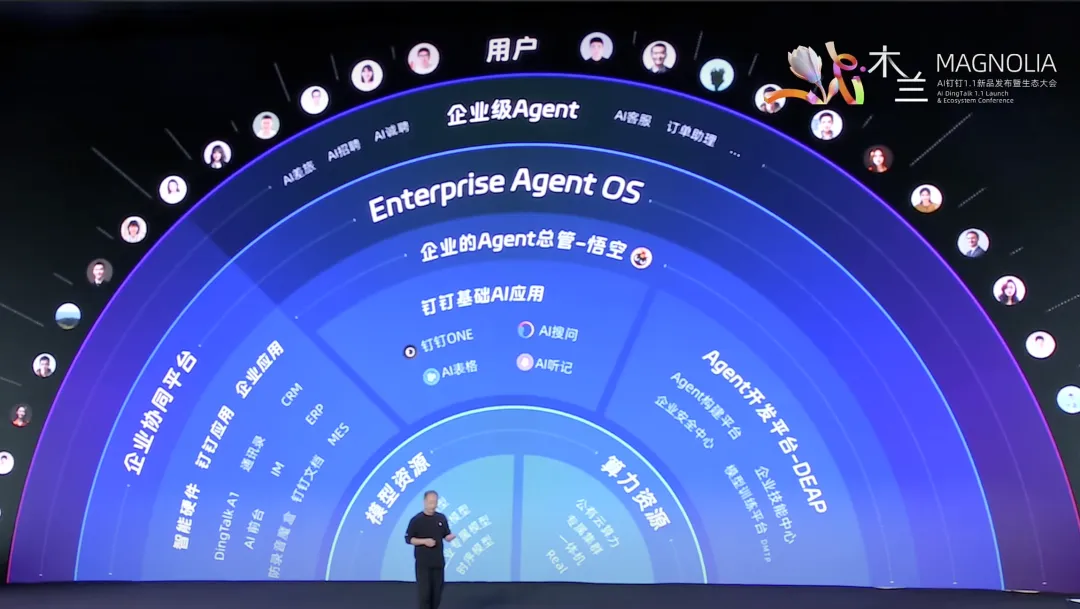
DingTalk released the AI DingTalk 1.1 version at the "AI DingTalk 1.1 New Product Release and Ecological Conference", codenamed "Mulan", and proposed the "work intelligent operating system" Agent OS for enterprise AI collaboration for the first time. The system is composed of DingTalk ONE (new interactive entrance), DingTalk Real (enterprise-level AI hardware and execution environment), AI Search and Ask (enterprise-level search Q&A entrance), general task Agent "Wukong" (task disassembly and orchestration and execution), and enterprise AI platform DEAP (enterprise self-built and governance platform), with the goal of allowing AI to move from Q&A to "takeover tasks" and operate safely in the real workflow of the enterprise.
At the hardware and execution layers, DingTalk Real is positioned as the dedicated operating environment for enterprise agents, emphasizing that it can deploy and read internal and public data on the intranet, and provide risk control mechanisms such as "emergency power unplugging". DEAP at the platform level provides enterprises with one-stop capabilities from model access and management, business data governance, skill and tool access, to agent construction and operation analysis, aiming to lower the threshold for enterprises to build and operate their own agents.
At the product and scenario level, DingTalk has centrally upgraded AI search, AI forms, AI listening notes and DingTalk A1: AI search and ask strengthens "can search, ask, and work"; AI forms have added voice filling capabilities such as "speak casually" and unstructured information can be entered into tables such as "universal stickers", and support the generation of zero-code business applications from tables, photos or hand-drawn sketches. AI listening and memorization expand cross-document Q&A, photo recognition, and multilingual translation/simultaneous interpretation; DingTalk A1 expands from a personal assistant to a recording summary, annotation, and analysis tool for team scenarios. At the same time, DingTalk released a variety of "deliverable agents", covering high-frequency businesses such as manufacturing orders/quality, corporate travel and customer service, and more subdivided delivery scenario names such as recruitment agents and AI printing appeared in on-site reports; The specific availability scope, price and delivery method of relevant functions are still subject to the official follow-up launch information.
FAQs
Q: What is the biggest change between AI DingTalk 1.1 "Mulan" and 1.0 "Fern"?
A: 1.1 emphasizes the use of Agent OS as the base to upgrade AI capabilities from a single point function to a systematic collaboration framework that can be run, scheduled, and governed.
Q: What are the key components included in Agent OS?
A: It mainly includes DingTalk ONE, DingTalk Real, AI Search, General Task Agent "Wukong" and enterprise AI platform DEAP.
Q: What are the core problems solved by DingTalk Real?
A: Focus on solving the problem of agents performing tasks and accessing data safely and credibly in the enterprise environment, and provide risk control mechanisms.
Q: What can the "universal sticker" and "AI application generation" of AI forms do?
A: You can quickly structure screenshots, photos, or copies into tables, and support generating business applications including forms, pages, and dashboards from tables, images, and sketches.
Q: Which companies are suitable for the travel, customer service, orders, quality, etc. agents mentioned at the press conference?
A: It is more suitable for enterprise scenarios with clear processes and data precipitation, which is used for itinerary planning and price comparison, dialogue precipitation and business opportunity identification, order picture conversion and scheduling, equipment forecasting and maintenance reminders, etc.