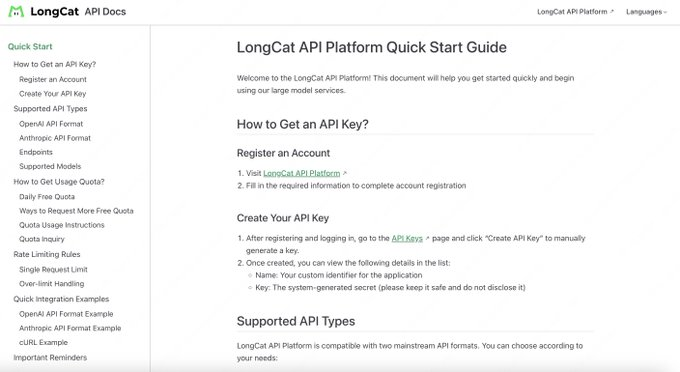
According to the LongCat API platform changelog, LongCat-Flash-Chat has been upgraded to a new version, which is a capability enhancement update, and the model name and API call method remain unchanged. This upgrade continues the positioning of "high efficiency and low latency", focusing on strengthening the performance of long contexts and developers' real tasks, and improving the stability of complex tool calls and multi-step task execution.
Key points include: Increasing the context length to 256K (double the previous 128K) for more efficient processing of large documents and long-sequence tasks; programming-related capabilities have been significantly enhanced, covering scenarios such as code generation, debugging and code interpretation; Multilingual capabilities have been strengthened, and support for 9 languages including Spanish, French, Arabic, Portuguese, Russian, Indonesian, German, Korean, and Japanese has been added or strengthened. At the same time, the platform documentation states that accounts provide a free daily quota of 500,000 tokens by default, and can apply to increase to 5 million tokens per day, and the quota is refreshed daily and does not carry over.
FAQs
Q: Does this update to LongCat-Flash-Chat change the model name or call method?
A: There is no change, the model name is consistent with the API call method, which is a capability enhancement update.
Q: What tasks is LongCat-Flash-Chat's 256K context suitable for?
A: It is suitable for long document Q&A, code repository-level analysis, multi-round alignment of long dialogues, cross-file information extraction and summary, etc.
Q: What are the main aspects of LongCat-Flash-Chat's programming ability improvement?
A: It is more inclined to developers to deliver their needs, including code generation, debugging positioning, code interpretation, and rewriting optimization.
Q: What are the daily free credit rules for LongCat API?
A: The account defaults to a free quota of 500,000 tokens per day, and supports applying to increase to 5 million tokens per day.
Q: Does the new multilingual support mean that all languages have the same effect?
A: Not necessarily, there may be differences between different languages and task types, so it is recommended to verify it in the target language and business examples.