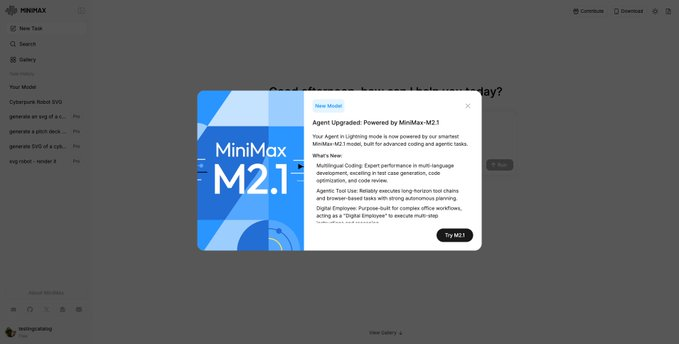
MiniMax announced that its next-generation model, MiniMax M2.1, is available on the MiniMax Agent side and is used as the default driver for "Lightning mode". According to the introduction of official and cooperation channels, M2.1 focuses on strengthening multilingual software development and more reliable task planning and execution capabilities while maintaining response speed, and can more stably complete the whole process from dismantling requirements to output deliverables for complex instructions.
At the functional level, M2.1 is emphasized in three categories: first, the improvement of multilingual programming capabilities, covering engineering links such as test case generation, code optimization and code review; second, it has a stronger ability to use agent-type tools, which can connect multi-step toolchains and handle browser-like tasks over a long period of time; The third is the positioning of "digital employees" for office processes, which is suitable for multi-step workflows across documents, forms, web pages and communication and collaboration. The actual experience may still be affected by account permissions, regional opening pace, and platform usage policies.
FAQs
Q: What scenarios is MiniMax M2.1 mainly used in MiniMax Agent?
A: It is mainly aimed at programming research and development and complex task execution, including multilingual development, browser tasks and multi-step office processes.
Q: What is the relationship between MiniMax Agent's Lightning mode and M2.1?
A: The platform page shows that Lightning mode is driven by MiniMax M2.1 as the default for faster completion of general and productivity tasks.
Q: Which programming skills are the key directions of M2.1?
A: Test case generation, code optimization, code review, and engineering rewriting and fixing across multiple languages.
Q: What exactly can the so-called "digital employees" do?
A: Decompose tasks, call tools, organize materials, and output directly usable documents or results under clear instructions, but you still need to manually review key content and permission operations.