1. Company and product positioning
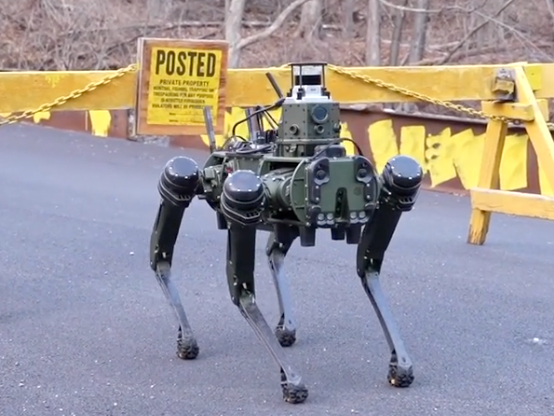
Headquartered in the United States, Ghost Robotics focuses on quadruped ground unmanned platforms, and its core product is the Vision 60 Q-UGV (Quadrupedal Unmanned Ground Vehicle). The overall positioning is a highly reliable robot that can be "on duty for a long time in complex outdoor environments", and is used for inspection and security tasks in high-risk scenarios such as national defense, public safety, and industry, energy, and construction.
2. Core parameters and hardware features of Vision 60
The Vision 60 adopts an all-electric drive quadruped structure, with a total weight of about 51kg, a load capacity of about 10kg, and a maximum speed of 2.4m/s, making it suitable for mounting a variety of sensors and communication equipment for mobile patrols.
In terms of battery life, it can walk continuously for about 3 hours at a speed of 0.9m/s and standby for more than 20 hours, making it suitable for performing automatic inspection tasks with long paths.
The whole machine is IP67 certified, with an operating temperature range of about -40°C to 55°C, and with replaceable foot pads, it supports working in rain, snow, sand, gravel and other terrains, corresponding to the engineering orientation of "all-weather + outdoor multi-terrain".
The compute platform uses NVIDIA Xavier, equipped with high-capacity SSDs and multiple high-speed interfaces, and can mount 3D lidar, low-light cameras, thermal cameras, CBRN sensors, and more, forming a highly modular payload platform.
3. Navigation control and software ecology
In terms of navigation, Vision 60 supports multi-camera, depth camera, and RTK GPS fusion positioning, which can work in both GPS-good and GPS-limited environments, and provides "Blind Mode" for gait redundancy under low-perception conditions.
The software side provides interfaces such as C/C++, ROS/ROS2, and MAVLink, as well as a simulation environment, making it easy to integrate into existing command systems or use as a scientific research platform. The Mission Control platform supports unified web-based monitoring, power and health status viewing, point-and-click task planning, and map overlay of multiple video and detection results, making it convenient to dispatch multi-locomotive fleets.
4. Typical application scenarios and selection suggestions
Vision 60 has been used in military and police patrols, airport and base perimeter security, post-disaster search and rescue, chemical and refinery hazard area inspections, bridge and construction site inspections, and other scenarios. Its advantages are: withstand harsh environments, move slowly for a long time, and continuously "see" and "listen" with a complete set of sensors, replacing manual duty in dangerous areas for a long time.
For users, it is more suitable as a "highly reliable sensing platform" rather than a robot that pursues high-load handling or complex two-handed operations. If the focus is on outdoor security, unattended inspection, and scientific research and experimentation platforms, the hardware integrity and software openness of the Vision 60 will be more attractive.
Q&A Frequently Asked Questions
Q1: What are the significant differences between the Vision 60 and the common four-legged "robot dog"?
A: It is more suitable for long-term deployment rather than campus or indoor demonstration purposes: high protection level, large temperature range, guaranteed battery life, supporting mission control platform and industrial-grade communication architecture.
Q2: What is the value of Vision 60 if you are doing a university or research institution project?
A: It provides a mature mechanical, drive, and perception chassis, allowing research teams to focus on perception algorithms, multi-robot collaboration, reinforcement learning, and task planning without having to solve reliability and weathering issues from scratch.
Q3: Is it suitable for direct use as a "handling robot"?
A: There is no problem with sensors and tools carrying less than 10kg, but they are not good at handling large materials; A more reasonable positioning is a "mobile sentinel walking around with sensors", focusing on information collection rather than logistical handling.
Q4: What is the practical significance of the newly launched manipulator arm?
A: The robotic arm allows the Vision 60 to open doors, pick up and place small items, operate simple equipment and other actions, and expand into a mobile platform with a "simple operating environment" on the basis of maintaining the original mobility, but it is still a lightweight operation capability.